



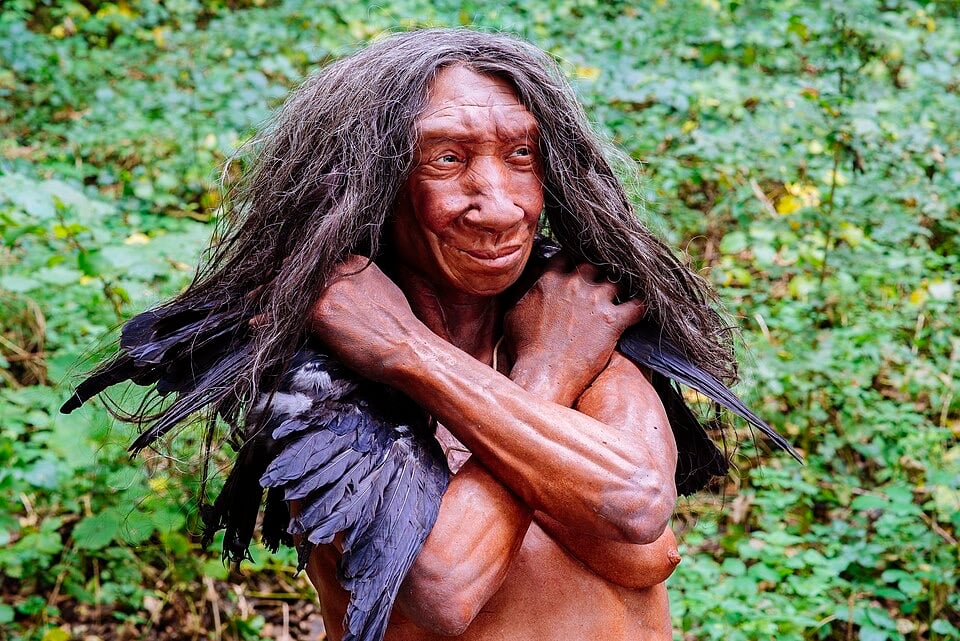
Researchers say a 75,000-year-old skeleton shows a individual who survived a smashed face, was probably looked after, and was later struck by what may have been a wooden spear.
Neanderthals were not the unintelligent cave dwellers of popular imagination, according to researchers who have studied a partial skeleton found in a cave in Iraq’s Zagros Mountains. The remains, dated to about 75,000 years ago, include a left shoulder blade, some ribs, a nearly complete right hand and seven teeth. The individual, named Shanidar A, bears evidence of a serious facial injury that was survived and a penetrating wound that may have been fatal. The findings were published on 15 October 2026 in the peer-reviewed journal Scientific Reports.
The wound in the shoulder
The shoulder blade has a hole about 1.5cm across, suggesting a deeply penetrating stab, possibly from a forceful thrust with a sharpened wooden spear. Neanderthals are known to have used such weapons. Its rounded shape is consistent with wood, as a stone or flint point would normally leave a different kind of damage. The researchers suggest it could be one of the earliest known examples of lethal interpersonal violence involving a wooden spear in the human fossil record.
Emma Pomeroy, a biological anthropologist at Cambridge University and lead author of the report, said the spear “would have gone through the skin and major muscles, especially the pectoralis, as well as the ribcage and muscles between the ribs, and the lung”. She said the location “could be like the kind of ‘heart shot’ hunters use to kill animals quickly by puncturing the heart”.
Graeme Barker, a Cambridge archaeologist who has led excavations at Shanidar Cave since 2015, said interpersonal violence, whether from the same group or rival groups, was the likeliest explanation. The researchers put Shanidar A’s age in the mid-40s but could not determine gender.
The evidence does not conclusively prove murder. The weapon was not recovered from the wound, and it cannot be shown who caused the injury or definitively separated deliberate violence from an accident. The most accurate description is possible interpersonal violence. The shoulder injury is thought to have occurred around the time of death and may have been fatal, though the precise cause of death cannot be proved.
Evidence of care
Shanidar A had also survived a brutal injury at least a year before death. Their teeth show signs of a blow to the face that smashed and dislodged the front teeth. One tooth was split, with half still rotated in the mouth, and others were pushed out of position.
Ms Pomeroy said the pain “would have been extreme, and basic needs like eating and drinking would have been difficult, perhaps meaning Shanidar A needed food mashing and being able to rest”. She added: “It’s likely that Shanidar A did need some care from members of the group for some basic needs during recovery.”
She said the bones provide evidence “of two contrasting facets of human nature – care and violence – juxtaposed in the same individual”. She continued: “We see evidence all around us today that violence and care are both aspects of how we humans behave, and we see this here in Shanidar A, too. Neanderthals were like us in many respects, both the good and the bad, and this find really highlights that, going against stereotypes of Neanderthals as unintelligent, uncaring cavemen and cavewomen.”
Burial and a flash flood
Shanidar A was found under about 7.5m (25ft) of rock and sediment. The study concludes that the body had decomposed before the skeleton was disturbed by an ancient flash flood, which helps explain why only parts were recovered. Shanidar A was one of at least five Neanderthals, four adults and an infant, whose remains lay in the same area of the cave. The researchers believe this supports the idea of complex burial behaviour, though it does not conclusively show religious ritual.
Earlier finds at Shanidar
Shanidar Cave has produced other evidence prompting questions about prehistoric care. An individual known as Shanidar 1, nicknamed Nandy, lived about 45,000 to 50,000 years ago. He had a severe right arm injury, hearing loss and degenerative joint disease, but survived into relatively old age for a Neanderthal. Researchers have argued this suggests his group helped him.
The cave’s famous “flower burial” theory, involving Shanidar 4, was challenged in 2023. Pollen found near the remains had led to a proposal that the individual was buried with flowers. A later study found some pollen could have been deposited by nesting solitary bees. The arrangement of several skeletons continued to support the possibility of intentional burial.
Neanderthals lived as hunter-gatherers across Eurasia, from the Atlantic coast to the Ural Mountains, from about 400,000 years ago until a little after 40,000 years ago.
