



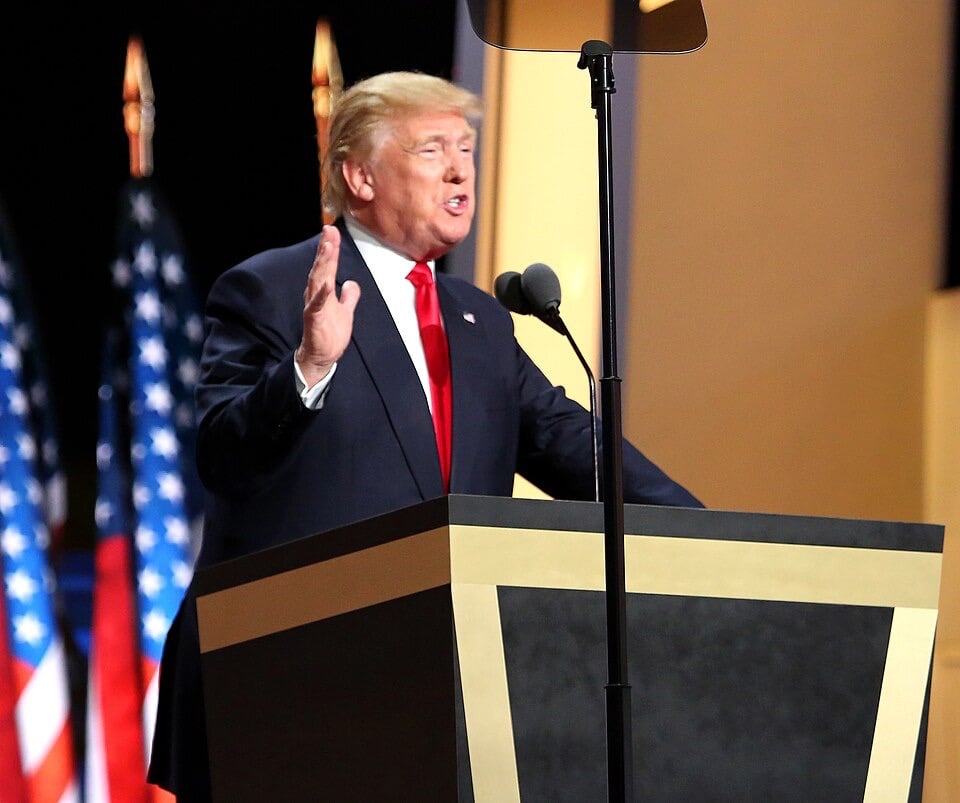
The 80-year-old president, hoarse after a punishing run of midterm rallies, said he hoped his voice would “hold out” and floated the idea of a robot double so he could “sit home and watch”.
President Donald Trump has joked that he could send a robot lookalike to campaign for him, after a punishing schedule of midterm rallies left his voice raspy. Speaking at a White House lunch on Thursday, the 80-year-old said: “I just hope my voice holds out.” He had returned to Washington at 4am that morning after speeches in Arizona and Montana. The midterm elections are on 3 November.
The joke
Mr Trump described the travel as “a lot”. He then suggested a way to get some rest. “I could maybe get one of those beautiful robots that they make nowadays and make them look just like me, and you wouldn’t know the difference,” he said. “They make them pretty good. Send them out on the trail. I can sit home and watch them on television.”
The remark followed his recent embrace of artificial intelligence. There is no evidence he has commissioned a robotic replacement, and the comment was a joke rather than an announcement. The event was a lunch honouring first responders in the Rose Garden. A press pool reporter independently described his voice as raspy.
No official medical statement has identified any illness behind his strained voice. The demanding schedule may explain some vocal fatigue, but the voice alone cannot show the cause. There has been no announcement that he will cancel or reduce appearances.
The ‘midterm blitz’
In just over a week, Mr Trump has held events in Texas, New York, Tennessee, Ohio, Alaska, Arizona, Maryland and Montana, which is eight states and thousands of miles of travel. The White House has called the schedule a “midterm blitz”. It has mostly taken him to Republican strongholds rather than to typical battleground states such as Michigan, North Carolina and Georgia.
This week’s West Coast swing was particularly compressed. On Tuesday he flew more than seven hours from Washington to Wasilla, Alaska, for an evening rally, then went on to Las Vegas, where he stayed at the Trump hotel. The next day he flew to Bullhead City, Arizona, and then to Kalispell, Montana, for two more rallies before returning to the capital early on Thursday. At the Kalispell rally he announced plans for a new military testing site described as a “super range”, focused on hypersonic weapons, autonomous systems, space-related defence technology and electronic warfare. He gave no opening date or construction timetable.
His published schedule includes four more rallies over the next five days:
- Friday 16 October: Dalton, Georgia
- Saturday 17 October: Highland Heights, Kentucky
- Monday 19 October: Wichita, Kansas
- Tuesday 20 October: Greenville, North Carolina
The Georgia event is of particular interest, as Republican Mike Collins is challenging Democratic Senator Jon Ossoff in one of the year’s closely watched Senate races.
Attack on a Democratic candidate
While acknowledging the toll of his own schedule, Mr Trump turned attention to the health of Democratic candidates. At the lunch, he focused on Texas Democratic Senate candidate James Talarico, who took two weeks to recover from the flu during the campaign.
He also suggested extending the death penalty to people convicted of murdering firefighters, building on his support for capital punishment in cases of police killings. No legislation or executive order was confirmed.
The political backdrop
A Fox News poll put Mr Trump’s job approval at 36%, with approval of his handling of the economy at 22%. National approval figures do not directly predict individual congressional races. The same poll found Democrats ahead of Republicans by 54% to 45% on which party voters would back for the House.
At his Arizona rally, Mr Trump urged supporters to behave as though his own name were on November’s ballot. Some of his supporters are less likely to vote when he is not standing. Republican-aligned groups are reportedly redirecting resources to defend seats once considered safe, including in Kansas, Texas and Iowa, while Democrats target districts where Republicans were previously stronger. Rising living costs and dissatisfaction with the economy remain significant concerns.
