



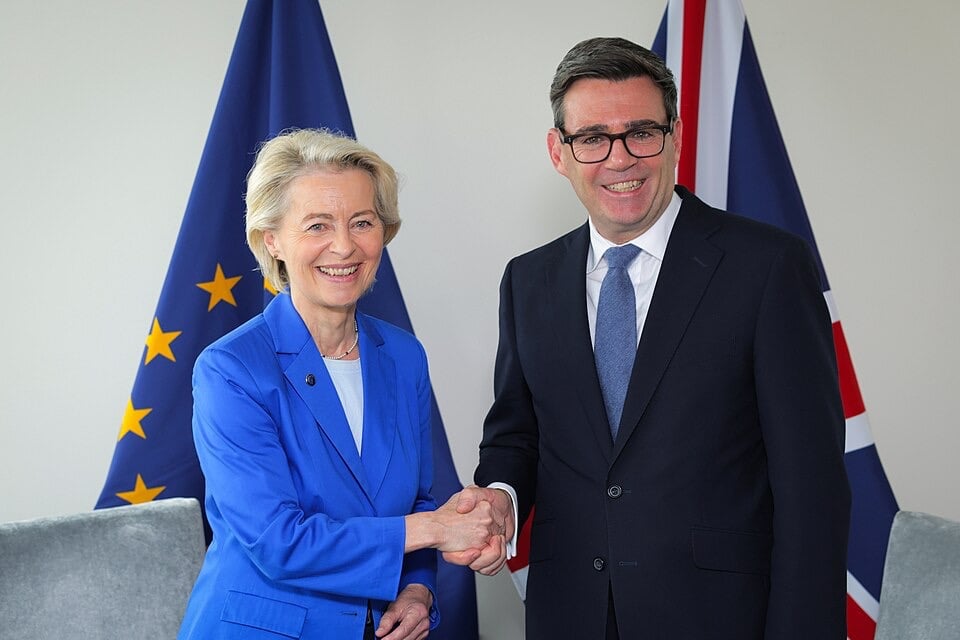
The Prime Minister says reopening talks has helped progress on several agreements ahead of next week’s Brussels summit. He rejected Lord Cameron’s warning about reopening the debate, saying “no one’s talking about rejoin”.
Prime Minister Andy Burnham has said a “win-win” agreement with the EU can be struck that could be “more like the Brexit that people thought they were voting for in 2016”. Speaking at the European Political Community meeting in Ireland on Thursday, he said reopening talks on future UK-EU ties had helped progress on several pacts. He will meet European leaders in Brussels next week to finalise treaties on food and agriculture, emissions trading and a youth mobility scheme, which could raise GDP by 0.4%. Afterwards, the UK plans to “explore options” for a renewed long-term framework with the bloc.
What Mr Burnham said
“The requests are coming from the European side. We are putting our requests on the table too,” he said. “I believe there is a good deal to be done that could be a win-win for Britain and Europe. I think it actually could be more like the Brexit that people thought they were voting for in 2016.”
He said he did not think people had expected a Brexit “as hard as the one that finally came through at the end of 2019”, which he described as “much harder than Theresa May’s deal”. “So let’s see where we get to in the next seven days. But I think in the end, what we get could be good for Britain, but also closer to what people voted for at the referendum.”
Asked whether reopening the debate had helped or damaged the talks, he said: “I think it has helped, but there’s a long way to go.” He promised to “fight now, over the days to come, to make sure we get this deal over the line”. He did not rule out reduced tuition rates for young Europeans, saying: “There’s a lot of issues on the table as part of a deal and I’m certainly one that supports greater youth exchange between the UK and Europe.”
Mr Burnham’s recent remarks have fuelled questions about whether the UK could rejoin the EU or adopt its freedom of movement rules. He has insisted voters would ultimately be “the boss” of any changes.
The row with Lord Cameron
Lord Cameron, who resigned as prime minister after leading the Remain campaign following the 2016 referendum he called, said in an interview this week that starting a conversation about rejoining would be “very long and painful”. He also said the UK’s economic problems over the past 10 years were not because of Brexit.
Mr Burnham said: “I think he is wrong to say that the low growth that we’ve had over the last decade is, quote, ‘nothing to do with Brexit.’ I would say the evidence says otherwise, and indeed the Treasury analysis says otherwise, which is if we are able to come to a good working arrangement on emissions trading, on agri-food, on other things as well, that we can add growth to the British economy.”
He added: “It feels like his intervention is more about unity in the Conservative Party than it is about fighting for the British interests. So just to finish, though, no one’s talking about rejoin. This is a deal that is about the next seven days.”
Sticking points reported by the Guardian
The Guardian reported on 12 November that Brussels has warned that the food and agriculture agreement and the emissions-trading agreement may not enter into force unless Britain also charges eligible European students domestic tuition rates. The government is reportedly considering an arrangement costing about £450m a year, a reported estimate and not an approved commitment. The UK also wants to join the proposed “Made in Europe” industrial framework to protect British manufacturers in public procurement, but EU officials say agreement is not expected at the 20 November summit.
On youth mobility, the Guardian reported that Britain is seeking an annual cap of about 50,000 EU participants. Some European governments have proposed ceilings of 100,000 to 500,000, and others oppose a cap. Britain wants participants to pay the £1,035 immigration health surcharge, with a 25% discount reportedly discussed. European diplomats have reportedly considered delaying the deadline by six months. The House of Commons Library says the European Commission’s April 2024 proposal would have allowed 18- to 30-year-olds up to four years in the other territory, and was rejected then by both the Conservative government and Labour opposition.
Euronews reported on 10 November that the leaders of Germany, Belgium, Denmark, Luxembourg and the Netherlands, in a letter to Ursula von der Leyen and António Costa, called for British payments to EU regional development funds in return for closer electricity-market integration. No amount has been agreed. The Guardian reported that Energy UK estimates current post-Brexit electricity arrangements could cost £10bn more between 2024 and 2029.
Food, carbon and security
The Guardian reported on 3 November that negotiators had finished a roughly 200-page food safety text that would remove most certificates and checks on products such as cheese, sausages, flowers and leather goods. It remains subject to political and legal approval. Implementation could slip to early 2028, though government guidance still says mid-2027. Defra says UK food rules would stay aligned with certain future EU standards.
The EU’s carbon border charge has applied since 1 January 2026, according to the Commons Library. Ministers said on 4 November that the first certificates for 2026 imports are not payable until September 2027. Linking the UK and EU emissions-trading systems could remove those requirements for qualifying UK goods, but only once a final deal takes effect. Britain’s own carbon border tax starts on 1 January 2027, covering aluminium, cement, fertiliser, hydrogen, and iron and steel.
The Guardian also reported that the UK wants renewed access to the Eurodac asylum database and the Schengen Information System, and that there is a dispute over EU demands restricting deportations of certain foreign national offenders. No agreement has been announced.
Britain has already agreed to rejoin Erasmus+ for 2027/28, a separate deal from youth mobility. The expected UK payment is about £570m, a 30% discount on the standard £810m, according to a government answer in the Lords. More than 100,000 people could benefit in the first year, Reuters reported, but participation after 2027 requires fresh negotiations.
The economy
The Office for National Statistics said on 12 November that UK GDP grew 0.7% in the third quarter, up from 0.5% in the second, and 1.9% on the year. Services rose 0.9% and construction fell 0.7%. The 0.4% GDP boost from the proposed deal is an estimate of the effect on the level of output, not annual growth.
