



Britain’s headline unemployment rate stayed flat in the three months to July, defying forecasts of a rise — but weaker vacancies, falling payrolled employment and a jump in benefit claims suggest the jobs market is cooling faster than the single percentage figure implies.
Britain’s unemployment rate held at 4.9% in the three months to July, according to the latest figures from the Office for National Statistics, defying analysts’ forecasts of a rise to 5%. The flat headline figure comes despite mounting pressure on the Labour government to address the growing number of young people not in employment, education or training. Separate data released this week showed the number of people claiming jobless benefits rose by 27,800 in August, reversing a revised fall of 11,800 the previous month and far outpacing the 8,300 increase economists had expected.
A weaker picture beneath the headline rate
The unchanged rate masks signs of deterioration elsewhere in the data. Payrolled employment fell by 94,000 in the year to July, to around 30.3 million, offering a less reassuring counterpoint to the stable unemployment figure. The ONS has also cautioned that its Labour Force Survey estimates remain subject to volatility, meaning the 4.9% reading shouldn’t necessarily be read as evidence of a healthy labour market.
The number of unemployed people now stands at roughly 1.77 million, around 88,000 higher than a year earlier, even though the headline rate itself hasn’t moved. That reflects the fact that the working-age population has also grown, rather than showing an absence of underlying deterioration.
Vacancies falling as jobseekers face more competition
Job vacancies have fallen to approximately 707,000 for the May-to-July period, down around 30,000 over the past year, below pre-pandemic levels and far short of the peak of more than 1.3 million reached during 2021-22. Many economists regard this trend as more revealing of the labour market’s true direction than the headline unemployment rate.
With roughly 1.77 million people unemployed against around 707,000 vacancies, there are now approximately 2.5 unemployed people for every available role — a marked shift from the period when employers struggled to fill vacancies and demand for workers outstripped supply. That change points to a labour market where the balance of power has moved back towards employers.
Conflicting signals on employment
The picture is further complicated by a discrepancy between different employment measures. The Labour Force Survey suggests employment rose by around 250,000 in the year to April-June, yet HMRC’s PAYE data shows payrolled employee numbers fell by 86,000 over the same period — a gap highlighted by the House of Commons Library. As a result, analysts are increasingly looking across multiple data sources rather than relying solely on the headline employment survey.
Separately, the employment rate among 16-to-64-year-olds stands at around 75.1%, slightly higher than the previous quarter but lower than a year earlier, while economic inactivity remains close to 20.9%.
A hiring freeze rather than a wave of job losses
The Bank of England’s July projections already pointed to further weakening, forecasting unemployment rising to around 5.0% in the third quarter of 2026 and 5.1% in the fourth. Crucially, the Bank expects this increase to stem largely from employers holding back on hiring rather than from a surge in redundancies — a pattern that fits closely with Suren Thiru, chief economist at the ICAEW, describing the labour market as locked in a “low-hire, low-fire funk.”
According to Thiru, high labour costs, the continuing fallout from US-Iran tensions and uncertainty over domestic policy are together encouraging firms to be more cautious about both hiring and pay. He said the fall in vacancies should be a cause for concern, pointing to soaring staffing costs, burdensome regulation and rising automation as factors dampening demand for workers. Thiru warned that the labour market could be heading for a “rockier autumn,” with rising energy bills and uncertainty ahead of the Budget likely to further discourage hiring, pushing unemployment moderately higher and pay growth lower.
Youth unemployment remains a political flashpoint
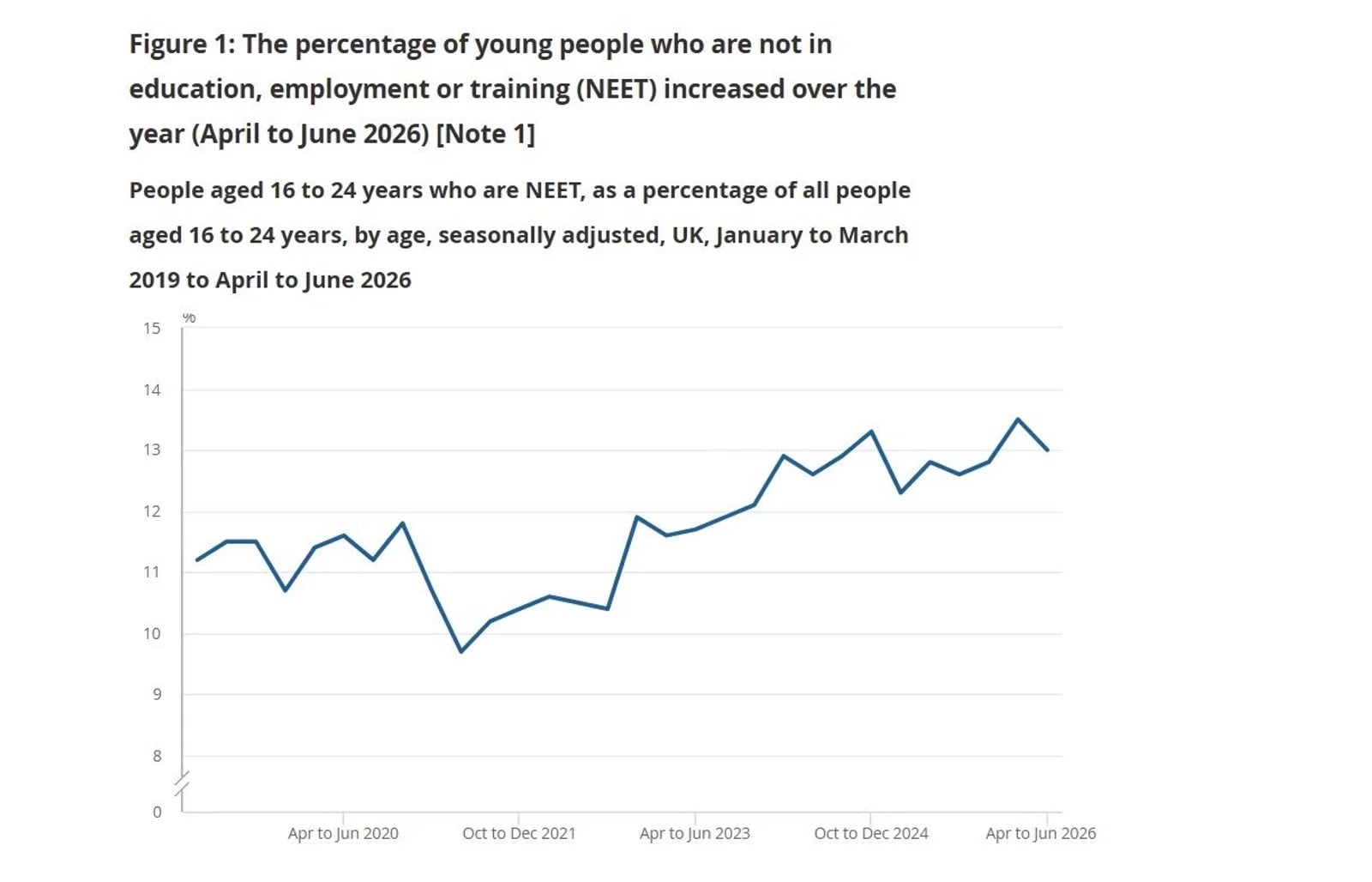
The number of 16-to-24-year-olds who are not in education, employment or training — commonly known as NEETs — remains in the hundreds of thousands, according to the latest ONS figures, and continues to be treated as a significant political concern. The issue is considered especially serious among young people who are economically inactive rather than actively job-hunting, since they risk becoming detached from the labour market for extended periods.
Automation’s limited but growing role
The Bank of England’s Decision Maker Panel found that businesses expect artificial intelligence to reduce employment by around 0.4% a year over the next three years, while boosting productivity by roughly 0.9% annually. However, nearly 90% of businesses surveyed said AI had not materially affected their staffing levels over the past three years, suggesting automation remains a medium-term risk rather than the primary driver of the current slowdown.
Pay growth being squeezed by inflation
Regular pay growth currently stands at around 3.6% a year. With inflation running at roughly 2.9%, that leaves real wage growth of only about 0.7 percentage points — a sharp change from the period when pay rises comfortably outstripped the cost of living. In practice, this means many workers are seeing their pay packets grow in cash terms while their actual spending power improves only modestly.
A difficult balancing act for the Bank of England
The combination of a weakening jobs market and still-elevated inflation leaves the Bank of England with a difficult judgement call. A softening labour market would typically support the case for interest-rate cuts, but with inflation still above the Bank’s 2% target, policymakers have less scope to cut rates aggressively. Thiru suggested that a cooling jobs market currently represents the “last line of defence” against inflationary pressure linked to the fallout from US-Iran tensions, at a time when overall economic growth has held up better than the jobs data alone would suggest.
Changes to how the figures themselves are measured
The reliability of the UK’s labour market statistics has faced scrutiny in recent years amid low survey response rates. In response, the ONS is preparing to move from the existing Labour Force Survey to a new Transformed Labour Force Survey (TLFS). A major readiness assessment is expected in 2027, with the ONS targeting November 2027 for the new survey to become the headline measure, provided the evidence supports the switch.
The bigger picture
Taken together, the data points to a labour market best described as stagnating rather than collapsing:
| Indicator | Latest figure |
|---|---|
| Unemployment rate | 4.9% |
| Unemployed people | ~1.77 million |
| Employment rate (16–64) | ~75.1% |
| Economic inactivity | ~20.9% |
| Vacancies | ~707,000 |
| Unemployed people per vacancy | ~2.5 |
| Regular pay growth | ~3.6% |
| Payrolled employees | ~30.3 million |
While the unemployment rate has stayed flat, falling vacancies, weaker payrolled employment and near-stagnant real wage growth all point to a jobs market that is cooling — even if it isn’t, for now, showing the sharp rise in joblessness that some analysts had expected.
