



Hundreds of people and three hospitals in Siberia have been placed under quarantine after a laboratory worker died of severe pneumonia, with a regional official initially describing her death as caused by plague, though federal health authorities have since declined to confirm the diagnosis amid growing accusations that Russian officials are concealing the true nature of the outbreak.
Three hospitals and around 200 people in Russia’s Irkutsk region have been placed under quarantine following the death of a laboratory worker from severe pneumonia, amid claims that authorities are withholding the full details of what happened. Darya Shipilova, reported to be either 27 or 28, worked at the Irkutsk Anti-Plague Institute in Siberia and was admitted to hospital on 29 September before being placed on a ventilator. She died two days later. While a regional governor initially stated she had died of plague, Russian federal health authorities have since described her condition only as pneumonia of unknown cause, and say the illness remains under investigation.
Conflicting accounts of what happened
According to the Russian news outlet Lyudi Baikala, Shipilova told medical staff she had accidentally broken a test tube containing live bacteria. However, there are conflicting accounts of where she may have been exposed to the pathogen that caused her illness. One version of events suggests exposure occurred inside the laboratory itself, while another indicates she became unwell during a field expedition with colleagues in Buryatia, near Russia’s eastern border with Mongolia. She was subsequently transferred to Shelekhov Hospital with severe pneumonia, where she later died. This discrepancy has left the precise origin of her illness unclear.
Alexei Tsydenov, governor of Russia’s neighbouring Buryatia region, said in a social media post that a woman in the Irkutsk region had “died of plague.” However, this claim has not been confirmed by federal authorities, who have reportedly said that subsequent testing did not identify microorganisms linked to her professional work at the institute. Later official statements have grown more cautious, suggesting only that she may have died from plague rather than confirming it as the definitive cause of death.
Quarantine measures and public response
Approximately 190 to 200 people believed to have had contact with Shipilova have been placed under medical observation or quarantine as a precaution. According to the latest statements from regional authorities, none of the identified contacts has developed symptoms, and all laboratory test results to date have come back negative. Shelekhov District Hospital, where Shipilova was treated, has been placed under quarantine, along with other hospitals in the Irkutsk area that have taken in people who came into contact with her.
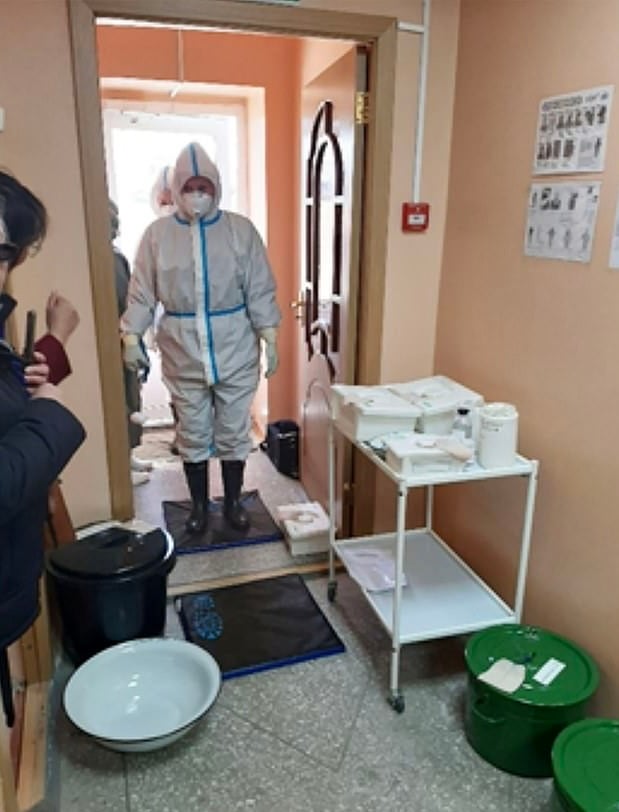
A mask requirement has been introduced at some workplaces in the Shelekhov area, and medical personnel have been seen wearing full protective clothing, masks and gloves as a precaution. Some local public events have also been cancelled or postponed while authorities continue their investigation. Irkutsk governor Igor Kobzev confirmed that an emergency meeting of the regional sanitary and anti-epidemic commission had been convened, attended by Russia’s Chief State Sanitary Doctor Anna Popova. “We held an extraordinary meeting of the regional sanitary and anti-epidemic commission with the participation of Russia’s Chief State Sanitary Doctor Anna Popova,” Kobzev said. “The reason was information that had emerged about a suspected case of a particularly dangerous infectious disease in a resident of the region.” Kobzev initially declined to publicly name the suspected disease, though he confirmed that “all identified contacts have been placed under medical observation,” adding: “As of today, none of the contacts has any signs of illness and their laboratory test results are negative.”
Anna Popova is reported to have travelled roughly 2,600 miles from Moscow to Siberia to personally oversee the response to the outbreak. Maxim Modin, mayor of the nearby town of Shelekhov, urged residents to remain calm and rely only on official information. “It is too early to draw final conclusions – we will wait for the specialists’ findings,” he said, also cautioning residents “not to spread rumours or unreliable information – use only official sources.”
Accusations of a government cover-up
The initial reluctance of officials to name the suspected illness, referring instead only to a “particularly dangerous infectious disease,” has fuelled speculation and accusations that the Russian government is concealing the true circumstances of the outbreak. According to the Moscow Times, senior Russian epidemiologist Mikhal Favorov dismissed the broken test tube explanation as implausible, given the protective equipment typically worn by staff at the institute. “It’s laughable. Someone working at the Anti-Plague Institute in Irkutsk wears a protective anti-plague suit,” he was reported to have said. “If you break a test tube, the likelihood of infection is actually very low. In short, it doesn’t matter to the general public – they’ll believe the ‘broken test tube’ story.” He added: “It’s absolutely hair-raising. We will not be told what really happened.”
The anonymously run political Telegram channel Nezygar drew a comparison between the situation and the early stages of the Covid-19 pandemic, when Chinese authorities attributed the outbreak’s origin to a wet market rather than a possible incident at the nearby Wuhan Institute of Virology.
It is important to note, however, that the claim of a deliberate government cover-up has not been established as fact. While the initial secrecy around naming the suspected disease helped fuel public speculation, the subsequent position taken by federal health authorities, who have not confirmed plague as the cause of death and maintain that the illness remains under investigation, is also a significant part of the picture.
Understanding pneumonic plague
Pneumonic plague is one of three forms of plague caused by the bacterium Yersinia pestis, and is transmitted when a person breathes in airborne droplets from an infected individual. It causes a severe lung infection, with symptoms including fever, shortness of breath and coughing up blood, typically emerging between three and seven days after exposure. If left untreated, the disease carries a near-100 per cent fatality rate, though this falls to around 17 per cent if patients are identified within 24 hours and treated with antibiotics. There have been reports that antibiotic supplies in the Irkutsk region are running low, as concerned residents place heavy demand on local pharmacies and medical facilities.
The other two forms of the disease are septicaemic plague, which infects the bloodstream and is typically contracted through flea bites or contact with infected animals, causing internal bleeding and tissue necrosis, and bubonic plague, historically known as the Black Death and responsible for the Great Plague of 1665, which killed around a fifth of London’s population. Bubonic plague is also spread by flea bites and causes fever, chills and painful, swollen lymph nodes known as buboes.
Plague remains present in parts of Russia
Plague has not been entirely eradicated from Russia’s natural environment. The country maintains known natural plague reservoirs, particularly in parts of Siberia and the Altai region. Russia’s last officially confirmed human case of plague was recorded in 2016, when a 10-year-old child in the Altai Republic contracted the disease.
