



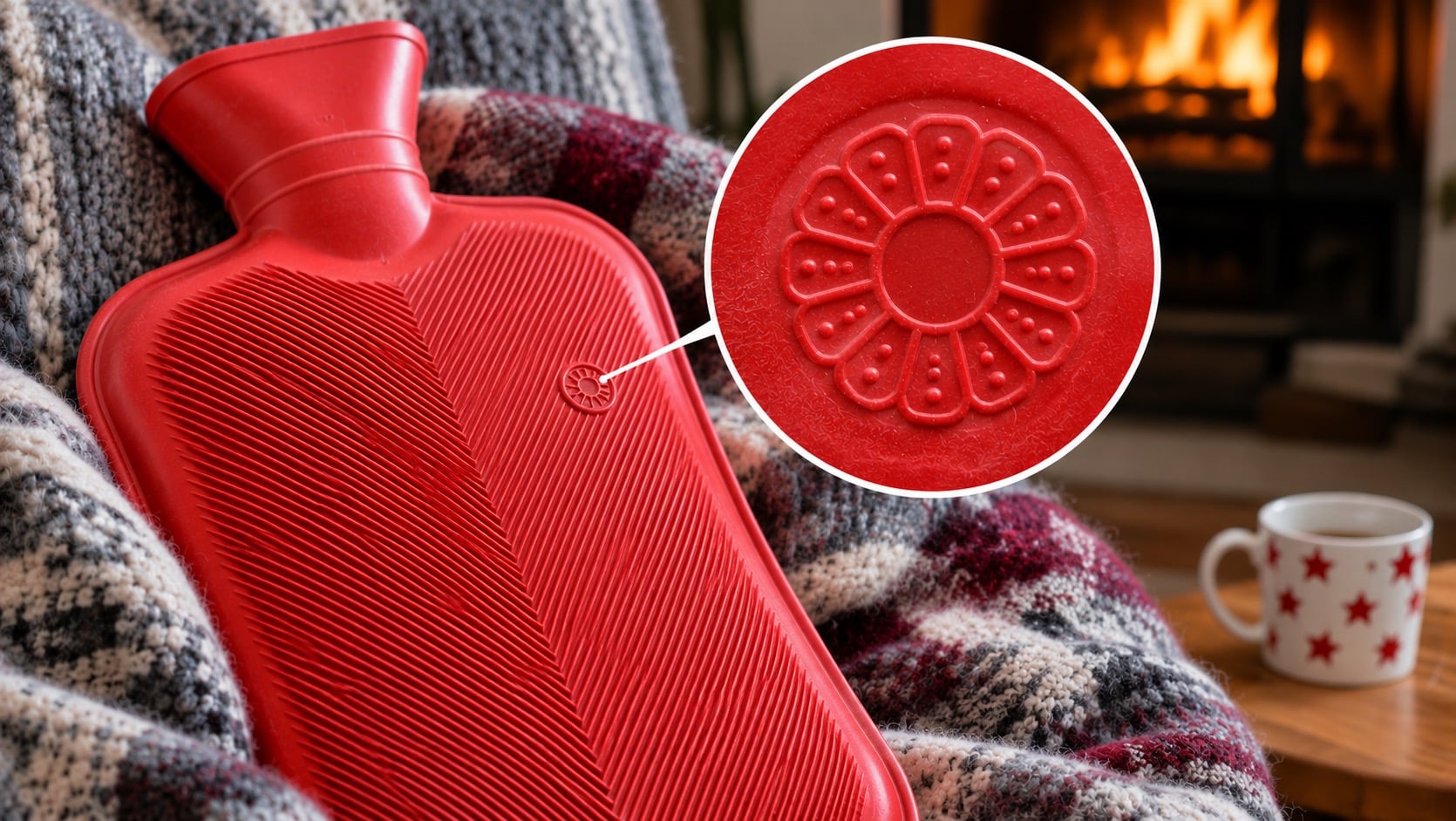
The consumer group says a small symbol on the bottle shows when it was made, and that bottles more than two years old risk splitting or leaking. The Children’s Burns Trust says 239 children suffered serious hot water bottle burns last year.
Households bringing hot water bottles out of storage as temperatures fall are being urged to check how old they are. Consumer group Which? says many bottles carry a small “daisy wheel” symbol showing when they were made. Citing the Children’s Burns Trust, it says a bottle more than two years old is too old to use safely. Ageing bottles are more likely to burst or leak, which can cause serious burns.
What the daisy wheel shows
In a recent post, Which? said: “This symbol means that I should have thrown away this hot water bottle years ago. See, hot water bottles have a short lifespan. The older they get, the more likely they are to burst or leak.” It added: “According to the Children’s Burns Trust, if yours is more than two years old, it’s too old.”
The symbol has a number in the centre showing the year of manufacture. A “25” means the bottle was made in 2025, and a “26” means it was made this year. The daisy has 12 petals representing the months of the year, and the dots within them represent the weeks of each month, Which? explained.
The daisy wheel is not an expiry date, the Child Accident Prevention Trust says. It records when the bottle was made, not when it must be thrown away, and a bottle may have spent months in storage before being sold. How long one lasts depends largely on how it is used and looked after, according to the report.
Replacement advice varies
Advice on how often to replace a bottle differs slightly between organisations. The Children’s Burns Trust says a bottle older than two years is too old. Boots recommends replacing bottles every two years from the date of purchase, even when there is no visible damage, and offers a two-year manufacturing-defect guarantee on its own. Trading Standards officers have advised replacing them after two to three years of use, according to the Journal of Trading Standards.
The Child Accident Prevention Trust says many reputable manufacturers give a two-year guarantee from the date of purchase, rather than manufacture. It says the guarantee generally covers manufacturing defects, not every kind of deterioration through use. None of the advice suggests ignoring visible damage because a bottle is fairly new.
Injury figures
The Children’s Burns Trust says 239 children suffered life-altering burns or scalds involving hot water bottles in 2025, based on the International Burn Injury Database. The charity warns that children can be badly hurt when bottles split, leak or are used incorrectly, and advises that adults, not children, should fill them.
A withdrawn safety standard
British Standard BS 1970:2012, which set safety requirements for rubber and PVC hot water bottles, was withdrawn on 4 March 2024, according to the British Standards Institution’s catalogue. The Charity Retail Association says it was not replaced, so there is no equivalent current British Standard for traders to use as a benchmark. Bottles must still meet general UK product-safety requirements.
The withdrawn standard required permanent markings, including the manufacturer’s identification and the daisy wheel date symbol, as well as physical performance and durability requirements. Retailers still refer to it when describing their products. Boots, for example, still advertises bottles made to its requirements. The withdrawal does not make every existing bottle unsafe.
Burns can happen without a burst
A bottle does not have to split to cause harm. NHS guidance warns against prolonged contact with a hot water bottle, including when it is covered, as it can cause a contact burn. The NHS recommends letting boiled water cool before filling. NHS England South West advises waiting at least 10 minutes, while the Children’s Burns Trust suggests about five. Both warn against using freshly boiled water.
The Child Accident Prevention Trust advises against freezing a bottle to use in hot weather, as freezing can damage the rubber and make it unsuitable for later use with hot water. Boots advises people who cannot reliably feel excessive heat not to use hot water bottles, because prolonged contact can burn the skin before they notice.
Electric bottles
The Office for Product Safety and Standards issued a serious-risk report on 17 August 2026 on the Marco Paul Electric Hot Water Bottle, item number MP24, model HK-380 and barcode 5056713212730. Regulators found that users could reach live electrical parts and that poor connections created a fire risk. They found it did not comply with the Electrical Equipment (Safety) Regulations 2016, and the affected product was destroyed.
On 12 January 2026, the government announced a recall of the Southern Arbor Electric Rechargeable Hot Water Bottle sold through TikTok Shop. Regulators classed it as a serious fire risk because it lacked adequate protection against overheating. The online marketplace removed the listing. A Dinsheng Milkycat rechargeable bottle sold through Amazon was withdrawn in January 2025 because of a serious risk of electric shock, as the device could stay energised while being filled. These are electrical faults and are separate from the ageing of conventional rubber bottles.
What to do after a burn
NHS advice is to cool a burn under cool running water for 20 minutes, ideally straight away, though cooling can still help for up to three hours afterwards. Clothing or jewellery near the burn should be removed unless it is stuck to the skin. After cooling, the burn can be covered loosely with cling film or a clean dressing. Ice, butter, toothpaste, creams and oils should not be put on a fresh burn, according to NHS burns specialists at Queen Victoria Hospital. The NHS advises calling 999 or going to A&E for large or deep burns and for burns on sensitive areas such as the face or genitals.
