



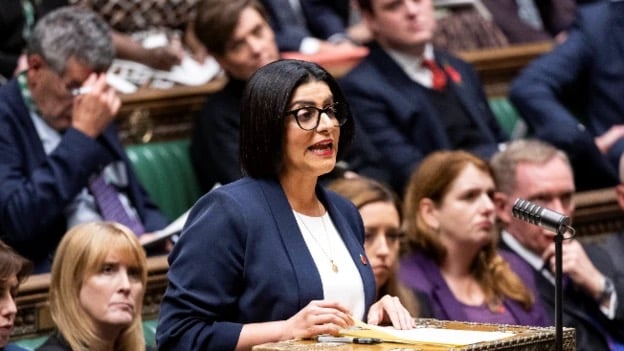
The Home Secretary’s concession on care workers, and a campaign by MPs and unions, took much of the sting out of the Commons response, though the retrospective element remains
Most Labour MPs held back from sharp criticism on Monday after Home Secretary Shabana Mahmood announced a softened version of the government’s plans to tighten settlement rules for migrants. Care workers who arrived before May 2025 and earn at least £25,000 a year will still qualify for settlement after five years. About 500,000 people will now face a longer wait, against around 800,000 under the original proposals. The rules still apply to people already in Britain, the aspect that had most troubled some Labour backbenchers.
What changed
Mrs Mahmood’s first version of the reforms, announced last year, would have made many social care workers wait 15 years for settlement. After Andy Burnham replaced Sir Keir Starmer as prime minister over the summer, some Labour MPs hoped for two changes: a better deal for care workers and an end to the retrospective element. They secured the first but not the second. Under the retrospective rules, people who arrived expecting to be eligible after five years may face a longer wait.
Housing secretary Angela Rayner, who returned to the cabinet under Mr Burnham, had called that approach “un-British” and said the government should not move “the goalposts”. She repeated the criticism in an interview at the party conference in September. Other MPs, particularly in Brexit-supporting areas, wanted the Home Secretary to hold her course. Some in government were wary of giving the Conservatives and Reform what they saw as an opening.
Beyond care workers, the Home Office says the 15-year requirement has been dropped for other workers below degree level, who will generally move onto a ten-year route. A plan to assess family members’ earnings separately has also been abandoned, with households instead assessed against a £25,000 minimum income, according to the Financial Times. The reforms are due to be introduced in 2027.
The Commons response
Labour’s Rachael Maskell, who opposes the retrospective element, offered perhaps the strongest pushback. John McDonnell and Diane Abbott, from the party’s left, were critical but not scathing. Outside the chamber, one Labour MP who has concerns told the political correspondent they thought Mrs Mahmood had taken the political sting out of the issue for now. They called the campaign by MPs and unions a “big win” for care workers but expected to hear from constituents who will be hit by the new rules. A Number 10 source praised her “take no prisoners” performance, said she had “found the right balance” and that the announcement had gone down as well as could be expected.
Conservative shadow home secretary Chris Philp accused her of a significant U-turn. He pointed to her earlier claim that letting care workers settle more quickly could cost the UK £10bn. The Guardian reported that estimate was for projected lifetime public spending linked to care-sector settlement, not an annual cost, and it is not known what the revised concession will cost. In a broadcast interview, Mrs Mahmood would not say what the softer approach would cost, or whether Mr Burnham had directly asked her to dilute the plans.
The wider package
The Home Office said applicants will generally have to meet four requirements: a stricter good-character threshold, a high standard of English, no outstanding debt to the taxpayer, and at least three years of National Insurance contributions. People who have claimed benefits may need five continuous years off them before applying. People earning over £125,000 and some exceptional-talent migrants could qualify in three years. The Financial Times reported government estimates that more than 500,000 of a projected 1.9 million applications between 2026 and 2030 will be delayed, about 26%. No full impact assessment has been published.
Refugees arriving through approved safe and legal schemes keep a five-year path. Those arriving outside such schemes could face 20 years, reducible to ten through work or study, with a further ten-year penalty for those arriving by small boat or other clandestine means. Refugee charities and the Law Society have criticised the proposals. Family members of British citizens, Hong Kong British National (Overseas) visa holders, armed forces members and Windrush-related routes keep their current arrangements.
Net migration fell to an estimated 171,000 in the year to December 2025, from a peak above 900,000 in 2023, according to figures cited by the Associated Press.
