



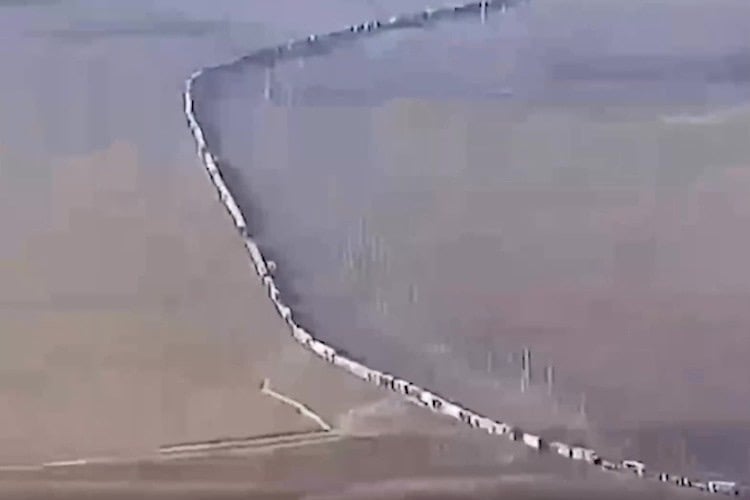
Footage reported to show about 1,200 trucks near the Kazakhstan–Uzbekistan border has been circulated as evidence of the strain on Iran’s land routes. Uzbekistan’s customs authority says the video is several days old and the crossing is operating normally.
A video reported to show a 26-mile queue of about 1,200 lorries near the Yallama crossing between Kazakhstan and Uzbekistan has been widely shared as evidence of the pressure on Iran’s land routes. The Telegraph linked the queue to the US naval blockade, which has pushed trade that once went by sea on to long overland detours. Uzbekistan’s Customs Committee says the footage dates from several days earlier and that only 100 trucks were waiting on 20 November. Iranian officials, meanwhile, have admitted difficulties moving cargo and say prices are rising.
The reported queue
According to the Telegraph, goods bound for Iran are being sent through Kazakhstan, Uzbekistan, Pakistan, Turkmenistan and Turkey. One driver told the paper: “There is a long queue here. It’s been our third day here.” Another, Mohammadreza Shiri, said he had been stuck for five days and had “never seen anything like this” in 15 years of driving. Drivers were reported to be waiting weeks at the Bazargan crossing with Turkey. The Telegraph also reported that fresh produce often cannot get through, because the long journey and the queues mean customs will not clear it.
Amir Roshanbakhsh of Iran’s trade development organisation said: “Instead of 200 trucks, there are now 1,200 trucks at one border.” The Associated Press reported the same comment in September in its coverage of the Gürbulak crossing with Turkey, so it may not describe the Kazakhstan–Uzbekistan border. Majidreza Hariri, head of the Iran-China Chamber of Commerce, said that land transport costs have more than quadrupled compared with sea transport.
Uzbekistan disputes the scale
On 21 November, Uzbekistan’s Customs Committee said crossings with Kazakhstan were operating normally and that videos online showed congestion from several days earlier. It said that at 9am on 20 November there were 100 trucks at the Bauyrzhan Konysbayev checkpoint, opposite Yallama, and that the crossing handles more than 1,500 trucks a day, so a queue of 100 was within normal conditions. It said daily freight traffic across the Kazakhstan–Uzbekistan border has risen from 1,165 vehicles in 2021 to 3,130 in November 2026, partly because of Chinese transit cargo. The different figures refer to different times and do not show that the earlier queue did not exist.
Tafs.uz reported that Kazakhstan acknowledged a 40-kilometre (about 25-mile) queue on 13 November, and that drivers had reported a 25-kilometre queue and waits of up to three days in early November. Kazakhstan put the congestion down partly to seasonal freight growth and transit traffic, and to drivers arriving without a booking on its electronic queue system. New booking rules, including a security deposit for freight operators, took effect on 9 November.
The US pressure
The US has a naval blockade restricting Iran’s access to the Strait of Hormuz. A new group, Task Force Iron Gate, has been set up to work with US intelligence agencies “on preventing the movement of advanced weapons systems, dual-use technologies, sanctioned materials and illegal revenue streams across Iran’s land borders and the Caspian Sea”. It will be overseen by a team of about 20 in Tampa, Florida, according to the Telegraph. The National reported that the US Central Command (CENTCOM) has not announced plans to deploy troops along Iran’s land borders or to close crossings. Stars and Stripes reported that CENTCOM has not said how it would disrupt shipments through third countries.
Effects inside Iran
Iranian officials have acknowledged the strain. The Telegraph reported that inflation has risen for 18 months in a row, with prices up about 84% on a year earlier. Iran has banned exports of tomatoes, onions and potatoes “until further notice”. President Masoud Pezeshkian called the price rises “natural” given the blockade. “Before, imported goods came by ship. Now they travel a long way to enter the country, and the finished price of goods goes up,” he said. “Our income has also fallen. Before, we sold oil and now we cannot sell it.” The health minister, Mohammad-Reza Zafarghandi, confirmed drug prices had risen because raw materials once shipped by sea now had to be flown in.
Iran’s roads minister, Farzaneh Sadegh, told parliament that more than 85% of the country’s cargo previously passed through southern ports, and that land infrastructure cannot immediately replace them, IranWire reported. She also blamed quotas imposed by neighbouring countries.
On 23 November, Iran International, citing the state news agency IRNA, reported that Foreign Minister Abbas Araghchi said a full US blockade of Iran’s land borders would be almost impossible to enforce, and that embassies were seeking new markets. Deputy foreign minister Hamid Ghanbari said Iran had no shortages and that disruptions at some border posts had been resolved. On 20 November, the economy minister, Ali Madanizadeh, said only one land border remained closed for security reasons, and later said the fall in foreign trade had narrowed from 35% to 20%, according to Press TV. These are government claims and have not been independently verified.
Iran and Afghanistan agreed to introduce around-the-clock customs operations at three crossings, Ariana News reported on 15 November. Turkey doubled its X-ray scanners at Gürbulak, cutting the wait for vehicles entering from Iran from 30 days to 22, an official told the AP in September.
