


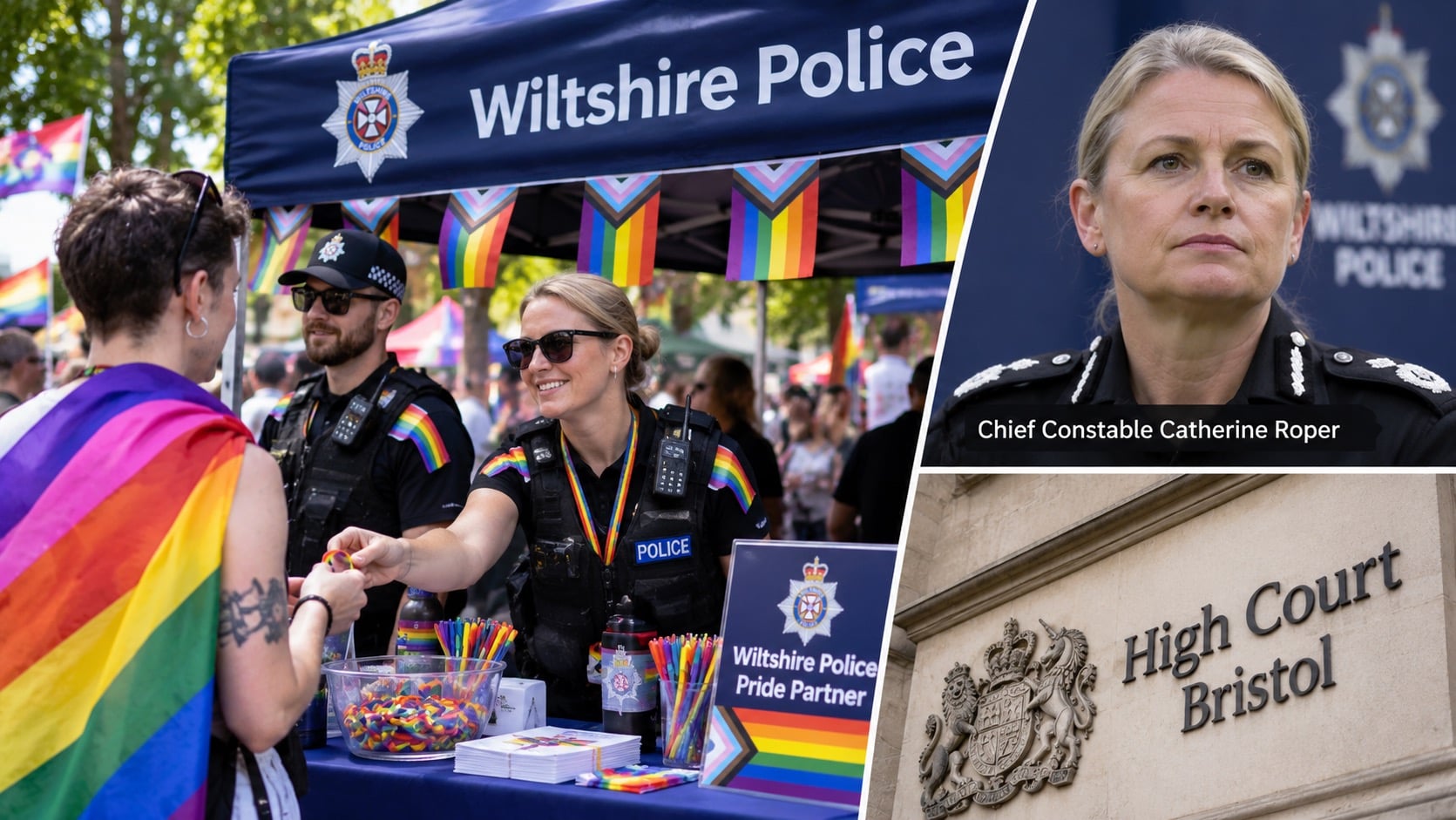
Chief Constable Catherine Roper acknowledged that the force’s support for Swindon Pride gave some people the “unintended impression” that officers might not act fairly. The final bill has not been disclosed.
Wiltshire Police has settled a High Court challenge over its sponsorship of Swindon Pride, three days before a full hearing was due in Bristol, and will pay the claimant’s reasonable legal costs. Chief Constable Catherine Roper acknowledged that the force’s support for the event and officers wearing transgender flag colours gave gender-critical members of the public the “unintended impression” that officers might not act fairly. The claim was brought by the barrister Sarah Phillimore, who argued that police must stay impartial in the debate over transgender rights. The force says it has reviewed its practices, and the final costs have not been published.
The dispute
In July 2025, lawyers warned Wiltshire Police not to repeat its support for Pride events. The force went ahead, paying to sponsor Swindon Pride the following month and taking a stall as an official “Pride Partner”. Officers and staff wore police clothing in transgender and Progress Pride flag colours, and the stall displayed rainbow flags and handed out Pride merchandise. Officers did not march in the parade. Off-duty police and staff ran the stall, while on-duty colleagues took part in building relationships with the community.
Ms Phillimore, who co-founded the free-speech group Fair Cop with the former police officer Harry Miller, brought the claim. She argued that the Chief Constable acted unreasonably and had no power to authorise activities that could compromise police neutrality, and she asked the High Court to declare the decision unlawful. The court gave permission for a full hearing. On Friday the force agreed to settle and to pay her reasonable costs, including those of an earlier hearing. The final bill has not been disclosed but is reported to run into hundreds of thousands of pounds.
What each side said
Ms Roper said the force’s activities had raised concerns about police bias, but defended attending community events to meet people and build trust. “We must protect that engagement while remaining, and being seen to remain, politically and operationally impartial,” she said. She confirmed the force had reviewed its practices to ensure officers avoid even the appearance of taking sides, and said police must listen to people with opposing views, including those who disagree with transgender ideology.
Ms Phillimore said: “The police must be impartial – it’s a very basic and fundamental duty. If they’re aligned with any political cause, like Pride, upright and decent citizens with the ‘wrong’ views will suddenly find themselves ‘on the wrong side’ of the police.” She added: “I am shocked and dismayed but sadly not surprised that Wiltshire chose to fight this almost to the door of the court. They have wasted a considerable amount of public money on a fight they could not win. But at least there appears some belated recognition of their duty to be impartial.” She said she hoped other forces in doubt would now be persuaded not to adopt “the colours of a contested political ideology”.
What the force’s own records show
A Freedom of Information response in 2025 said Wiltshire Police had no formal written policy specifically governing participation in Pride events. A search of its systems found more than 68,000 records containing the word “Pride”, though that is the number of hits and not distinct discussions. An internal message from a superintendent acknowledged the earlier High Court ruling involving Northumbria Police and described perceptions of bias as a reputational risk. The force told staff a senior officer had attended each local Pride event since 2024, and that the event attracts more than 10,000 people a year.
The national picture
The Northumbria case, R (Smith) v Chief Constable of Northumbria Police [2025] EWHC 1805 (Admin), concerned uniformed officers marching in the 2024 Northern Pride parade. The judge found the authorisation irrational. The court did not rule on the underlying transgender-rights debate, and the judgment concerned specific policing activities, not a blanket ban on attending Pride events.
On 18 November, Home Secretary Shabana Mahmood commissioned a national “Impartiality in Policing” standard, to be drawn up by the College of Policing, with a public consultation in early 2027. She has backed stopping uniformed officers from marching in Pride parades, referring to the Northumbria ruling, and rejected claims that “two-tier policing” is systematic. Nik Adams, City of London Police’s deputy commissioner and the national police chiefs’ LGBTQ+ lead, told The Guardian that describing LGBTQ+ issues as politically contested could leave LGBTQ+ officers and members of the public feeling less safe and valued.
According to the law firm Conrathe Gardner, a judicial review brought for Mr Miller against the Independent Office for Police Conduct was withdrawn after the watchdog issued new guidance on neutrality, and Hertfordshire Police changed its position on Pride flags and badges after a pre-action letter.
Wiltshire Police has said it must find at least £4.6m in savings for 2026–27, a figure that predates the settlement.
