



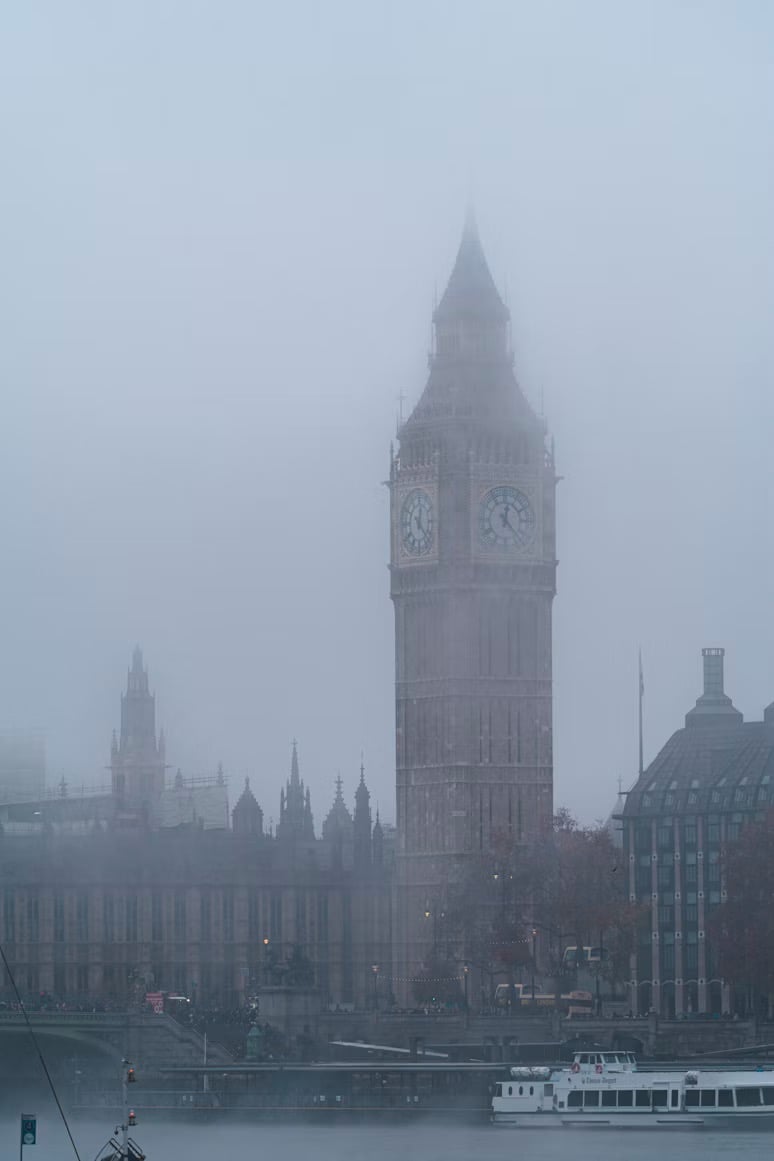
Yellow warnings are in place across England, eastern Wales and Northern Ireland, with visibility possibly down to 50 metres. Fog was blamed for serious crashes on the M20 and A303 at the weekend.
The Met Office has issued two yellow warnings for dense fog across Britain on Monday morning. One covers much of England and eastern Wales until 11am, and a separate warning for Northern Ireland runs until 10am. Visibility could fall to 50 metres or less in places, with possible delays to bus and train services and a chance of flight cancellations. Heathrow has urged passengers to allow extra time for journeys.
Where the warnings apply
The England and Wales warning stretches from York to Bath and includes London, Birmingham and parts of Greater Manchester. The Met Office expanded it at 4.20am on Sunday to take in north-east Wales. It said the West Country and central southern England were the areas where Sunday’s earlier fog could take longest to clear.
The Northern Ireland warning was issued at 9.53pm on Sunday and covers all six counties: Antrim, Armagh, Down, Fermanagh, Londonderry and Tyrone. The Met Office said visibility could drop below 100 metres, with the fog expected to lift during Monday morning. It rated the likelihood of moderate impacts at 50 to 75%, and said the warning concerns possible transport disruption, not a guarantee of widespread cancellations.
Why the fog formed
Niamh Murray, a Met Office operational meteorologist, told the Press Association that conditions were the “perfect recipe” for fog. “With autumn and winter and getting fog during this time of year, we get much longer nights, and that allows temperatures to fall away,” she said. She explained that the longer period of cooling brings temperatures closer to the point at which air becomes saturated. Light winds, not absolutely none, are also needed. “We just have the perfect recipe at the moment: light winds, clear skies, long nights, to allow that fog to develop,” she said. She added that if temperatures dip below freezing, the fog “can be quite stubborn to clear the next day”.
Heathrow’s advice
Heathrow said on social media: “Overnight fog has affected visibility on roads around Heathrow and conditions may continue into this morning. If you’re travelling to the airport, please allow extra time for your journey. We advise passengers to check with their airline before leaving home and to drive with care.”
No verified airport-wide figure for fog-related Heathrow cancellations had been found. The warning to allow extra time should not be read as confirmation that flights have been cancelled.
Early on Monday, Transport for London’s National Rail status feed, at about 6.50am, showed good service on most major operators, including Heathrow Express, Gatwick Express, Thameslink, Southern, Southeastern and Avanti West Coast. It showed a special service on c2c, though that does not by itself show fog was the cause.
M20 pile-up
The M20 in Kent was closed in both directions between junctions eight and nine near Maidstone after a pile-up involving more than 30 vehicles on Saturday evening. Two people were seriously injured. Kent Police said the crash was reported at 6.41pm and the motorway reopened at about 5am on Sunday, according to ITV News Meridian, meaning the closure lasted roughly 10 hours. The earlier report put it at nearly 12 hours.
Kent Police said the two seriously injured people were not believed to have life-threatening or life-changing injuries. One was taken to a London hospital and the other to a local hospital. Eleven people were assessed by ambulance crews, and Kent Fire and Rescue Service sent three fire engines and a technical rescue unit, according to Sky News. Police are appealing for witnesses and dashcam footage, and ask people to quote incident reference 07-1245.
A303 collision
In Hampshire, fog was blamed for a crash on the A303. The initial report said 19 cars were involved, but National Highways and South Central Ambulance Service reported 16 vehicles, according to AOL. It happened at about 8.20pm on Saturday near Thruxton. At least eight people suffered minor injuries, and one person with a broken arm was taken to hospital by family members. The ambulance response included two ambulances, specialist paramedic vehicles and a Hazardous Area Response Team.
A large oil spill kept the westbound carriageway shut after the vehicles had been recovered, as contractors cleaned it and inspected the surface for damage. The affected stretch was between the A342 near Thruxton and the A338 near Cholderton. National Highways said the closure was not causing major delays at the time of its Sunday update.
Driving advice and outlook
AA president Edmund King previously warned that fog could transform a familiar road in a “matter of minutes”. “One of the biggest mistakes is simply following the rear lights of the car in front,” he said. “It can give you a false sense of security and means you may be travelling too close to react safely if that vehicle suddenly stops.”
The Met Office expected fog patches to thin slowly later on Monday morning. London’s forecast shows a cloudy morning followed by some afternoon sun, with temperatures rising from about 5C to 7C early in the day to around 10C by mid-afternoon. That is a city-level forecast and does not mean the fog will clear at the same time everywhere in the warning area. The published warning outlook showed no further warnings for Tuesday 10 November, though warnings can change.
