



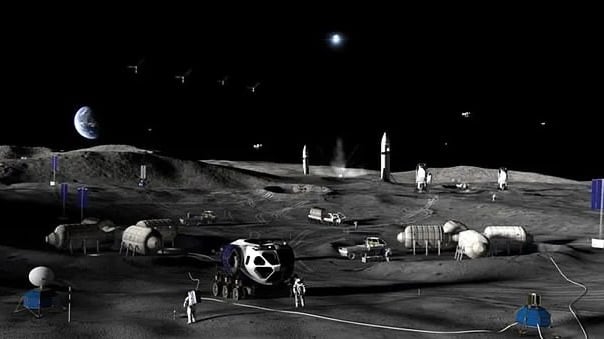
NASA has unveiled a three-stage plan to construct a permanent human outpost on the moon by 2032 at a cost of $20 billion — and experts are now revealing what life on the lunar surface could actually look like, from inflatable tents and nuclear reactors to 3D-printed buildings spread across miles of barren terrain.
NASA Administrator Jared Isaacman laid out the agency’s roadmap at a press conference on Tuesday, describing a phased approach that begins this autumn and culminates in a full-time inhabited base with regular crew rotations. Between now and 2029, up to 21 robotic lunar landings will deliver scientific equipment and scouting technology, including a fleet of MoonFall helicopter drones and uncrewed rovers tasked with searching the South Pole region for water sources and identifying the best location for human settlement. Between 2029 and 2032, the first astronauts will arrive to establish basic infrastructure, power supplies and habitation. The final phase, from 2032 onwards, will see permanent occupation established.
The most immediate challenge, Isaacman acknowledged, is the moon’s extreme environment. Temperatures swing from around 100°C in the day to -100°C at night, with no atmosphere to moderate the change. Astronauts would face constant radiation exposure, impacts from micrometeorites and clouds of fine, abrasive lunar dust. “There is no atmosphere to moderate these extremes,” he said.
Dr Simeon Barber, a lunar scientist at the Open University, told the Daily Mail that the closest earthly comparison is Antarctic research stations — remote, self-sufficient habitats built from materials carried over long distances to protect their occupants from brutal conditions. But he emphasised that a moon base would require additional protections specific to the lunar environment. “It needs to provide a habitable environment — air to breathe, temperature control to tame the wild day-night changes, protection from radiation and from the very fine, abrasive and toxic moon dust,” he said. Beyond physical protection, he noted that the psychological needs of the crew would be equally important. “The explorers will be living in harsh and stressful conditions, so mental health will be important,” he added, pointing to the need for rest, exercise facilities and personal space as essential components of any successful long-term mission.
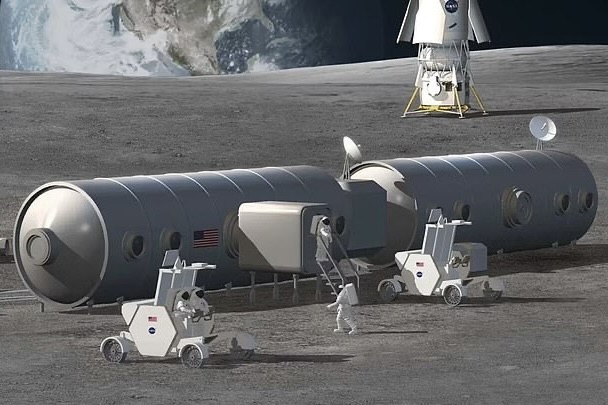
The most likely early solution, experts say, is prefabricated modular structures transported from Earth and assembled on the surface — possibly incorporating repurposed components from the spacecraft used to deliver the crew. NASA has also explored inflatable structures that can be packed small before expanding on arrival. Professor Mahesh Anand, another lunar surface expert at the Open University, told the Daily Mail that the earliest habitable structure would most likely be “a self-inflatable tent made of light but mechanically very strong material, sited in a sheltered place in the vicinity of the lander.” Early modules could then be buried under lunar regolith — the loose surface soil — to provide basic shielding from radiation and meteorite impacts.
The defining infrastructure milestone will come around 2029, when NASA plans to install a small nuclear reactor capable of generating 40 kilowatts of power. The reactor would be launched inert from Earth and activated on arrival, positioned at a safe distance from inhabited areas or buried deep in the regolith due to radiation risk. With a reliable power supply established, astronauts could begin extracting and processing materials from the lunar surface itself — a process known as in situ extraction — dramatically reducing the need to transport everything from Earth. Dr Barber explained the logic: “Earth’s strong gravity field means a lot of energy is required to lift anything off Earth’s surface and then land it on the Moon. So there is a strong argument for living off the land and making use of local resources.”
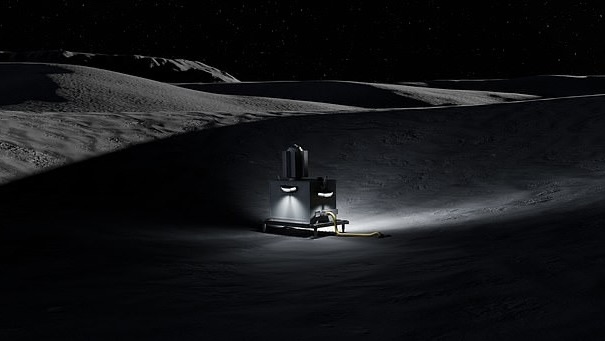
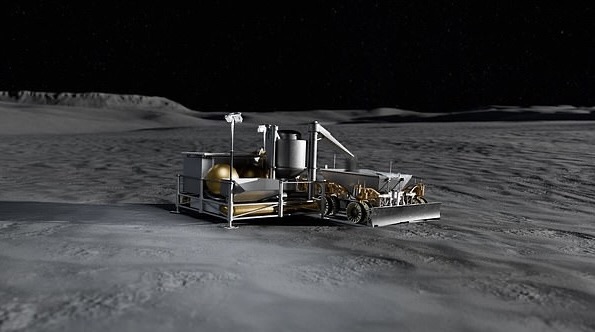
NASA is currently developing robots capable of converting lunar soil into construction bricks, as well as technology to 3D print structures by melting layers of regolith with lasers to form durable buildings. Those methods could ultimately produce more permanent and comfortable habitation than anything transported from Earth.
The layout of the finished base would look nothing like a conventional research station. Rather than a tightly clustered facility, the various requirements — keeping the nuclear reactor at a safe distance, isolating hazardous dust-processing operations, maintaining radio-quiet zones for scientific instruments — would force the base to sprawl across a vast area. The result, experts say, would resemble less a single outpost and more a collection of individual structures dotted across miles of desolate lunar terrain.
