



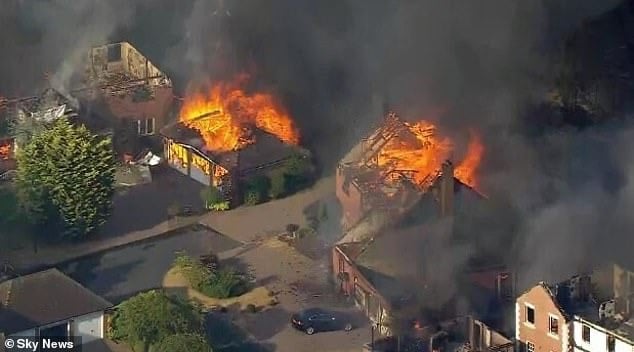
Up to 30 homes were destroyed after a wildfire tore through Stourbridge’s most expensive street near a golf course, forcing residents to flee at short notice, as Britain endured its fifth warmest day on record amid a deepening national drought.
Up to 30 homes have been destroyed after a wildfire swept through one of Stourbridge’s most expensive residential streets, with firefighters battling the blaze near the town’s golf course as drought-hit Britain continued to swelter following its fifth warmest day on record. The fire spread rapidly through dry grass and woodland yesterday afternoon, engulfing homes and forcing residents to evacuate at short notice. A child and three firefighters were among those taken to hospital, while paramedics said 54 people in total were treated as a result of the wider wildfires affecting the West Midlands.
How the fire spread
Around 100 firefighters were deployed to tackle the blaze, which broke out near Stourbridge Golf Course and went on to destroy around 40 acres of land. Golfers reportedly fled the course in their carts as the fire took hold. Drone footage captured smoke-filled skies over the market town, showing the blaze threatening further properties along the edge of a badly scorched field.
Witnesses described flames “jumping from house to house” as residents grabbed what belongings they could before fleeing. Local residents said ash was “raining down” amid smoke described as “very strong.” One local witness said he watched the fire spread rapidly, consuming hedges, power lines and even a fire engine in its path.
Homes on ‘millionaires’ row’ destroyed
Some of the worst-affected properties were on Brunswick Gate, a road previously described by estate agents as Stourbridge’s most expensive street. One home on the road sold for £1.25 million in 2024, while other large detached properties in the area previously sold for £875,000 in 2017 and £900,000 in 2012.
Local Labour MP Cat Eccles said she believed up to 30 homes had been completely destroyed in the blaze. A Stourbridge councillor described “apocalyptic scenes” as the fire tore through the area.
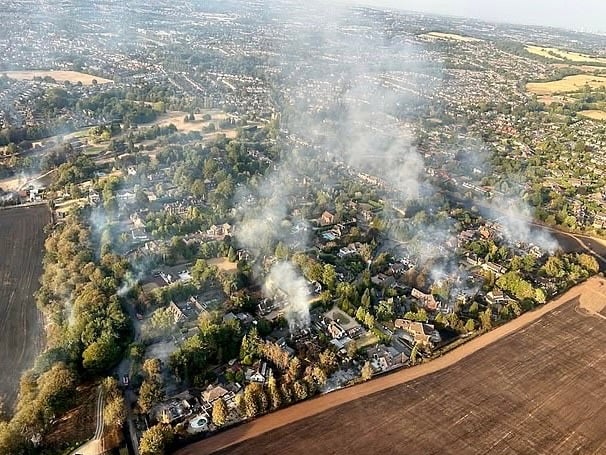
An evacuee’s account
Jane Baxter, whose home backs directly onto the golf course where some of the worst damage occurred, described the moment police told her family to leave. Speaking to BBC Radio 4’s Today programme, she said: “The police knocked our door and said that everyone had to be evacuated quickly because they thought the fire was changing directions, and they didn’t know which direction it was going in. So, it was literally grab what you need and get out. And within about four or five minutes, the police knocked the door again and said: ‘You really have got to get out now’. So, get out we did with the cat and away to go to our son’s house.”
She described watching the flames from her own home before leaving. “Just literally 200 yards away from us, we could see the flames from our bedroom window. They were well above the rooftops of all the houses that had been evacuated, so you could just see the extent of it. It was spreading so fast and going in quite a few different directions across the fields.” She added: “The smell is horrendous at the moment, it’s really a choking smell in the air.”
Fire service response
Chief fire officer Simon Tuhill of West Midlands Fire Service described the Stourbridge blaze as “one of the most significant” incidents the region’s fire service has ever dealt with, after it forced residents to flee as it tore through homes. The service said this morning that crews were “making progress” and were “tactically working across several different areas of the site.”
Tuhill has been in direct contact with Prime Minister Andy Burnham, who released a statement paying tribute to the firefighters battling the wildfires on the ground.
Other heat-related incidents
The wildfires come amid a broader pattern of heat-related disruption across the country. In the Highters Heath area of Birmingham, one man said his mother’s home had also been destroyed by fire, telling reporters she had lost everything, including 100 years’ worth of family photographs.
Separately, a train derailment in Sussex, involving a Southern service near Lewes, saw 150 people evacuated and two people seriously injured; officials said the incident may also have been linked to the extreme heat.
The chairman of the National Fire Chiefs Council said today that the fire service was “under significant pressure,” with 11 major incidents declared across the UK as a result of the ongoing conditions.
Record-breaking heat
The UK reached 38.1C at Kew Gardens in London yesterday, making it the warmest day of 2026 so far and the country’s fifth warmest day on record overall. Yesterday also marked the ninth day this year on which temperatures reached at least 35C, the fourth day at 36C, and the third at 37C, with all three figures representing new records.
Extremely hot weather is set to continue today across south-east England, East Anglia, Lincolnshire and the Midlands, with temperatures expected to reach between 29C and 34C. East Midlands Railway issued an “essential travel only” alert for the third consecutive day, while c2c, Great Western Railway and West Midlands Railway confirmed some services would be cancelled.
Health warnings remain in place
A UK Health Security Agency amber heat health alert remains active across all of England until 9pm tonight, warning of increased demand on health services and a “rise in deaths, particularly among those aged 65 and over or with health conditions.” Officials have urged people to take precautions, including staying hydrated, checking in on vulnerable friends and family, and avoiding the sun during the hottest part of the day.
Drought deepens further
Hampshire, the Isle of Wight and West Sussex have now gone 63 days without rain as the drought intensifies, with Surrey close behind on 58 days and London on 52 days. Around 45 million people in England are now living in drought-stricken areas, while 27 million customers remain under hosepipe bans as many regions continue to wait for significant rainfall.
What the forecast holds
The Met Office said some thunderstorms could reach central and south-eastern England tonight, though there is no meaningful rain forecast for the most severely parched areas. Forecasters are, however, watching an area of low pressure that could influence UK weather from the south-west towards the end of next week, potentially bringing rain.
Met Office chief forecaster Neil Armstrong said: “Friday will be a less hot day, with temperatures forecast to reach highs of 34C in the south-east.” He added: “Into the weekend temperatures could still hover over 30C in the south, with a gradual return to average over the next few days.”
Deputy chief forecaster Steven Keates addressed the prospects for rain directly: “Many people are desperate for some rain to alleviate the impacts of the prolonged dry spell. There is a chance of some thunderstorms developing in central and southeastern parts of England later on Friday into Saturday, however these are very uncertain.”
He added: “A front moving south eastwards across the UK on Monday and Tuesday could bring northern areas some rain but amounts of rain in the south will be small at most and the majority will fall over Northern Ireland and Scotland. The next meaningful rain forecast for these very dry areas could be towards the end of next week as an area of low pressure influences our weather from the southwest. The detail on this will become clearer over the coming days.”
The heatwave itself is expected to continue into this weekend, with temperatures of up to 30C forecast for southern England, before highs ease to around 27C to 28C by the start of next week.
