



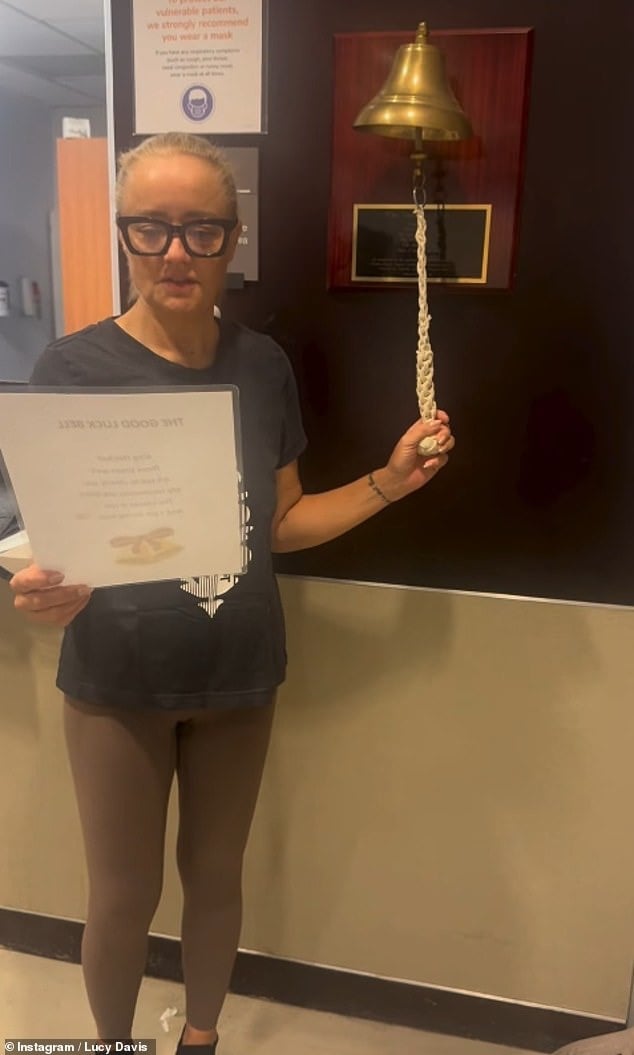
Actress Lucy Davis, best known for playing Dawn Tinsley in Ricky Gervais’s The Office, has revealed she was diagnosed with incurable Stage 4 breast cancer eighteen months ago, telling fans she is determined to live out whatever time she has left “in as fun a way as I possibly can.”
The Office star Lucy Davis has revealed she has been diagnosed with terminal breast cancer and does not know how long she has left to live. The 53-year-old actress shared the news in an Instagram post on Tuesday, explaining that she was diagnosed with Stage 4 breast cancer a year and a half ago, which has since spread to her bones, including her spine, right hip and ribs. Davis said the cancer is incurable and that it is now too late for chemotherapy to be an option.
How the diagnosis began
Davis explained that the discovery began with what she initially dismissed as a minor concern. “The initial lump that I felt, wasn’t a ‘lump’ as such; rather a kind of hard spot. Really tiny. I almost didn’t bother getting it checked,” she wrote. “So I guess I’m saying don’t ignore anything – get everything checked out.”
Living with the diagnosis
In her post, Davis described her approach to the time she has left. “As of now, I’m trying to live out whatever might be left of my life in as fun a way as I possibly can,” she wrote. “I always like to find the teachable moments in anything negative that happens. And cancer has not disappointed in that regard; there’s a lot I have learned from it, and I’m grateful for that.”
She also spoke candidly about the physical toll of her illness. “As some of you will know, the pain can really be something else. Standing and walking for too long a time can be hard, and I need to use a wheelchair sometimes (so if you see me toddling around in one, feel free to give me a push!)”
Humour, she said, has been central to how she has coped. “The thing that has been most vital to me is humour. I asked my friends and family to make fun of me as much as possible (which they’re really good at), and most importantly of all to not treat me like a sick person. There’s nothing that will make you feel more unwell than being treated as if you’re unwell.”
Addressing what lies ahead, Davis wrote that she felt at peace with her situation. “I’m not scared of whatever comes next. I’m at peace with it. I’ll see my Gracie sooner than expected, and for me, leaving my physical body just means going home. Any and all grieving is for my family; it’s far harder for them than for me.”
She confirmed she intends to continue working and campaigning for causes important to her. “I’m still going to keep up all my work for animal rights. It’s so important to me. And I still would like to keep working. I’m perfectly able to do so, and acting is one of the biggest joys in my life.”
Davis closed her post with a message to others facing similar circumstances: “For those of you on a similar journey to mine, I do wish you well. Cancer asks a lot from us, physically and mentally. And we all get to do it however we choose. Much love to you all.”
Career highlights
Davis made her name playing Dawn Tinsley in Ricky Gervais’s The Office, a role that established her as one of the show’s most recognisable cast members. She has since appeared in Chilling Adventures of Sabrina as Hilda Spellman, one of the lead character’s aunts, and played Etta Candy in the 2017 Wonder Woman film. She had also been filming the US comedy series Amy from Amarillo.
A history of health challenges
This is not the first serious health battle Davis has faced. In 1997, she underwent a kidney transplant, receiving an organ donated by her mother, Hazel. She is diabetic and required hospital treatment for kidney failure in 2005, before going on to make a full recovery.
Davis has also spoken openly in the past about her experience with bulimia, which she has said was at its most severe around 2011, during her divorce from fellow actor Owain Yeoman, to whom she had been married for five years. Speaking to The Telegraph in 2017, she reflected on her recovery, saying: “Whatever your body’s meant to be, it will figure itself out… it’s been a journey.” She added that in her 30s, her relationship with food and her body had been very different: “I probably wouldn’t have gone out much. I’d diet for a week and then eat all the food I hadn’t consumed in the previous seven days in a single day.”
Davis, who said she enrolled in Overeaters Anonymous during that period, described gaining a deeper understanding of what her eating disorder had really been about. “I came to realise that all eating disorders aren’t essentially about what you look like. They’re about something much more fundamental. Like any addiction, I suppose. It’s not that you have a drink problem, for example; it’s that you have a problem, which is why you drink. For me, a cycle of throwing up and starving was my solution.”
This is a sensitive topic. If you have been affected by any of the issues raised in this article, support is available. Anyone experiencing eating disorder concerns can contact the National Alliance for Eating Disorders helpline, and those affected by cancer can contact Macmillan Cancer Support for information and support.
