



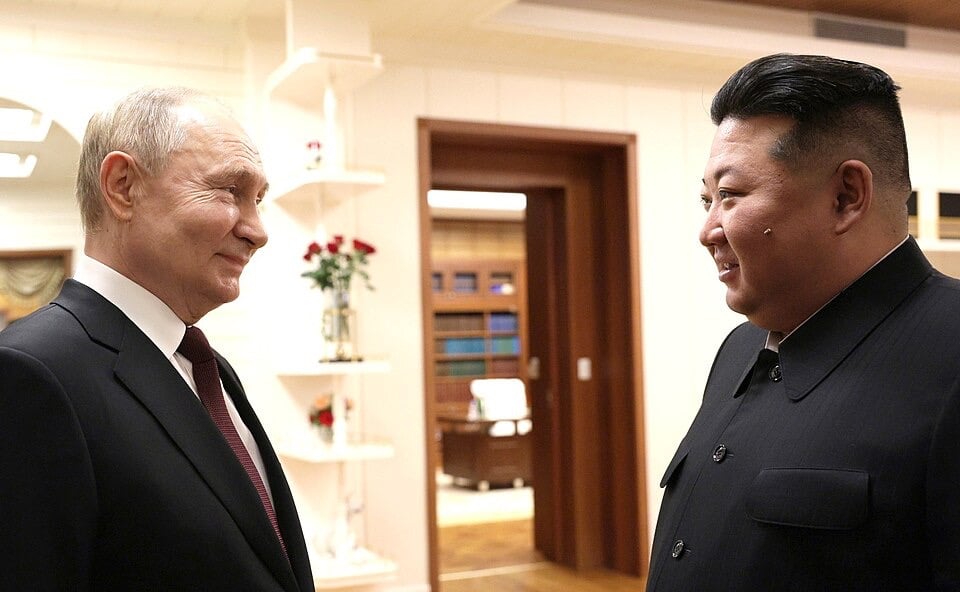
Ukraine’s military intelligence agency has said a North Korean missile unit, potentially equipped with 120 ballistic missiles and six launchers, has begun deploying to western Russia, in what would mark a significant escalation of military cooperation between Moscow and Pyongyang.
A North Korean missile unit has begun deploying to western Russia and could eventually be equipped with 120 ballistic missiles and six launchers for use against Ukraine, according to an official at Ukraine’s military intelligence agency. Andrii Cherniak, of Ukraine’s Main Directorate of Intelligence (HUR), said the unit, comprising around 90 North Korean personnel, is expected to be based in Russia’s Voronezh region as part of Russia’s 112th Missile Brigade. The report emerged shortly before overnight Russian strikes on homes in the eastern Ukrainian city of Balakliia killed three people, as rescuers worked to extinguish fires and clear debris. Neither Russia nor North Korea had publicly confirmed the reported deployment at the time of publication.
Details of the deployment
According to Cherniak, North Korea has already sent a fresh batch of 40 KN-23 and KN-24 missiles, along with accompanying personnel, to Russia. He said Russia expects the eventual deployment to comprise 120 North Korean ballistic missiles and six launchers, though the precise configuration and total missile numbers are due to be finalised at high-level talks scheduled for next month. It remains unclear what specific role North Korean personnel would play in Russian missile operations.
The unit would reportedly be positioned in Voronezh, roughly 300 kilometres from the Ukrainian border. The reported deployment appears to coincide with Russia firing its first two North Korean missiles at Ukraine since last August, according to the report.
If confirmed, this would represent the first known deployment of a North Korean missile unit in direct support of Russian operations, marking a considerable escalation beyond Pyongyang’s previous role supplying weapons and ammunition to Moscow.
The missiles involved
The KN-23 and KN-24 are short-range ballistic missiles that analysts say closely resemble Russia’s own Iskander-M system. Both missile types are designed to fly on lower, manoeuvrable trajectories specifically intended to evade missile defence systems, making them particularly difficult to intercept.
Russia has been firing North Korean ballistic missiles at Ukraine since late 2023. Ukraine, South Korea, the United States and independent weapons analysts have previously accused North Korea of supplying ballistic missiles, artillery shells and rockets to Russia, in what they say amounts to a breach of multiple United Nations Security Council sanctions. North Korea is prohibited under UN sanctions from exporting ballistic missiles or related technology, meaning any transfer of missiles or launch systems would itself constitute a violation of international sanctions.
Deepening military ties between Moscow and Pyongyang
The reported deployment comes against a backdrop of dramatically strengthened military cooperation between Russia and North Korea in recent years. Ties between the two countries deepened following Kim Jong Un’s visit to Russia in September 2023 and Vladimir Putin’s subsequent visit to Pyongyang in June 2024, during which the two leaders signed a Comprehensive Strategic Partnership Treaty that includes mutual defence commitments.
Western intelligence agencies have previously reported that North Korean military personnel have already been deployed to Russia to provide training, technical support and logistics, although both Moscow and Pyongyang have denied many of these allegations. Independent analysts have said that if North Korean personnel were to become directly involved in launching missiles, it would represent one of the clearest examples yet of foreign military involvement in support of Russia’s invasion of Ukraine.
Ukraine’s air defence vulnerabilities
The prospect of an expanded North Korean missile presence poses a particular challenge for Ukraine, which is already short of advanced air defence systems. Russia has sought to exploit this gap by increasing its use of ballistic missiles, which are especially difficult to shoot down owing to their high speed and steep descent onto targets; only advanced systems such as the Patriot are considered reliably capable of intercepting them. Ukraine has repeatedly warned that its stockpile of advanced interceptor missiles is under growing strain as Russia intensifies large-scale ballistic missile attacks.
Rob Lee, a senior fellow at the Foreign Policy Research Institute, a Philadelphia-based think tank, said the North Korean resources posed a significant threat to Ukraine. “Ballistic missile defence is one of Ukraine’s greatest vulnerabilities so any increase in the quantities of ballistic missiles they face will pose a greater challenge,” he said.
The deadly strikes on Balakliia overnight underscored the continuing toll of Russia’s campaign against Ukrainian population centres, even as questions remain over the scale and nature of North Korea’s expanding involvement in the conflict.
