



Harvard University scientists have discovered that a rocky planet known as LHS 1140 b, located 48 light-years from Earth, has retained an atmosphere, marking the first time researchers have confirmed atmospheric evidence on a rocky world sitting within its star’s habitable zone. The finding offers one of the strongest leads yet in the long-running search for conditions capable of supporting life beyond our solar system.
LHS 1140 b was first discovered in 2017, orbiting a red dwarf star within what scientists call the habitable zone, the region around a star where temperatures could allow liquid water to exist on a planet’s surface. With a mass roughly 5.6 times that of Earth and a radius about 1.7 times larger, the planet’s physical similarities to our own have long made it an intriguing candidate in the search for life elsewhere. Until now, however, confirming whether such a planet actually retained an atmosphere, a crucial ingredient for supporting life as we understand it, had remained out of reach.
Why an atmosphere matters so much
Lead author Dr Collin Cherubim explained the significance of the discovery. “An atmosphere is essential for a planet to support life as we know it,” he said. “This is the first time anyone has found an atmosphere on a rocky planet in the habitable zone of another star.” While thousands of exoplanets have been identified over the years, including several rocky worlds located within their star’s habitable zone, scientists have consistently struggled to determine which, if any, of these planets have managed to hold onto an atmosphere.
A different approach to detection
Study co-author Dr Shreyas Vissapragada explained why the research team focused their search on red dwarf stars in particular. “Red dwarf stars present a good opportunity for this kind of search because they are small and cool, so habitable-zone planets orbiting these stars are relatively accessible using the transit method, where we detect tiny, periodic dips in the host star’s brightness every time the planet passes in front of it from our point of view,” he said. However, he noted that traditional methods of atmospheric detection come with their own limitations. “Atmospheric signals from species like water and carbon dioxide – usually found in a planet’s lower atmosphere – are extremely subtle and challenging to detect in these habitable-zone planets, even for flagship observatories like the JWST [James Webb Space Telescope]. So, our team decided on a different approach: to search for helium in the upper atmosphere, where signals can be a bit easier to detect.”
How the discovery was made
To search for helium, the research team used the Warm Infrared Echelle (WINERED) Spectrograph at the Magellan Observatory in Chile, capturing a rare alignment in which LHS 1140 b and a neighbouring planet, LHS 1140 c, both transited their star on the same night. The results were striking: while LHS 1140 c showed no evidence of an atmosphere at all, LHS 1140 b showed clear signs of helium escaping from its upper atmosphere, confirming that the planet has indeed retained one.
“This was clear evidence of an atmosphere on a habitable-zone exoplanet,” Vissapragada said. “It was an absolute thrill to see the transit spectra and slowly realize the implications of what we were looking at.” Researchers believe the atmosphere has likely persisted for more than three billion years, aided by the fact that LHS 1140 b orbits a relatively quiet red dwarf star that produces comparatively few powerful stellar flares, conditions that appear to have helped protect the planet’s atmosphere from being stripped away over time.
A possible water-rich world
Beyond its atmosphere, scientists believe LHS 1140 b could be a water-rich world, with previous observations suggesting it may hold significant amounts of water beneath its atmospheric layer rather than being an entirely rocky planet throughout. Researchers now plan further investigations using the James Webb Space Telescope, which is expected to search for additional gases, including water vapour, carbon dioxide and nitrogen, in an effort to build a clearer picture of whether the planet could realistically support life.
Robin Wordsworth, another author on the study, reflected on how far the field has come. “Twenty years ago we wondered whether other terrestrial-type planets even existed,” he said. “Then we learned they’re common, and found some in the habitable zone. The next question was whether any of them had managed to keep an atmosphere. Now we know at least one has.”
Scientists have been careful to stress that the discovery of an atmosphere does not mean alien life has actually been found on LHS 1140 b. Even so, they regard it as a genuinely significant milestone, given that an atmosphere is considered essential for maintaining liquid water and, by extension, for supporting the kind of life we understand on Earth.
A long history of searching for signs of life
The discovery adds to a decades-long history of scientific breakthroughs and false alarms in the search for extraterrestrial life. British astronomer Dame Jocelyn Bell Burnell became the first person to discover a pulsar in 1967, a rapidly rotating, highly magnetised neutron star that was initially suspected by some to be of alien origin. A decade later, in 1977, astronomer Dr Jerry Ehman detected a 72-second radio signal from the constellation Sagittarius so powerful that he wrote “Wow!” beside his data, a moment that has since fuelled speculation, though never proof, that the signal originated from intelligent extraterrestrial life.
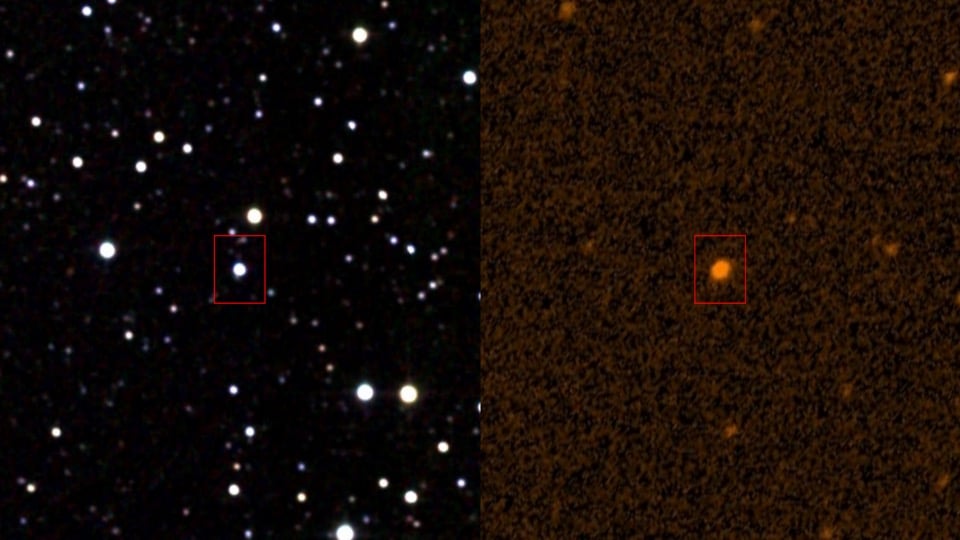
In 1996, NASA and the White House announced that a meteorite recovered from Antarctica, known as Allen Hills (ALH) 84001, appeared to contain fossilised traces of Martian microbes, only for the excitement to fade once other scientists raised concerns about possible contamination and alternative explanations for the structures observed. Tabby’s Star, discovered in 2015 roughly 1,400 light-years away, similarly baffled astronomers with its unusual dimming pattern, once speculated to be evidence of an alien megastructure harnessing the star’s energy, before more recent studies pointed instead to a ring of dust as the likely cause.
In February 2017, astronomers announced the discovery of seven Earth-like planets orbiting the nearby dwarf star Trappist-1, located just 39 light-years away, all believed capable of holding water on their surfaces, with three considered to have conditions favourable enough that life may already have evolved there. Researchers at the time predicted it would take roughly a decade to determine whether life existed on any of those worlds, describing the discovery as “just the beginning.” The confirmation of an atmosphere on LHS 1140 b now marks the latest, and in some ways most concrete, step forward in that ongoing search.
