



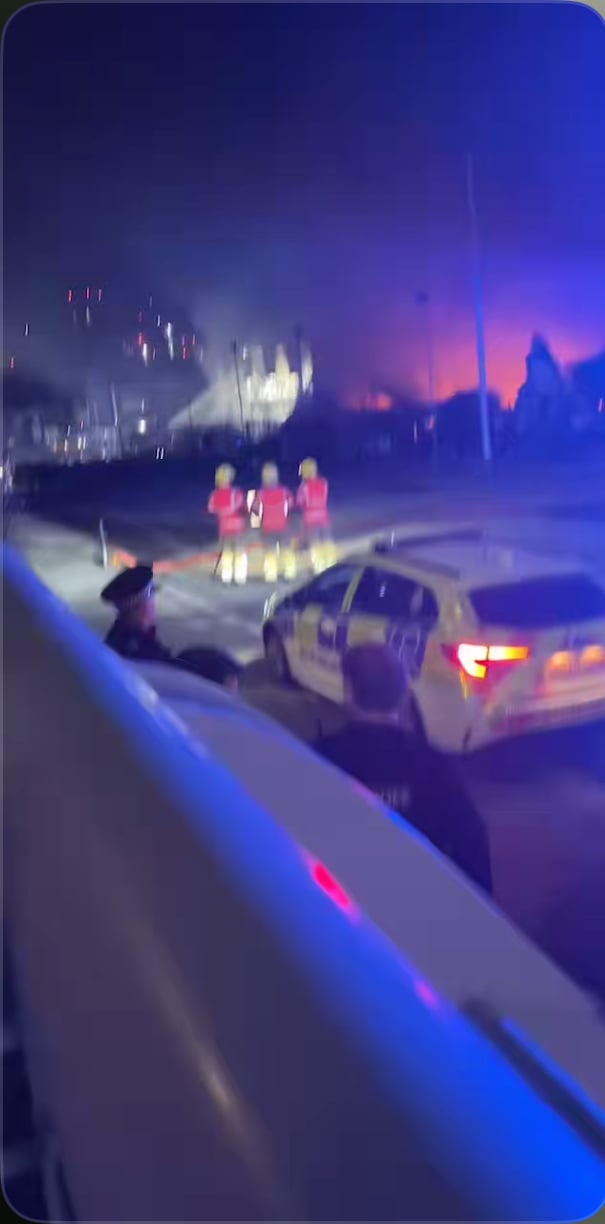
Greater Manchester Fire and Rescue Service deployed multiple crews and specialist equipment to tackle a significant fire in Salford, with cordons put in place and nearby residents advised to keep doors and windows shut as smoke spread across the area.
Firefighters were called to a large blaze in Salford, Greater Manchester, after plumes of thick black smoke were seen rising above the area and visible from several miles away. Greater Manchester Fire and Rescue Service (GMFRS) sent multiple fire engines and specialist crews to the scene, working alongside police to manage the response. Cordons were established to protect residents, workers and motorists, while nearby roads were closed to allow emergency vehicles clear access. The cause of the fire has not yet been confirmed.
Scale of the response
Footage and images shared on social media showed flames engulfing part of the affected building as crews fought the fire from several directions, using aerial ladder platforms and high-pressure hose reels. According to background details on such equipment, aerial ladder platforms can extend more than 30 metres, allowing firefighters to tackle blazes from above, monitor hotspots and, where necessary, carry out rescues from height.
GMFRS is one of the UK’s largest fire and rescue services, covering all ten Greater Manchester boroughs and responding to thousands of incidents annually. For fires of this scale, an enhanced incident command structure is typically put in place, with senior officers overseeing operations, logistics, communications and firefighter safety. Water supplies for major incidents of this kind are often drawn from a combination of hydrants, high-volume pumps and, where needed, nearby open water sources, depending on the duration and intensity of the operation.
Crews faced difficult conditions throughout the response because of the intensity of the flames and the volume of smoke produced. Defensive firefighting tactics were used to stop the blaze spreading to neighbouring buildings, while a safe perimeter was maintained around the structure itself. Specialist equipment was also deployed to deal with hotspots as part of efforts to fully extinguish the fire before crews began scaling back their operation.
Warnings issued over smoke and air quality
With heavy smoke drifting across the area, residents were urged to keep windows and doors closed for the duration of the incident. Those with respiratory conditions, including asthma, were advised to stay indoors until the smoke had cleared. As a precaution, air quality monitoring was carried out while crews assessed the potential impact of the fire on the surrounding community. Where industrial materials or chemicals may be involved in a fire of this nature, environmental agencies can also monitor for particulate matter and other hazardous combustion products as part of standard precautionary measures.
Emergency medical teams attended the scene as a further precaution. As of the time of reporting, no detailed information on injuries had been released, and there were no confirmed reports of fatalities. Officials said further updates would be issued as the incident developed and as assessments of the damage continued.
Investigation to begin once scene is safe
Officials have not said whether the fire is being treated as suspicious, and the exact cause remains unconfirmed. Fire investigators are expected to examine the scene once conditions allow, focusing on how the blaze started and whether structural or environmental factors contributed to how quickly it spread. Such investigations typically only begin once a scene has been formally declared safe, with investigators documenting burn patterns, electrical systems and possible ignition sources to establish a cause.
Because large fires can significantly weaken a building’s structure, structural engineers are often required to assess whether any part of a damaged property is at risk of collapse before investigators or recovery teams are permitted to enter. Incident commanders may also maintain both inner and outer cordons throughout this process, allowing emergency services and specialist investigators safe access while keeping the public at a distance. Fires involving industrial buildings or warehouses can continue to smoulder for hours, or even days, meaning crews may need to return to the scene to dampen down any hidden hotspots and prevent the fire reigniting.
Disruption and community response
The fire caused disruption to traffic and public transport in parts of Salford, with several roads closed for the duration of the emergency response. Motorists were advised to seek alternative routes, and residents were encouraged to follow official updates before travelling through the area. Members of the local community praised the swift response from firefighters and other emergency personnel, with local authorities in turn thanking nearby residents and businesses for their cooperation throughout the incident.
Members of the public have been reminded not to enter the affected area or cross safety cordons as the response moves into its investigative phase, and anyone with information that could assist investigators has been asked to come forward. In the aftermath of major fires, local authorities typically work with building owners and insurers to assess structural damage, environmental impact and disruption to surrounding businesses before any recovery or demolition work begins. Under the UK Fire and Rescue National Framework, neighbouring fire services may also be called upon to provide mutual aid during significant incidents such as this, should additional personnel or specialist equipment be required.
Greater Manchester Fire and Rescue Service said further information would be released as its investigation progresses and as the full extent of the damage becomes clear.
