



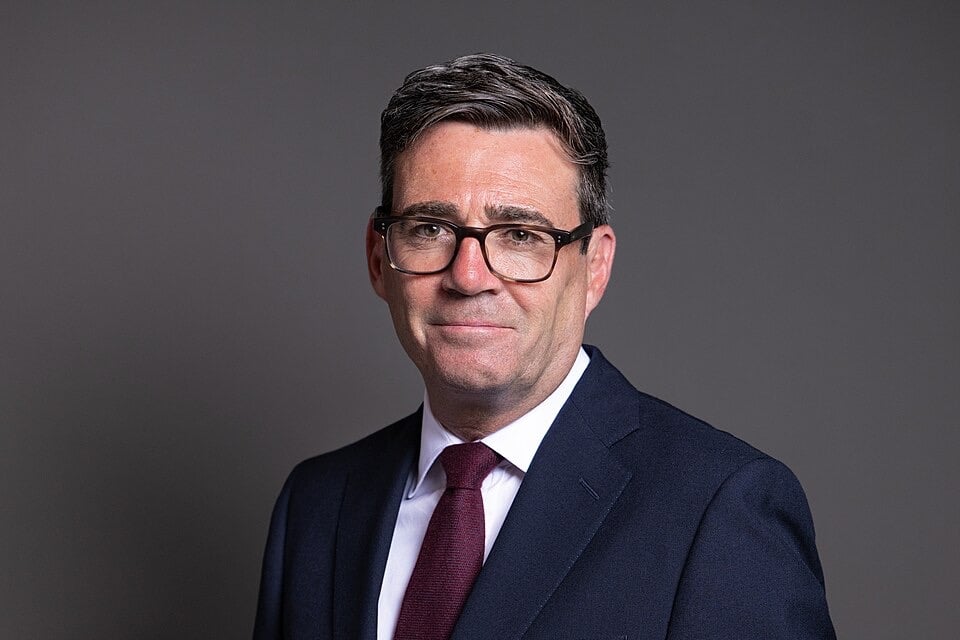
Prime Minister Andy Burnham is pressing ahead with trade sanctions against Israeli settlements in the West Bank, a move set to be formally announced in Parliament next week that risks straining relations with Donald Trump and has already exposed deep divisions within the Labour Party.
Andy Burnham has been left bracing for a row with Donald Trump after pushing ahead with plans to impose sanctions on Israel. The Prime Minister, who also risks a backlash from within his own party, is fast-tracking a trade ban targeting goods produced in Israeli settlements in the West Bank. Foreign Secretary Ed Miliband confirmed the sanctions form part of what he described as a “comprehensive reset” in relations with Israel, with the full package expected to be announced in Parliament on Tuesday, 8 September.
What the sanctions involve
The measures are expected to prohibit UK trade in goods produced within Israeli settlements in the occupied West Bank, but are understood to go beyond a simple import ban. Miliband is also expected to announce targeted sanctions against individuals involved in settlement activity, though the precise names and scope of these measures have not yet been made public. The sanctions are not thought to include broader financial restrictions on specific companies or individuals unrelated to settlement activity.
The government has been careful to distinguish these settlement-related measures from a wider boycott of Israel. Downing Street continues to describe Israel as an “important strategic partner” and has said diplomatic and security cooperation between the two countries will continue regardless of the new measures.
A practical challenge for officials
One significant obstacle facing the government is how to reliably distinguish goods produced in settlements from those produced elsewhere in Israel. Officials have acknowledged that tracing supply chains in this way could prove complicated, and that the measures could potentially have unintended consequences for Palestinian workers and businesses operating within the settlements themselves.
What triggered the escalation
The immediate trigger for the government’s move is Israel’s E1 settlement project, where plans have advanced for roughly 1,200 new homes. Britain argues the project risks effectively cutting the West Bank in two, undermining the possibility of a future Palestinian state. Miliband has repeatedly said Britain will not accept actions that undermine the two-state solution, and has promised a “comprehensive reset” of UK policy toward Israeli settlements as a result.
Israel’s response
Israel has already threatened to retaliate before the British package has even been formally announced. Foreign Minister Gideon Sa’ar said Israel has “tools” to respond and warned that Britain would come to regret imposing the sanctions.
The dispute has also drawn an unusually sharp intervention from US Ambassador to Israel Mike Huckabee, who accused the British government of “Jew-hate” over its approach to Israel, an accusation Downing Street has completely rejected.
The Trump dimension
Burnham informed Trump of his plan to impose sanctions on Israel during a phone call on Monday night. A No.10 spokeswoman said: “On the Middle East, the Prime Minister set out the UK’s commitment to working towards peace and security in the region, stressing the importance of the Two-State Solution, the reopening of the Strait of Hormuz, and ensuring that Iran never acquires a nuclear weapon.” The UK-Israel sanctions issue is therefore being discussed against the backdrop of a much broader UK-US strategic relationship, and the White House is now expected to issue a statement criticising Burnham’s decision.
There is a further potential source of tension with Washington. Trump has recently indicated that the US position on the Falkland Islands is under review, at the same time as Britain is taking a more independent line on Israel, prompting concern among some British commentators that Trump could use other areas of foreign policy to pressure Burnham over the sanctions decision.
Divisions within Labour
Labour MPs have been left divided over how to respond to events in the Middle East. MPs connected to the Labour Friends of Israel group have warned that the trade ban risks becoming a “de facto boycott” of the world’s only Jewish state. One Labour MP told The Telegraph: “The risk is that what are intended to be targeted sanctions could have quite messy knock-on implications. It will end up with a boycott of most stuff from Israel.”
Support for the measures within the parliamentary party is nonetheless substantial. A parliamentary campaign in June recorded 141 Labour MPs backing a full ban on trade with Israeli settlements, while a cross-party tally put the total number of MPs supporting a ban on settlement trade and financial dealings at 238, including 63 Liberal Democrats and MPs from several smaller parties. Recent polling has also found that roughly half of Britons support banning trade with Israeli settlements, compared with around 16% opposed, suggesting the government’s position is more closely aligned with parliamentary and public opinion than some critics within Labour Friends of Israel might suggest.
The measures could become a further flashpoint at Labour’s upcoming party conference, where activists are expected to push for broader sanctions and potentially a significantly wider trade and arms embargo against Israel.
A wider European context
Britain would not be acting entirely alone in taking action against settlement trade. Spain, Ireland, Belgium and the Netherlands have already taken, or are actively pursuing, similar measures. Even so, the UK’s move carries particular significance given that Britain remains one of Israel’s major Western allies, including in defence and intelligence cooperation, and continues to participate in the international F-35 programme through which Israel receives aircraft components. Annual trade between the UK and Israel is worth around £6.2 billion, meaning that even measures formally limited to settlements could carry broader diplomatic and commercial consequences.
What comes next
The announcement is set to be made while Labour simultaneously fights a by-election against the Green Party in Holborn & St Pancras, adding to the political pressure surrounding the decision. It is worth noting that the measures currently being prepared do not amount to a blanket sanctions regime against the Israeli state; the central, confirmed proposal targets economic activity connected specifically to settlements, though the government is also considering targeted measures against individuals and organisations involved in settlement expansion. Even so, the shift represents a substantially tougher stance than that taken by the previous government, marking a move from condemnation of settlement expansion toward concrete economic consequences, while still stopping short of a comprehensive boycott of Israel.
