



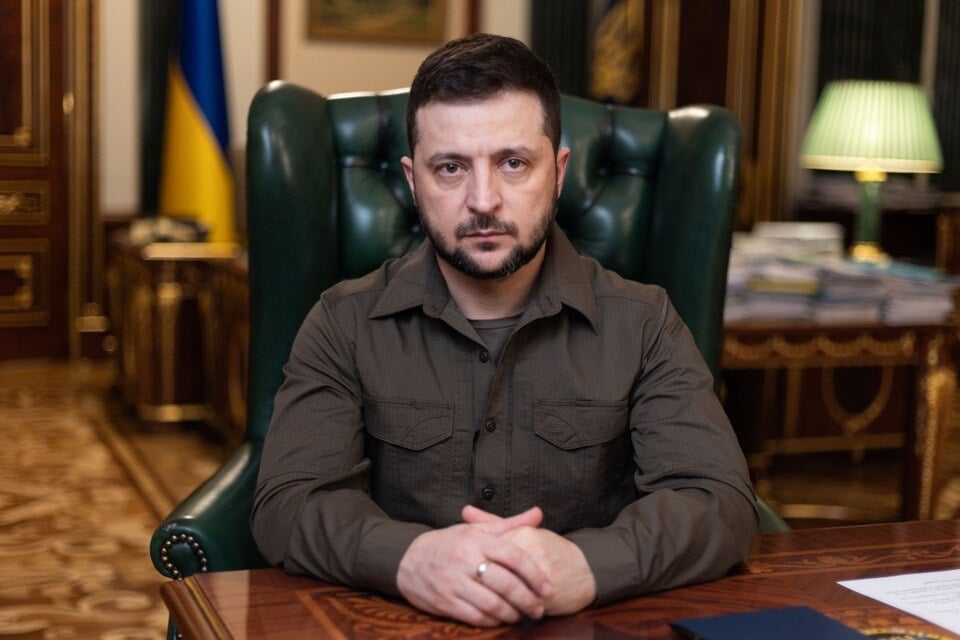
The Ukrainian president, visiting London, says the United States and SpaceX knew what they were doing when the satellite service was restricted overnight, and warns that “people will die”.
Volodymyr Zelensky has said he feels betrayed by Donald Trump after Ukraine’s military reported that Starlink, the satellite communications system produced by Elon Musk’s SpaceX but managed by the US government, stopped working at speeds above 100mph. The Ukrainian president, who is in London, accused his US counterpart of picking the other side after more than four years of war. He made the remarks ahead of a meeting with Prime Minister Andy Burnham in Downing Street. The cause of the restriction has not been established.
‘A pity that we are losing a strong partner’
In a TV interview before the Downing Street talks, Mr Zelensky was asked whether the sudden restriction was deliberate and whether he felt betrayed. “Really, yes … but it’s a little bit more complicated than just my emotions or my feelings,” he said. “It’s a pity that we are losing, we are losing a strong partner.”
Speaking to Piers Morgan, he said: “I am sure they knew what they did, absolutely. Because it was 1am at night, Starlink was blocked by SpaceX and the United States.” He added: “This decision will bring a lot of human losses … Of course, people will die.” He called for access to be restored, arguing that continued restrictions could lead to Ukrainian casualties.
What the restriction has affected
Overnight, Ukraine’s military reported that Starlink no longer worked at speeds above 100mph, with no explanation given. That rendered most of the drones Ukraine uses to strike behind the front lines inoperable. It later emerged that the restriction also affected the most effective air defence system against the Russian jet-powered attack drones bombing Kyiv.
According to Ukrainska Pravda, which spoke to four front-line sources, one commander supplied footage of two Ukrainian drones losing satellite connection mid-flight. The military’s 7th Rapid Reaction Corps reportedly described intermittent disconnections of about 10 to 20 seconds when equipment exceeded the speed threshold, forcing some units to abandon planned missions. The restriction appears to hit Starshield, the military-grade service, more than ordinary Starlink connections.
Ukrainian volunteer Serhii Sternenko said on 14 October that some operators were being disconnected at only 60 to 70km/h (37-43mph), below the reported 160km/h (100mph) threshold. That lower figure has not been independently confirmed.
Deliberate or technical?
Whether this was a deliberate US decision, a technical limitation or a measure introduced by SpaceX has not been established. Starlink has used speed-based restrictions before to stop terminals operating on fast-moving platforms without authorisation. In February 2026, Ukrainian officials announced co-operation with SpaceX to limit unauthorised terminals used by Russian forces, reportedly including speed limits to stop Russian attack drones from using Starlink. A speed restriction is not the same as a nationwide outage. The question is whether authorised Ukrainian equipment was caught up by mistake or access was deliberately changed. That is an alternative explanation to investigate, not evidence that the latest restriction was accidental.
According to Ukrainska Pravda, Ukraine’s Defence Ministry is collecting information from affected units, testing backup communications and contacting US representatives, NATO partners and SpaceX. It is also assessing disruption to drone interception, reconnaissance and front-line logistics. Polish Foreign Minister Radosław Sikorski has criticised Mr Musk and questioned whether political considerations were influencing service decisions. Poland helps pay for Starlink subscriptions used by Ukraine. A Ukrainian company, Stetman, is reportedly developing a domestic alternative called UASAT-NANO, but there is no reliable confirmation that it can replace Starshield in active operations.
Intelligence sharing
The outage came as Russia launched ballistic missiles at Ukraine without advance warning from the US for a second night. For years, the US has given Ukraine intelligence when strikes were about to take place.
Mr Trump denied on Tuesday that his administration has cut intelligence sharing. Mr Zelensky told US broadcaster NPR, in an interview aired on Wednesday, that military advisers had received threats from the US that intelligence sharing could be limited in future. On 14 October, NATO Secretary General Mark Rutte said there was no indication that US intelligence sharing with Ukraine had stopped, and the European Commission reported no evidence of a complete suspension. Those statements do not resolve Mr Zelensky’s separate allegation about missing warnings of particular attacks.
Strained relations
Relations were already under strain after the US agreed to buy diesel from Moscow. Mr Trump has demanded that Ukraine stop striking Russian oil refineries, which he has blamed for the high cost of diesel. Most analysts say the closure of the Strait of Hormuz after the US-Israel attack on Iran has had a far larger effect on global energy prices.
The two leaders fell out in the spring of 2025 during a disastrous visit by Mr Zelensky to the Oval Office, where Mr Trump said: “You don’t have the cards” to win the war. A brief pause in intelligence sharing followed, along with a scramble by European allies to calm the row.
