



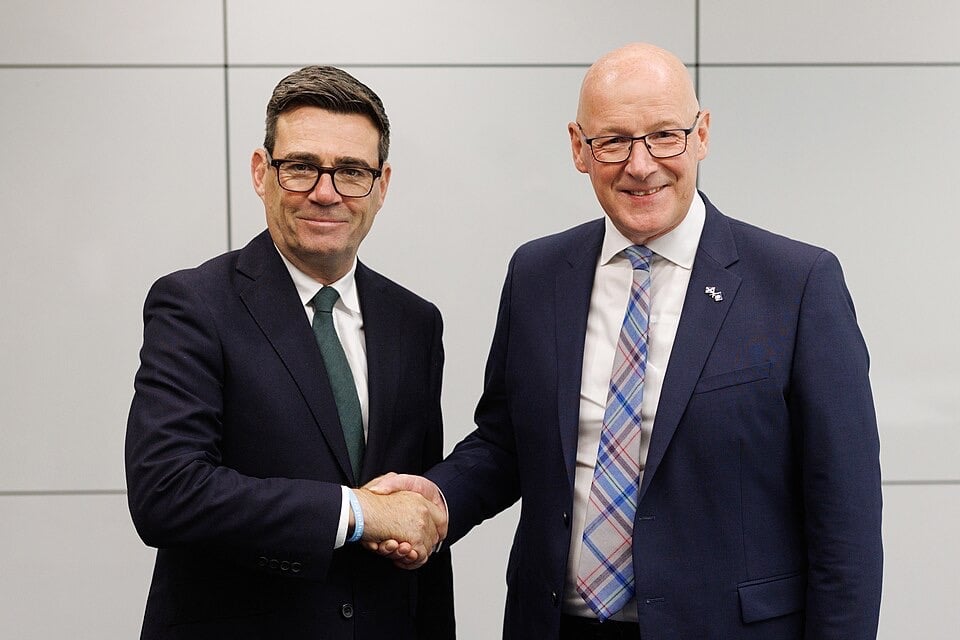
The Prime Minister will visit Lanarkshire on Friday and argue that Scotland’s devolved government is among the most centralised in Europe, while the SNP holds its conference and presses for another independence referendum.
Prime Minister Andy Burnham will invite First Minister John Swinney to work with him on pushing power away from both Holyrood and Westminster. He will make the offer during a visit to Lanarkshire on Friday. Mr Burnham is expected to say that Scotland’s devolved administration is one of the most centralised in Europe, and that giving more decision-making powers to cities and regions should be the next stage of Scottish devolution. The trip coincides with the SNP’s annual conference in Aberdeen.
What Burnham will say
Devolution has been central to Mr Burnham’s agenda since he took office in the summer. He has insisted that giving regional mayors and authorities in England more control will boost economic growth. His plans for Wales, Scotland and Northern Ireland have been less clear, but he has said he will listen to calls for further powers while urging the nations to share more responsibility with local authorities. In Scotland, he is expected to argue that devolving power to cities and regions would help drive reindustrialisation.
Ahead of the visit, he said: “During my first week in office, I told the First Minister that I wanted to work with him to spread opportunities to communities across Scotland’s regions and cities. Through No 10 North, we are rewiring the state and I want to make sure regions in Scotland are fully part of this. This is me making an offer to the Scottish Government. With us working together, there is no limit to what we can achieve for the Scottish people.”
Scottish Secretary Douglas Alexander said: “Devolution has done a great deal, but power was never supposed to stop at the doors of the Scottish Parliament. People in North Lanarkshire, in Fife or in the Highlands know what their communities need better than any minister, whether they sit in London or Edinburgh.” He described the offer as “a genuine one” and said the Scotland Office was “ready to roll up its sleeves”. He added: “Two governments, one goal – good jobs and real opportunity in every corner of Scotland.”
The Scottish Government’s response
Deputy First Minister Jenny Gilruth said it was “very welcome” that Mr Burnham was coming to Scotland to take part in the Scottish Government’s consultation on public service reform. She said Mr Swinney had said for many months that he wished to work with the Prime Minister on this and on further devolution to the Scottish Parliament, and had told him so when they met in July. “Our focus is on delivering stronger and efficient citizen-centred public services that are sustainable for generations to come,” she said.
The independence question
The SNP has its own priorities. Deputy leader Keith Brown has invited Mr Burnham to address the conference, calling it the “perfect and natural place” for him to set out an agreed legal process for independence. On 10 September, Mr Swinney wrote to the Prime Minister asking for talks on a legal mechanism for another referendum, citing remarks in which Mr Burnham appeared to acknowledge that major changes in Scottish opinion could justify revisiting the issue.
Mr Swinney was the only rival party leader widely mentioned in Mr Burnham’s Labour conference speech. The Prime Minister said he was “utterly determined” to prove wrong the First Minister’s prediction that he would be the last prime minister of the United Kingdom.
On Thursday, Ms Gilruth said the SNP would welcome an early general election. She argued that a strong SNP result would make it harder for Mr Burnham to reject calls for another referendum. A Survation poll reported on 14 October, with 2,039 respondents surveyed in September and October, put Westminster voting intentions in Scotland at:
- SNP 34%
- Labour 20%
- Reform UK 18%
- Conservatives 12%
- Liberal Democrats 8%
- Scottish Greens 6%
Polls on independence differ. Survation found 52% for independence and 48% against, More in Common 48% to 52%, and YouGov 47% to 53%.
Within the SNP, a faction calling itself Independence has criticised the leadership for failing to deliver on past commitments. It reportedly wants a constitutional convention, a nationwide Yes campaign and a dedicated civil service unit for independence preparations. The conference agenda includes resolutions on further devolution, abolishing the Scotland Office, and an independent Scotland’s return to the EU.
What already exists
Scotland already has 12 City and Regional Growth Deals. A Scottish Parliament committee report in 2025 identified about £6.3bn in committed funding. Examples include £1.45bn for Edinburgh and South East Scotland, £1.43bn for Glasgow City Region, £1.01bn for Aberdeen City Region, £700m for Tay Cities and £315m for Inverness and Highland. On 8 January 2026, Mr Alexander announced a separate £140m programme for five regions over three years, which predates Mr Burnham’s visit.
On 30 July, the UK Government announced plans to let English mayors keep a share of income tax and business rates raised in their areas. It is not clear whether Mr Burnham plans similar arrangements for Scotland. Separate reporting says Mr Swinney is considering replacing Scotland’s 32 councils with fewer, larger regional authorities and community-level bodies, which could complement or compete with Mr Burnham’s approach. No detailed agreement between the governments has been announced.
