



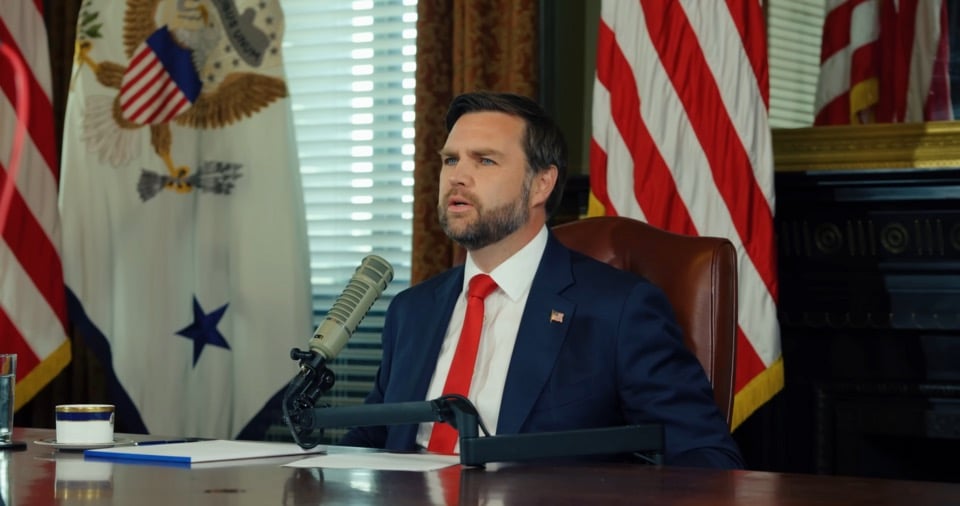
The vice president told a CBS News town hall that his wife and four young children could influence his decision, but that he has not made up his mind.
Vice President JD Vance has said there is “a chance” he will not run for president in 2028, even though he is widely seen as the frontrunner to succeed Donald Trump as the Republican nominee. He made the remark at a CBS News town hall in Michigan. He said his family, including his wife Usha and their four young children, would help shape the decision. Mr Vance has not announced a campaign and has not ruled one out.
What Vance said
“Of course there’s a chance,” Mr Vance said. “We’ve got four little kids, my wife has never loved politics. She loves public service.”
He added: “I think you know you can do a lot of good in this job, and I’ve tried to do as much good as possible.”
He described himself as a “procrastinator” about big decisions. “The way that I think about life, big life decisions — my wife will tell you this: I’m a procrastinator. I hate thinking about it,” he said. He indicated he would give the question more serious thought after the November midterm elections.
Not a change of position
Mr Vance’s reluctance to commit before the midterms is not new. In a CBS Sunday Morning interview on 14 June 2026, according to the research notes, he said he and Mrs Vance would discuss the family’s political future after the 3 November elections. His acknowledgement that he might not run is new in its explicit wording, but the timetable is consistent with what he said four months earlier.
In that interview, he reportedly said he expected Mr Trump to support whatever he decided. He said Mr Trump had raised the subject in private and in public, that he did not usually start those conversations himself, and that the two had not agreed whether he would seek the nomination. Mr Trump has described him as his “most likely” Republican successor, but there is no formal endorsement of a Vance campaign.
The polling picture
The RealClear Polling average puts Mr Vance on 39% in the Republican primary, 15 points ahead of Secretary of State Marco Rubio. Donald Trump Jr is third on 11%. This is more than two years before the election, and early polls measure current preferences, not who will win the nomination. The Washington Post reported on Sunday that Mr Rubio is supportive of Mr Vance’s possible ambitions. Neither man has announced a campaign.
A run would give a bigger political role to Mrs Vance, who has previously acknowledged that she and her husband do not always agree on political issues. The Washington Post also reports that the midterms are becoming an early stage for possible 2028 contenders on both sides, among them Ted Cruz, John Kennedy and Rand Paul for the Republicans, and Kamala Harris, Pete Buttigieg, Gavin Newsom, Alexandria Ocasio-Cortez and Josh Shapiro for the Democrats. Campaign activity does not show that any of them will run.
Other moments from the town hall
According to AP and CBS reporting cited in the research notes, Mr Vance was challenged on several issues:
- Iran war: Joey Amor, whose wife, Master Sergeant Nicole Amor, was among six American soldiers killed in an Iranian drone strike on a US site in Kuwait on 1 March 2026, questioned him about military planning and protection of personnel. Mr Vance acknowledged mistakes, including on where troops were stationed, and said he wanted to learn more.
- Immigration: Sister Nancy Sylvester, a Catholic nun, asked about the treatment of immigrants. He said officers sometimes make mistakes and that investigations had led to extra training or discipline, but gave no full list of incidents. Another audience member challenged his past language about H-1B workers. He acknowledged shortcomings in his wording but said he was criticising firms that exploit workers.
- Cost of living: A small-business owner said her family entertainment business was struggling, and a voter who previously backed Mr Trump criticised petrol prices linked to the Iran conflict. Mr Vance said recovery would take time and that rebuilding manufacturing was essential, and acknowledged that fuel prices were too high.
- Data centres: A resident complained about noise from one nearby. He said such sites can cause problems, should bring local tax revenue and should not raise household electricity bills.
