



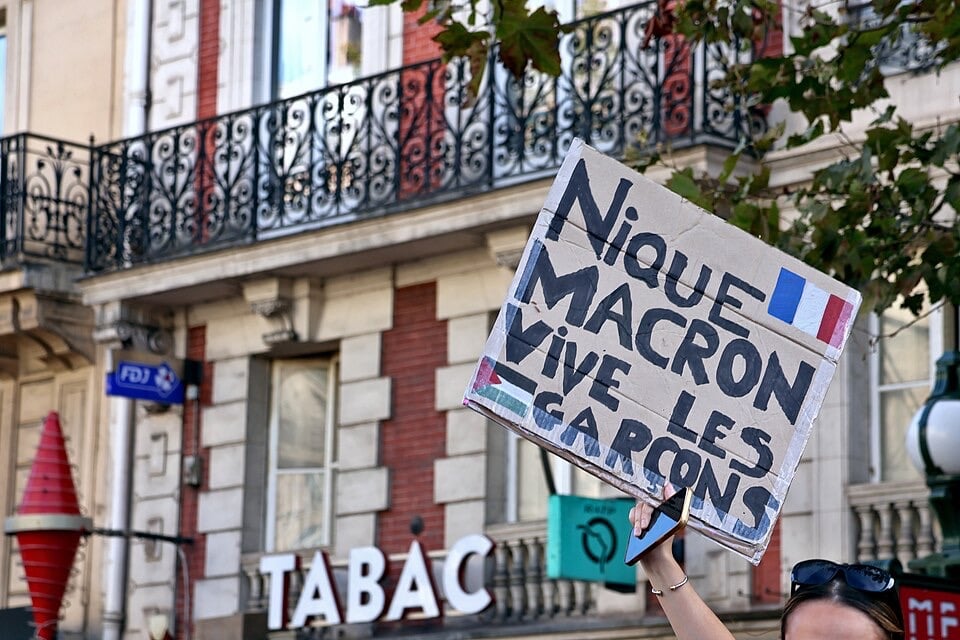
Hundreds of thousands marched against rising living costs and conditions in schools, but clashes, fires and looting broke out in several cities. Sixty police officers were injured.
Violent clashes, fires and looting marred demonstrations across France on Saturday, as hundreds of thousands of people protested against rising living costs and poor conditions in schools. Interior minister Laurent Nunez said about 400 people were arrested nationwide. He put attendance at about 550,000 across 110 marches, while organisers, including the CGT union and student groups, said about 800,000 took part. President Emmanuel Macron said: “There is no place for violence in our Republic.” Some incidents were continuing in central Paris on Saturday evening.
Government response
Mr Nunez described the troublemakers as “extremely violent, radical far-left groups” who sought confrontation with police and targeted public buildings, including city halls and local government offices. He said they had been joined by offenders ready to loot shops. Most of those arrested were adults, he added. He confirmed that 60 members of the security forces were injured, two of whom were taken to hospital unconscious. He described coordinated attacks on police stations and public buildings in several cities, including Marseille and Brest, but ruled out declaring a nationwide state of emergency at this stage.
Mr Macron said in a message on X: “Those who vandalized property, attacked government offices and businesses, and even looted our town halls will be prosecuted and punished.” He added: “We will stand united against those who sow chaos… and who prevent people from peacefully expressing their demands.”
Prime Minister Sebastien Lecornu convened an interministerial crisis meeting at the Interior Ministry on Saturday evening. Mr Nunez and Justice Minister Gerald Darmanin were expected to take part.
Scenes in Paris
In Paris, police fired tear gas and water cannon at people in hoods and masks who threw fireworks, paving stones and other objects at officers in the Place de la Republique. Associated Press reporters saw thick black smoke from burning cars, bicycles, other vehicles and bins. A newspaper kiosk was burned and several shops were looted. Several people were injured. Many metro stations were closed at police request, including around the Champs-Elysees and near the presidential palace, parliament and government offices.
Paris mayor Emmanuel Gregoire warned that damage could be extensive, with commercial premises, public spaces and monuments affected and some streets widely vandalised. No estimate of the cost was available. He distinguished between peaceful protesters and those responsible for looting and vandalism.
Incidents elsewhere
- Saint-Etienne: A 17-year-old protester reportedly lost a hand after picking up a police grenade before it exploded. He was treated at the scene and taken to Saint-Etienne University Hospital. Prosecutor Anne Gaches confirmed an investigation, which has been assigned to the police oversight body, the IGPN. It has not been established whether police acted lawfully.
- Limoges: Masked individuals reportedly attacked the 1883 town hall after the demonstration, set fire to a municipal police vehicle outside, smashed windows and entered the building, where a fire was started. Firefighters were still tackling the blaze at about 8.30pm local time. The extent of the damage is not known.
- Bordeaux: People reportedly entered and vandalised the official residence of the prefect of Gironde, and city-centre shops were targeted. The RAID police tactical unit was called in. Prefect Sophie Brocas condemned the destruction.
- Angers: Authorities confirmed intrusions at the city hall and the Maine-et-Loire prefecture. About 10,000 people took part in the demonstration, and local authorities accused 300 to 400 of vandalism. A fire in a prefecture mailroom was put out by a staff member, the town hall entrance was badly damaged, and police defended a local station against an attempted intrusion. Mayor Christophe Bechu warned repairs would divert public money from other priorities.
- Toulouse: Police estimated the turnout at 32,000, unions at 80,000. Four senior union representatives were reportedly injured and evacuated as clashes escalated. Place du Capitole was cordoned off after reports of fire, and barricades, burning bins and shop damage were reported. Unions criticised police tactics, and the mayor accused elements of the left of tolerating violent groups. Neither is an established account of responsibility.
Spread to Belgium, and what is next
Reuters reported that demonstrations in Brussels were partly inspired by events in France. Several hundred protesters gathered, police used tear gas and water cannon, and some overturned a car. Students protested over education costs and changes they feared could limit university access. There was a separate protest in Liege. The Belgian protests had their own domestic causes and are not an organised extension of the French movement.
The movement began in September with student protests over teacher shortages, overcrowded classrooms, deteriorating buildings and university admissions. By October it had grown to include workers, pensioners, environmental campaigners and some Yellow Vest supporters. The CGT and other unions are preparing another national strike and demonstrations on Thursday 5 November, demanding higher wages and pensions, protection of public services and opposition to proposed spending cuts. That plan predates Saturday’s unrest, and the CGT called for peaceful mobilisation to continue.
