



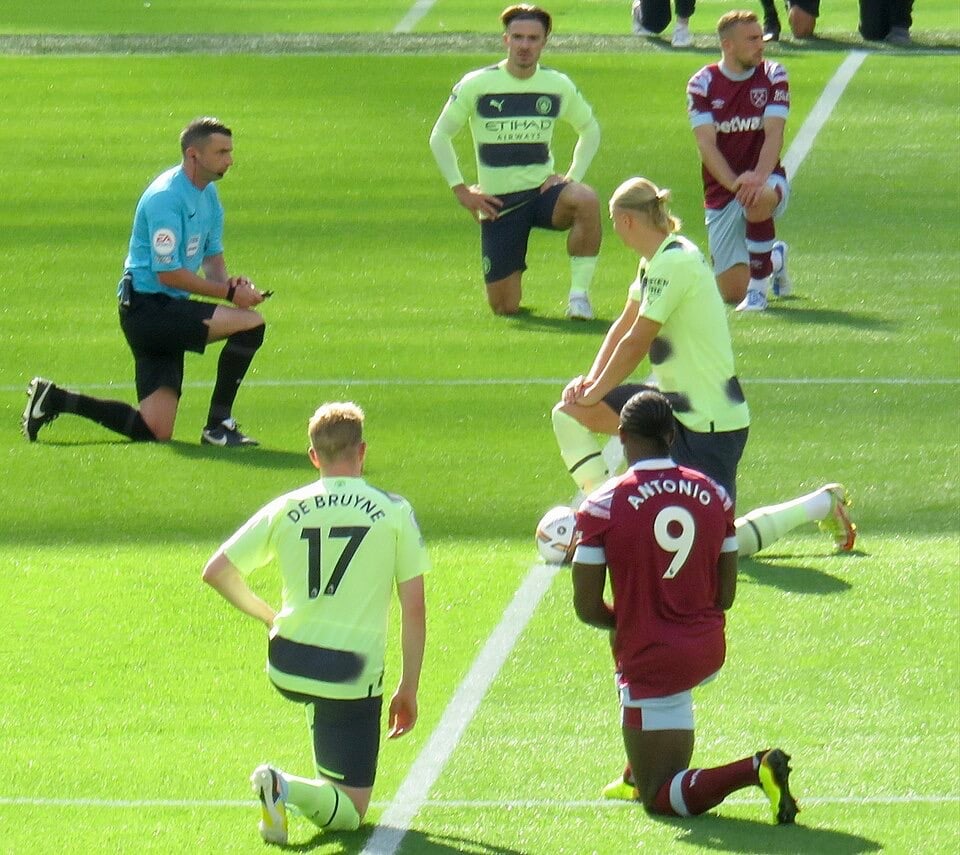
Marc Guehi says he has not knelt “for a while”, but still claps, as he suggests the campaign should “move along”.
Premier League clubs took the knee this weekend for the first time this season as part of October’s No Room for Racism campaign. Six players across five clubs chose to stay standing during the pre-match gesture. Manchester City defender Marc Guehi, one of the six, said he now claps instead, and that football should “see how we can move the campaign along”. The campaign’s match rounds run from 17 to 25 October.
The six players
The players who stood were:
- Tyler Adams (Bournemouth)
- Rayan (Bournemouth)
- Dominic Calvert-Lewin (Leeds)
- Issa Diop (Ipswich)
- Marc Guehi (Manchester City)
- Ainsley Maitland-Niles (Everton)
Only Guehi and Calvert-Lewin, through his manager, have explained their position. The other four have not commented publicly, so it would be wrong to read their choice as opposition to anti-racism efforts. No sanctions have been announced. The Premier League says taking the knee is led by the players, and that it supports whatever stance they choose.
What Guehi said
Asked whether the gesture had lost its impact, the England international told reporters ahead of City’s Champions League game: “I haven’t been taking the knee for a while now. I always clap, just because of what that actually signifies.”
He added: “I don’t think it’s necessarily a football issue, I think it’s a wider societal issue and football is just that beacon of hope to try and get the message out. The message is still there, which is great. More can always be done. I think we should see how we can move the campaign along.”
According to the Associated Press, he suggested working with the Professional Footballers’ Association and the Premier League on how the campaign develops. He did not announce a new initiative or call for the campaign to end.
Leeds manager Daniel Farke explained Calvert-Lewin’s position: “Dom is more or less like, ‘no, I don’t go down. I show my respect by standing up’. Every individual is different and shows respect for this campaign in a different way.”
He added: “It’s definitely a good campaign and a good topic that football and sports, in general, support situations like this because a dressing room is a perfect example of how we should all live together.”
How the gesture has changed
Premier League players began taking the knee in 2020, after the death of George Floyd and the Black Lives Matter protests. Club captains agreed before the 2022-23 season to limit it to selected matches. This season they agreed to kneel during October’s fixtures, which coincide with Black History Month. The Premier League said players would take the knee before kick-off “to show unity against all forms of discrimination” in the next two match rounds.
Wilfried Zaha, then at Crystal Palace, became the first Premier League player to stop in 2021. He said: “I feel kneeling has just become a part of the pre-match routine and at the moment it doesn’t matter whether we kneel or stand, some of us still continue to receive abuse.”
The Lionesses stopped kneeling after England defender Jess Carter received racist abuse online during last summer’s Women’s Euros. Manager Sarina Wiegman said at the time: “Taking the knee, that’s not enough. We have done that for a while. The impact is not good enough, it’s not as big as we think.”
Kick It Out told BBC Sport that taking the knee “still has value in raising awareness of the structural inequalities that exist in football and society”. The charity added: “We can also understand the reasons players might become frustrated with the pace of change.” A 2025 YouGov poll found that a majority of ethnic minority football fans in Britain still considered it important in tackling racism, though most English football fans overall did not.
Record reports of discrimination
Between 2021-22 and 2025-26, reports of discrimination and of racism to Kick It Out more than doubled and reached record levels last season. The charity’s figures, published on 29 July, show:
| Measure, 2025-26 | Reports | Annual change |
|---|---|---|
| All discrimination | 1,744 | up 25% |
| Racism | 792 | up 19% |
| Professional football | 636 | up 41% |
| Grassroots football | 458 | up 41% |
| Online abuse | 650 | up 5% |
Racism made up about 45% of reports, which covered 1,255 separate incidents. Reports of homophobia rose 46%, antisemitism 43% and Islamophobia 88%. These are reports received by the charity, not a full count of incidents, and higher reporting can reflect greater awareness. The Guardian reported 39 cases of anti-immigrant abuse during the season, more than in the previous two seasons combined.
High-profile abuse has continued. In February, Burnley’s Hannibal Mejbri, Chelsea’s Wesley Fofana, Wolves’ Tolu Arokodare and Sunderland’s Romaine Mundle were racially abused on social media over one weekend. A BBC Sport investigation found 22,389 potentially abusive messages across Facebook, Instagram, TikTok and X over another weekend. On 13 October, a Championship match between Millwall and Swansea was halted for about seven minutes over alleged discriminatory chanting at Swansea’s Eom Ji-sung, according to the Guardian. Investigations are continuing.
What else the campaign does
The No Room for Racism campaign began in 2019, with a formal action plan in 2021. Premier League chief executive Richard Masters said: “We are using the reach of our players to send an important message: we are united in the fight against racism.” Players have helped create diversity resources for more than 19,000 primary schools in England and Wales. Liverpool captain Virgil van Dijk said: “I think it’s important for young people to see role models who look like them, to see that they can achieve anything. It doesn’t matter who you are, what you do or how you look.”
A new film featuring players from all 20 clubs was released on 16 October, including Van Dijk, Callum Hudson-Odoi, Ruben Dias and Kaoru Mitoma. Newcastle have also launched an official supporters’ group, The Black Geordie Club. Shola Ameobi, the club’s head of corporate affairs, sits on the Premier League’s Black Participants Advisory Group, which helped develop its anti-racism plan.
