



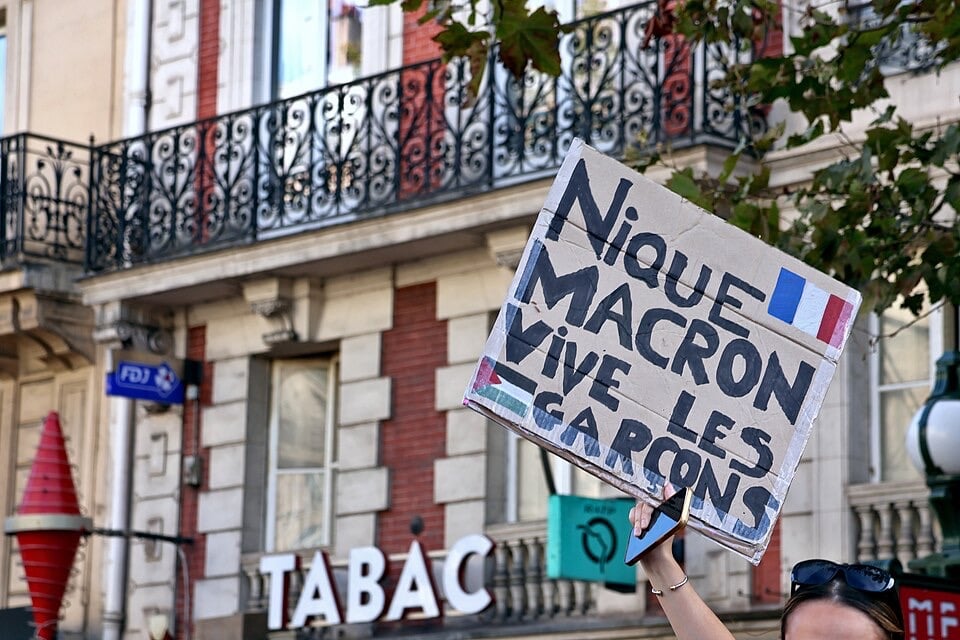
Student leaders say ministers’ education package falls short, as protests enter a fourth week and unions prepare a wider strike on Thursday
French student unions say high school blockades will restart on Monday, when pupils return from a two-week holiday, despite a package of government concessions and a plea from President Emmanuel Macron for a calm return to classes. Pierre Sourzat, head of the Lycéens! group, told broadcaster RMC on Sunday that some schools would be blocked from the first day, with disruption growing from Tuesday. The announcement follows a third weekend of nationwide demonstrations. The unions say the government’s offer does not go far enough.
‘Smoke and mirrors’
“We support all our comrades who are blocking their schools from tomorrow,” Mr Sourzat said. He rejected Mr Macron’s claim that “young people have been heard”, saying: “the president hasn’t listened to us”. He called the proposals “smoke and mirrors” and said: “There’s a bit of polish on the surface, but once you scratch beneath it, there’s nothing there.”
He said the planned replacement of Parcoursup, the university admissions platform long criticised for a lack of transparency, would not fix the shortage of university places. He also said the proposed cut in class sizes was too narrow, because it covers only 10th-grade classes. “We were asking for all year groups,” he said. He added that several regions could not afford to take up the school-renovation loans, which TF1 Info reported as his claim, and acknowledged that more blockades could delay pupils’ education but argued it was a price worth paying for future generations.
What the government has offered
The package, announced on Monday 26 October, was drawn up after what the education ministry said were more than 100,000 contributions to its Agora student consultation. The main measures are:
- Funding: €4bn in loans for renovating secondary schools and €1bn for university campuses.
- University places: 15,000 extra higher-education places by 2028, including 10,000 on advanced vocational diploma courses and 4,000 on technical bachelor’s programmes.
- Admissions: Parcoursup to be replaced by 2028. From the 2027 intake, institutions would have to explain their automated selection criteria, and removing applicants’ school names from decisions is under consideration.
- Grants: student bursaries linked to the cost of living from the 2027 academic year.
- Teachers: 500 extra teaching posts in the 2027 budget and cancellation of planned cuts to secondary posts. Class sizes would be capped at 28 in 10th grade, initially in half the most disadvantaged schools in 2027, and extended in 2028.
An emergency teacher-replacement scheme announced on 8 October is already recruiting 920 teachers. With the economy under pressure and calls to curb debt, the government has little room for extra spending.
A week of planned action
Union Etudiante spokeswoman Sabrine Kharbach said university and high school blockades would take place on Tuesday and Thursday. Ryad Rani, president of the Union syndicale lycéenne, told Le Parisien that pupils should hold general assemblies on Monday and then escalate blockades from Tuesday to Friday, continuing “as long as necessary”. A Lyon university committee has called for a broader day of action on Tuesday 3 November. It wants Parcoursup abolished outright, not just replaced. A student linked to Sud Solidaires told Europe 1 he wanted a general strike from Thursday 5 November, which is an activist demand and not a confirmed nationwide stoppage. Le Parisien reported that the same day will see a separate interprofessional strike involving major unions, over pay, jobs and public services, which students may join.
Saturday’s protests
The Interior Ministry’s 9pm tally on Saturday showed 565 detentions nationwide, down from 768 the previous weekend, with about 70,000 police and gendarmes deployed. Le Monde reported five officers injured in Paris, three of them reportedly by Molotov cocktails, and 79 detentions in the Paris police area. Police also used tear gas and stun grenades in Grenoble after the authorised march ended.
Official turnout has fallen from an estimated 550,000 on 17 October to 410,000 on 24 October and 320,000 on 31 October, about 42% down, according to Interior Ministry estimates reported by AP. Organisers put Saturday’s turnout at around 500,000, including 200,000 in Paris against the authorities’ 70,000. Neither side’s figures have been independently verified. AP also reported protests by youth and others in more than 30 German cities over proposed military service and investment, and in Lisbon over housing costs. There is no evidence the movements are linked.
