



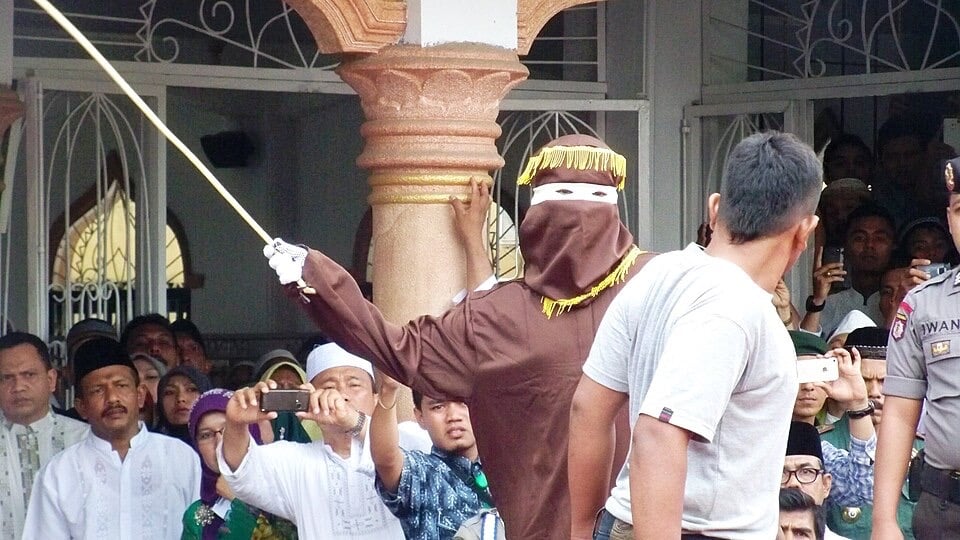
A decade after Remita Sinaga’s punishment in Indonesia’s only sharia province, public canings continue, and the province has revised its Islamic criminal code
Remita Sinaga, a 60-year-old Christian from the town of Takengon, was publicly caned 28 times in April 2016. She is reported to have been the first non-Muslim punished under Aceh’s Islamic law. A court in Central Aceh had found her guilty after police reportedly discovered 50 bottles of alcohol at her stall. It sentenced her to 30 lashes of a rattan cane, reduced to 28 for the time she had spent in detention. Aceh remains the only Indonesian province to apply sharia criminal law, and documented canings there this year include 35 in Banda Aceh alone between July and October.
Why a Christian was caned
Aceh’s Islamic criminal code bans alcohol, gambling, adultery, sex outside marriage, homosexuality, public displays of affection and unmarried men and women mixing. Punishments include caning, fines and imprisonment. The code is intended for Muslims, but non-Muslims can choose to come under it. Researchers say they may also be covered if a Muslim is involved in the offence or if the conduct is not covered by the national criminal code.
Sinaga accepted the punishment because she felt prison would be worse, with poor conditions and little welfare for inmates. A peer-reviewed study in Human Rights Review in 2022 found that non-Muslims in Aceh sometimes chose the sharia courts because cases were quicker and cheaper, not because they agreed with Islamic law.
According to The Jakarta Post and a submission by the Indonesian Institute for Criminal Justice Reform, the caning took place on 12 April 2016 at an arts building in Takengon. Four others were punished at the same event. Prosecutor Lili Suparli said her religion did not exempt her from the rules on alcohol. The Post also reported that the then governor, Zaini Abdullah, had previously said non-Muslims would not be subject to the code.
A revised law
Aceh enacted a revised criminal code on 21 November 2025, Qanun No. 12 of 2025, which amends the 2014 code under which Sinaga was punished. The province said the earlier law did not adequately protect women and children from sexual violence. Under the changes, sex between an adult and a child under 16 is treated as child rape. Adults convicted of adultery can still receive 100 lashes, but unmarried 16- and 17-year-olds now face other sanctions, including up to 33 months’ imprisonment or return to their parents’ care.
Whether the amendments change the position of non-Muslim defendants has not been established.
Canings continue
Indonesian state news agency ANTARA reported that eight people were publicly caned in Banda Aceh in October 2026. Four received 100 lashes each for adultery, three received 21 lashes for unlawful intimacy and one received seven lashes for gambling. Prosecutor Muhammad Kadafi said they were examined by medical staff beforehand and that public punishment was meant to encourage compliance.
The Banda Aceh prosecutor’s office said 11 people were caned on 20 August, including one given 20 lashes for an alcohol-related offence. ANTARA reported 10 more on 17 September. The statistics are not a continuous series. For comparison, Amnesty International said 135 people were caned in Aceh in 2024.
Other non-Muslims
Sinaga was not the last. Reports document two Buddhists caned in March 2017 over cockfighting gambling, a Christian couple in February 2018 for gambling and two Christian men given 40 lashes each in February 2021. The academic study identified 52 non-Muslims in 40 cases in Aceh’s sharia courts between 2016 and March 2020. Those are case figures, not confirmed canings.
Rights concerns
Amnesty International says caning breaches international standards and may amount to cruel, inhuman or degrading treatment. The US State Department has said public canings continued after a 2018 order moving them into prisons, and recorded a man in North Aceh who collapsed during a punishment. Prosecutors say canings enforce final court decisions.
For readers in Britain, the contrast with the rest of Indonesia is stark. Millions of tourists, many of them British, visit Bali, around 2,200 miles from Aceh, where alcohol is available.
