



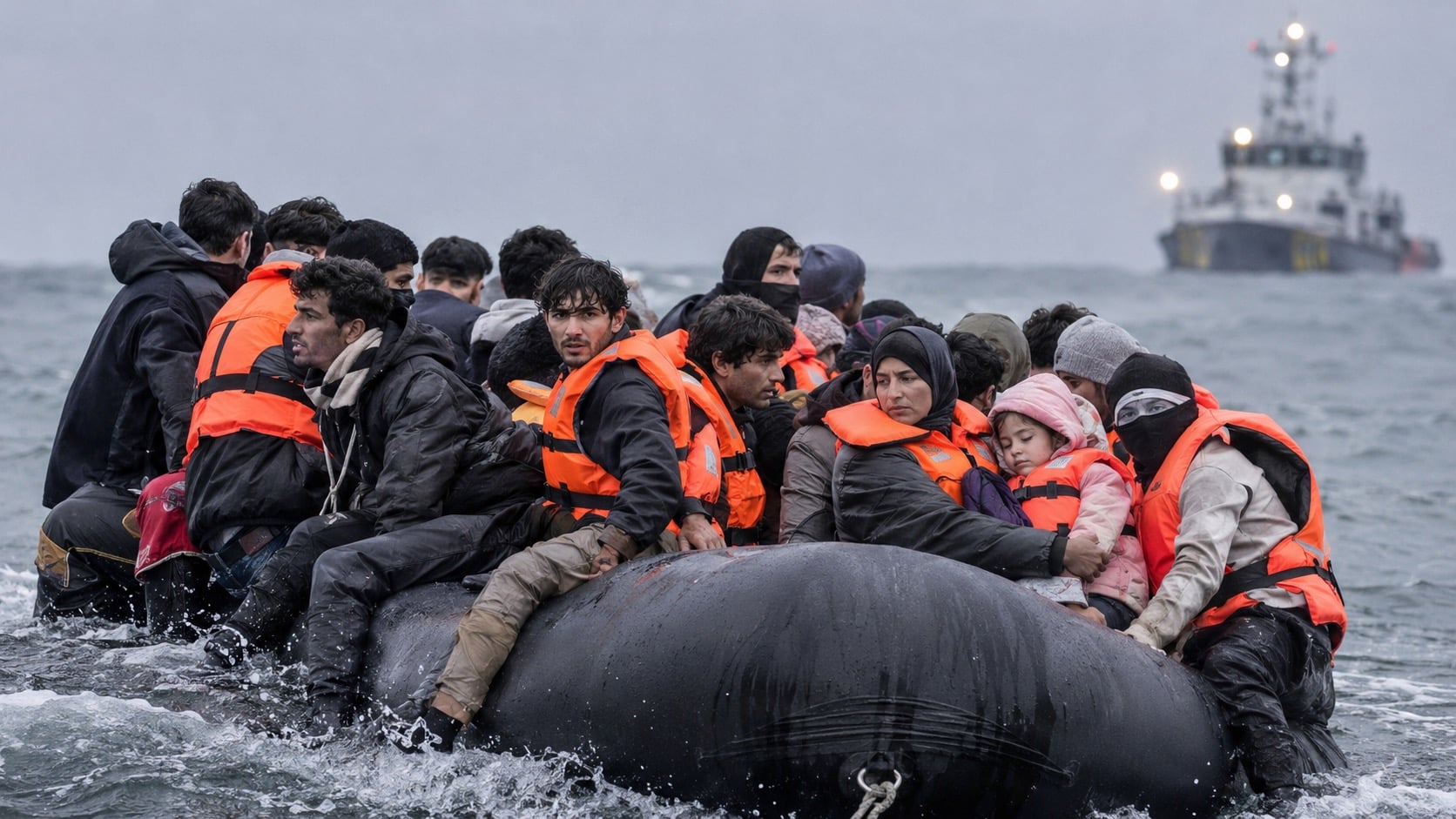
Home Office figures show 16 boats reached Britain between Thursday and Saturday, carrying an average of almost 75 people each, as footage from the French coast shows chaotic scenes at boarding points
A total of 1,193 people crossed the English Channel in small boats between Thursday and Saturday, ending a three-week lull in arrivals, according to Home Office figures. They came in 16 boats, an average of almost 75 on each vessel. The surge appears to have followed a break in the poor weather that had kept crossings at bay. It comes as video from the French coastline shows crowds fighting to board overcrowded dinghies.
Three days of arrivals
The Home Office recorded 263 people in three boats on Thursday 29 October. Friday brought 671 people in nine boats, the largest daily total of the three, and Saturday 259 people in four boats.
The 21-day gap was the longest pause in arrivals recorded so far this year. The Press Association reported that rough seas and strong winds were significant factors, so the lull alone does not show that enforcement had stopped departures.
The department describes its daily numbers as provisional operational data, which can be revised after checks for duplicates and misclassification. The finalised figures appear in the quarterly immigration statistics. The latest weekly publication, for the week ending 31 October, covers only Thursday and Friday (934 people in 12 boats) and does not yet include Saturday’s 259.
Despite the surge, arrivals remain well below last year’s pace. By 30 October, 21,869 people had reached Britain in 2026, compared with 36,954 by the same date in 2025, a fall of 40.8%.
Scenes on the French coast
Video from the northern French coast shows dozens of people scrambling into an inflatable dinghy, with some of those already aboard striking at others trying to climb in. The boat appears to dip towards the water as passengers jostle for space. Other images show men, women and children wading through cold water in winter coats and orange life jackets.
Separate footage published on Friday appears to show a man standing in the water at Hardelot-Plage threaten another passenger with a knife after an argument over access to a boat. He can be heard shouting “I will kill you”. A British man at the scene is heard alerting the coastguard, and another passenger tries to fend off the attacker. The man appears to drop the knife into the water before climbing aboard. It is unclear whether he reached Britain.
French police opened an investigation in July after a body was found on a beach in Calais, examining whether those responsible had escaped to Britain by boat. An Afghan national was also found dead aboard a dinghy in the Channel in August.
Crowded boats
Boats are carrying more people. The average load reached 69.0 people per boat in 2026 up to 30 October, compared with 61.7 across 2025, an increase of about 12%. In September the Home Office recorded 2,683 arrivals in 38 boats, an average of 70.6.
Home Office minister Anna Turley said in a written parliamentary answer on 8 September that smugglers were increasingly using unsuitable boats carrying larger numbers of passengers. She identified capsizing and structural failure as risks to those on board and to emergency responders.
The returns deal
The government’s “one in, one out” agreement with France stopped accepting new cases on 1 October, Sky News reported on 30 September. Official figures show 1,087 people were returned to France between 6 August 2025 and 30 June 2026, while 1,117 entered the UK through the reciprocal route, 30 more than were returned. Sky reported that around 1,500 people had been returned before the pilot ended, with a similar number admitted. Those are reported estimates, not final statistics.
Returns were about 3.9% of the 27,920 small-boat arrivals over the same period, based on the Home Office’s own figures. That is a comparison of scale, not the share of any one group of arrivals who were eventually returned.
The Guardian reported on 1 November that people who arrived before the cut-off are still being detained and returned. It said a flight left on Wednesday 28 October and another is planned for 17 November. The paper also reported that at least seven people returned to France have crossed back to Britain, that the operation had cost at least £78 million, and that nearly a third of removal flights scheduled between July and September were cancelled. It cited returnees who described homelessness, exploitation and threats from smuggling networks. Those are interview accounts and not findings about every returnee, and the £78 million is not a final audited figure.
Smugglers adapting
The Border Security Commander’s annual report for 2025–26 recorded 3,766 disruptions of organised immigration crime, up 46% on the previous year, including 108 classed as major, up 29%. Almost 2,000 suspected facilitators were arrested in the UK and overseas, a rise of 74%. The National Crime Agency and its partners seized more than 500 boats or engines in 2025, which the government estimates could have prevented up to 33,000 attempted crossings.
The same report says criminal networks are adapting their equipment, routes and logistics, and that evidence of lasting change to their operations remains limited. The UK funded an average of 907 personnel on patrols and intelligence work in France over the period.
