



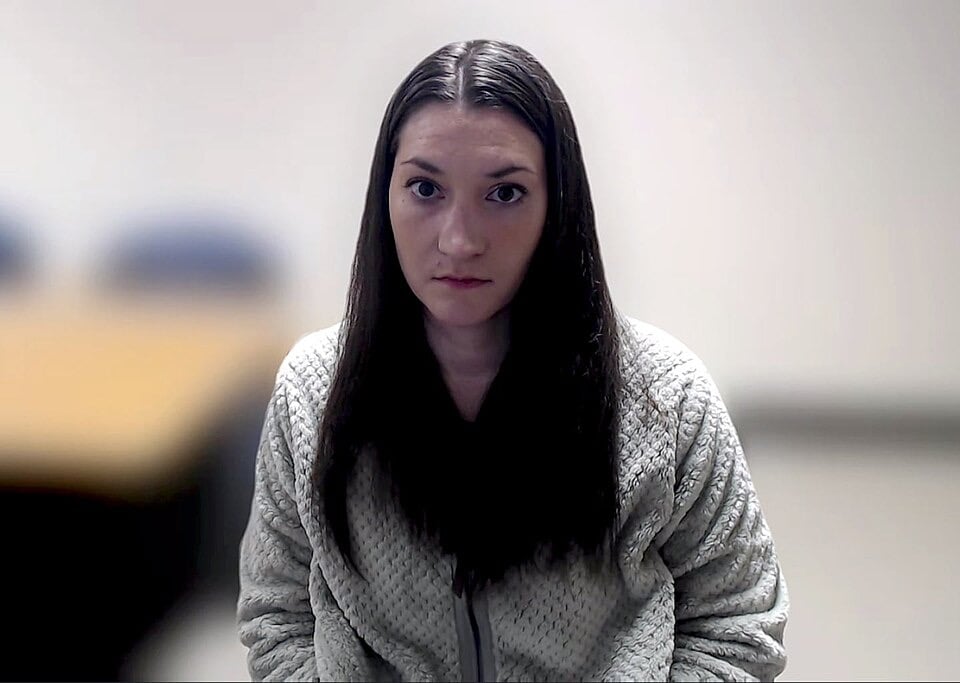
The Massachusetts judge ruled that information emerging after the mistrial cannot be used to challenge whether declaring it was justified. Prosecutors have not said whether they will retry her.
A Massachusetts judge has denied a request by Lindsay Clancy’s lawyer to question the one juror who refused to acquit her of murdering her three children. Michael Desronvil, 48, was the sole holdout on the jury. The other 11 jurors reportedly believed Ms Clancy should be found not guilty because she was suffering from postpartum psychosis when her children, five-year-old Cora, three-year-old Dawson and eight-month-old Callan, died. Judge William Sullivan declared a mistrial on 4 September.
The ruling
Ms Clancy’s attorney had asked for an evidentiary hearing to investigate whether Mr Desronvil lied during jury selection, used a mobile phone improperly or refused to follow the judge’s instructions. The attorney claimed he had lied to the court about earlier domestic violence allegations that would have barred him from serving.
Judge Sullivan ruled on Wednesday that information discovered after a mistrial cannot be used to challenge whether it was justified at the time. He also rejected the defence’s argument that the jury foreperson’s notes were unclear.
According to the Boston Globe, which obtained the five-page order, the judge cited two principles. The need for a mistrial must be judged on what the court knew at the time. Courts also generally cannot examine jurors’ private reasoning or the substance of their deliberations simply because questions arise afterwards. The ruling was not a finding that every allegation against Mr Desronvil was false. It established only that the defence was not entitled to the investigation it sought.
What happens next
Judge Sullivan has not yet ruled on a separate defence motion to dismiss the three murder charges on double jeopardy grounds. Arguments on it are due on 2 November. Plymouth County District Attorney Timothy Cruz has not said how prosecutors will proceed. Legal reporting identifies two possibilities: retrying the first-degree murder charges before a new jury, or reducing them to second-degree murder, in which case Ms Clancy could waive a jury and seek a judge-only trial. Neither has been announced.
A UMass Amherst and WCVB poll of 800 registered Massachusetts voters, conducted between 5 and 12 October and published on 20 October, found 49% in favour of a retrial, 26% against and 25% unsure, with a margin of error of 4.2 percentage points. Public opinion does not decide whether prosecutors may retry the case.
The juror’s account
The Boston Globe reports that court records show a civil restraining order was issued against Mr Desronvil in August 2025 after allegations involving his teenage nephew, whom he was alleged to have pushed and struck during a dispute. The order stayed in force until 11 August 2026, so it was active when he was selected for the jury in July. He also faced a domestic assault charge relating to his former wife in 2021, which was dismissed. Neither a dismissed charge nor a civil restraining order automatically disqualifies someone from jury service. The question raised by the defence was whether he answered selection questions truthfully.
In his first televised interview on 15 October, Mr Desronvil said he had answered the jury questionnaire truthfully, did not use his phone during deliberations except in permitted breaks, and reached his conclusion from the evidence. He rejected suggestions of prejudice against people with mental illness.
Jurors’ accounts of the deliberations differ. Some reportedly said he acknowledged reasonable doubt but still opposed acquittal. In a statement released through his representative on 18 September, he said he had no doubts about Ms Clancy’s criminal responsibility and that his attempts to discuss alternative readings of the evidence had been misinterpreted. The judge’s ruling means those conflicting accounts will not be tested further.
The Associated Press reported in September that a fundraising campaign set up after criticism and threats directed at him had raised more than $289,000, and that his lawyer said he had moved to an undisclosed location for his safety. That figure is historical and has not been updated.
Separate civil cases
Ms Clancy and her former husband, Patrick Clancy, are pursuing separate civil claims over her medical treatment before the children’s deaths. A hearing is scheduled for 28 October at Norfolk Superior Court in Mr Clancy’s wrongful-death lawsuit against medical providers. His suit alleges that inadequate mental healthcare contributed to the tragedy. Her own lawsuit alleges failures in diagnosis, prescribing and coordination of care. The providers dispute the allegations, and no finding of negligence has been made. The civil cases do not decide whether she is criminally responsible.
