



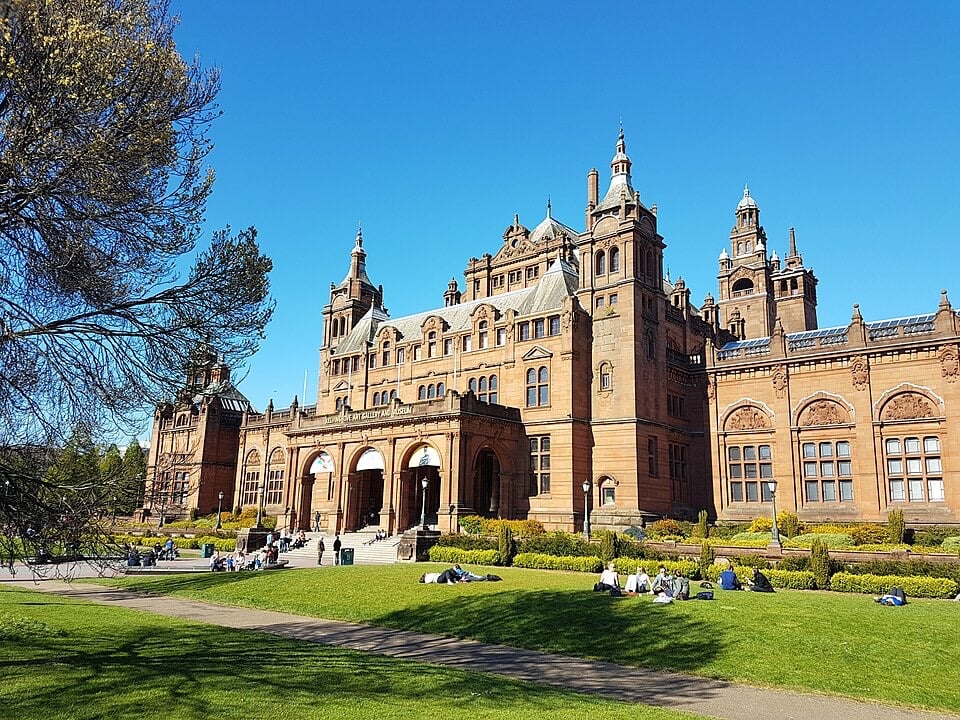
Glasgow Life says the move reflects contemporary museum practice, and that more human remains will be taken off show at its venues.
Kelvingrove Art Gallery and Museum has removed ancient Egyptian human remains from public display, citing the lack of “informed consent from the deceased individual”. The items include a coffin holding the remains of the priest Nekht, a mummified right hand from the Valley of the Kings in Luxor, and a mummified male head and right foot. The change came to light when a visitor noticed that the display that had held Nekht’s remains carried a sign reading: “We have removed human remains from this display as a mark of respect.” Glasgow Life, which runs the museum, says more removals are planned.
Glasgow Life’s position
Glasgow Life said the decision “reflects contemporary museum practice”. It said it is working to remove more human remains from the History Discovery Centre and the Scotland’s Early People gallery at Kelvingrove. It also plans to take a coffin and mummified human remains out of the St Mungo Museum, near the city’s cathedral. Mummies have been on show at Kelvingrove since it opened in 1901. Ancient Egyptians mummified their dead because they believed the body had to be preserved for the soul to live forever in the afterlife.
The decision is an ethical choice by Glasgow Life and not a legal requirement. Museums Galleries Scotland’s guidance accepts that displaying human remains can serve legitimate educational and historical purposes. It recommends museums weigh the views of relevant communities, show respect for the deceased, explain why remains are shown and consider whether the educational aim could be met another way. It also acknowledges that many visitors are comfortable seeing human remains in museums.
The coffin of Nakht
Glasgow Museums’ collections database, which spells the name Nakht, dates the coffin to Egypt’s 12th Dynasty, about 1985 to 1797 BC. It was found in Tomb 130 at Beni Hasan and excavated by the archaeologist John Garstang. It was originally made for a child, and later used for the remains of an adult man, Nakht, whose original mummified body had apparently deteriorated before reburial. The museum identifies him as a sem-priest, a figure in ancient Egyptian funerary ritual.
The coffin entered the collection in 1923, donated by the Glasgow branch of the Egyptian Research Students’ Association as part of the J. May Buchanan Collection. So it was not in the museum when it opened in 1901. The online record already lists it as in storage, which supports its absence from the galleries but does not show when it came off display. A separate 12th Dynasty cedar coffin belonging to Nekhtankh has been shown at Kelvingrove since February 2024 on loan from the British Museum. It is a different object, and it is not clear whether it remains on show after the changes.
What the change does and does not mean
Glasgow Museums holds more than 4,300 ancient Egyptian objects, according to a National Museums Scotland survey, so the removals affect only part of the collection. Ancient Egypt is still promoted on Glasgow Life’s Kelvingrove visitor page, and general admission remains free. No announcement says what will replace the removed remains.
Removing remains from display is not repatriation. No agreement to return these remains to Egypt has been confirmed. Glasgow Life has returned objects before: in January 2023 it sent seven historic items back to India, including a ceremonial sword and a carved stone doorway. It has not said where the removed Egyptian remains are held, though Glasgow’s specialist resource centre stores about 1.4 million objects across 17 storage areas.
Separately, the Department for Culture, Media and Sport announced a review of its 2005 guidance on human remains in museums on 16 September 2026. The review is chaired by Baroness Black of Strome and is due to produce revised guidance in autumn 2027. It applies to England, Wales and Northern Ireland, not Scotland, and is not the cause of Kelvingrove’s decision.
