



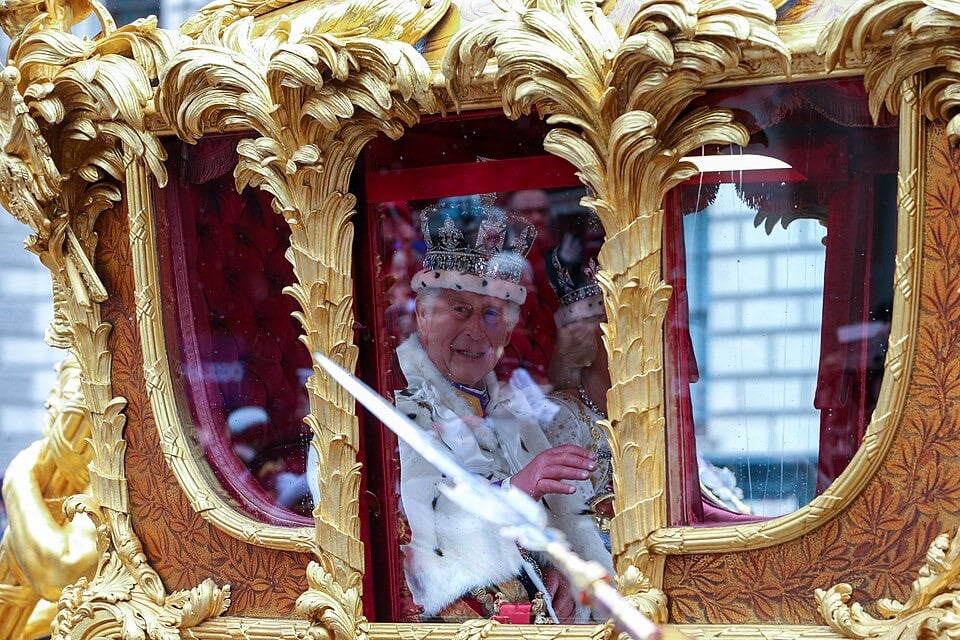
King Charles and Queen Camilla joined French President Emmanuel Macron and Prime Minister Andy Burnham at the British Museum this evening to view the Bayeux Tapestry, marking the first time the nearly 1,000-year-old artwork has ever left France to be displayed in Britain.
King Charles and Queen Camilla viewed the Bayeux Tapestry at the British Museum this evening alongside French President Emmanuel Macron, his wife Brigitte Macron, Prime Minister Andy Burnham, and his wife Marie-France Van-Heel. The royal and political party emerged into the museum’s Great Court after completing a private tour of the medieval artwork, where they were greeted by groups of British and French schoolchildren, along with officials who helped organise the historic cross-Channel loan. The King and President Macron are due to address the crowd later this evening to mark the occasion.
A day of royal and diplomatic engagements
Earlier in the evening, Charles and Camilla hosted the French President and First Lady for private tea at Clarence House. During the visit, the group viewed Fabuleu du Maucour, the horse Macron presented to the late Queen Elizabeth II, which has since served as an outstanding ceremonial horse, including as the Master of the Horse’s charger at Trooping the Colour and as an outrider during recent state visits.
The King, Queen, Burnham and the Macrons arrived together at the entrance of the British Museum this evening, where they were formally received by the museum’s director, Dr Nicholas Cullinan, and its chair, the Right Honourable George Osborne. Burnham and Van-Heel then led the royal party and French delegation into the building.
Touring the tapestry
Inside the Salisbury Exhibition Gallery, the group walked the full length of the embroidered cloth, guided step by step by the museum’s lead curators, who paused at key panels to explain the history stitched into the fabric. Among the scenes highlighted during the tour were the crowning of Harold Godwinson as King of England and his death after being struck in the eye by an arrow during the Battle of Hastings.
The Bayeux Tapestry itself measures 70 metres (230 feet) in length and is roughly 950 years old. It depicts the events leading up to the Norman Conquest of England in 1066, led by William, Duke of Normandy, and this marks the first time the artwork has ever been loaned to the UK since its creation.
The origins of the loan
The cultural agreement behind the exhibition was first negotiated during a formal State Visit to the UK by President and Mrs Macron in July 2025, made at the invitation of the King. During that visit, the British and French governments announced a diplomatic exchange of historic treasures, under which France agreed to allow the Bayeux Tapestry to cross the Channel for display at the British Museum. In return, the UK agreed to send a selection of British national treasures to France on temporary loan, including artefacts recovered from the Anglo-Saxon royal burial site at Sutton Hoo.
The idea for the loan actually dates back further than the 2025 state visit. Theresa May’s government first began discussing the possibility in 2018, but the project was delayed by Brexit and the Covid pandemic before eventually being revived. The current loan has also been made possible by the fact that the Bayeux Museum in Normandy, the tapestry’s usual home, is currently undergoing renovation.
Extraordinary security and public demand
The tapestry arrived in Britain in July 2026 under unusually strict security and conservation conditions, reflecting concerns over the fragility of the centuries-old embroidery. France has insured the tapestry for approximately €960 million, underlining its extraordinary cultural and historical value.
Public interest in the exhibition has already proven exceptional. Ticket sales reached almost £2.5 million in a single day, making it the British Museum’s best-selling exhibition ever, with the museum expecting around one million visitors during its time in London. Public viewing is scheduled to begin on 10 September 2026, and the tapestry will remain at the British Museum until July 2027.
A nationwide cultural programme
The British Government has launched a “Bayeux Around Britain” programme to ensure the cultural event extends beyond London. As part of this initiative, the Stothard Cast, the earliest known replica of the tapestry, will tour communities across England, Scotland and Wales. The government has described the nationwide programme, which aims to reach tens of millions of people, as one of the most ambitious and inclusive undertaken by a UK museum.
A special national history lesson for schoolchildren is also planned for 14 October, using the tapestry as a means of teaching the Norman Conquest and Britain’s shared history with France. The wider cultural exchange carries additional significance given that 2027 will mark the European Year of the Normans, as well as the millennium of William the Conqueror’s birth, with both countries intending to use the programme to highlight their shared heritage.
A visit with wider diplomatic significance
Macron’s visit extends well beyond the cultural sphere. He and Burnham are due to hold talks covering migration across the Channel, trade, energy, Russia’s war in Ukraine and the situation in the Strait of Hormuz. The visit carries particular weight as the first by a foreign leader since Andy Burnham became Prime Minister.
Both governments are presenting the tapestry’s return to Britain as a symbol of renewed UK-France cooperation following Brexit, with the cultural exchange intended to help strengthen wider diplomatic ties between the two countries.
The tapestry’s uncertain origins
Despite depicting William of Normandy’s conquest of England, the tapestry is believed to have been made in England shortly after the Norman Conquest, probably by English embroiderers. It is generally thought to have been commissioned by Bishop Odo of Bayeux, William the Conqueror’s half-brother, although its precise origins and the circumstances of its commissioning remain the subject of ongoing historical debate.
