



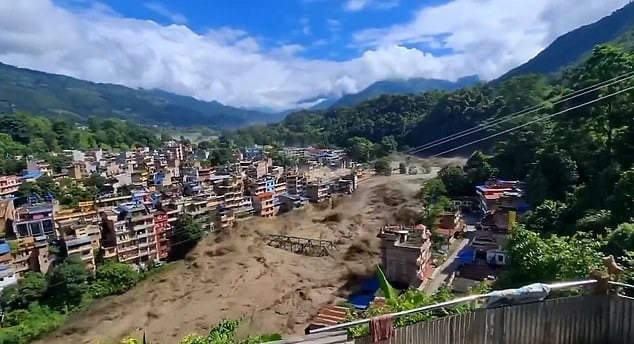
Flash floods and mudslides triggered by an earthquake have swept away buildings, bridges and roads along the Nepal-Tibet border, leaving at least eight people dead and hundreds unaccounted for, including 12 Britons, as rescue teams struggle to reach the worst-affected areas.
Hundreds of tourists, including 12 Britons, are missing after devastating floods and mudslides swept away buildings and bridges along the Nepal-Tibet border. Houses and roads were destroyed across Nepal, while officials in Tibet said they feared “major casualties” in the county of Gyirong, after a mudslide struck a land crossing between the two countries. Terrifying footage captured a wall of floodwater crashing through a town in the mountainous Rasuwa region, sweeping away everything in its path.
What triggered the disaster
At least eight people have been confirmed dead after a surge of water cascaded down the valley along the Bhote Koshi River, following landslides that officials believe were triggered by an earthquake. The Nepal Army has deployed 14 helicopters and disaster response teams for rescue and relief operations, though officials said floodwaters were too high for helicopters to land in the affected areas of Syapru Besi and Timure, within the mountainous Rasuwa district, home to around 50,000 people. Army spokesperson Raja Ram Basnet said rescue helicopters would remain unable to land until the waters recede.
Scale of those missing
Officials said as many as 384 tourists and trekkers are currently unaccounted for, comprising 291 foreign nationals and 93 Nepali citizens. Among those missing are 12 people from the UK, 105 Indian nationals, four from South Africa, 17 from Malaysia, three from the United States, and one each from Australia and the Netherlands. South Korea separately reported that eight of its citizens were unaccounted for, with a further 12 stranded by the floods. The nationalities of nearly 100 more people had not yet been established, while an additional 37 people are believed to be non-resident Indians living in Nepal.
Across the border, Tibetan authorities reported “major casualties,” with people also reported missing in Gyirong following the mudslide that hit the crossing between China and Nepal.
Eyewitness accounts
Describing the moment the disaster struck, one witness from the area told the Onlinekhabar news portal: “It all came suddenly. We heard a loud sound, like a volcano erupting. People started to scream and ran away.”
District administrator Narendra Pariyar told Reuters the scale of the damage remained unclear. “There could be heavy casualties or loss of property,” he said, “but I cannot say for sure now.” Pariyar urged residents living along the banks of the Bhote Koshi river to move to higher ground, pointing to reports that nearby villages and infrastructure project sites had been washed away.
Damage to infrastructure
Around 60 houses in the Trishuli Bazaar area were swept away, with the nearby Devighat also badly affected. Two bridges over the neighbouring Trishuli River were also destroyed in the floods. The disaster additionally damaged the Trishuli and Devighat hydropower projects.
According to Nepal’s energy ministry, 430 megawatts of electricity supply were affected, primarily from hydroelectric projects, equivalent to more than 12% of the country’s total national hydropower capacity of 3.2 gigawatts, according to a Reuters calculation. On the Chinese side of the border, the mudslide struck Gyirong port, cutting off roads, communications and power supplies in the wider Shigatse region.
Government response
Chinese President Xi Jinping called for “all-out” search efforts for those missing, alongside stronger monitoring and early warning systems to help prevent further, secondary disasters.
Nepal’s Prime Minister, Balendra Shah, said police and military personnel were joining rescue and relief teams already on the ground. “Instructions have been given… to move the people living in the lower areas to safer places,” he said. “People along the river are advised to exercise extra caution and remain alert.”
A river with a history of deadly floods
The Bhote Koshi river originates in Tibet before flowing into Nepal’s Trishuli river, which eventually joins the Gandak river in India. A previous deadly flash flood on the same river last year was traced to the draining of a glacial lake, killing nine people and leaving 24 missing after washing away the “Friendship Bridge” linking Nepal and China, disrupting trade and transport between the two countries for months. That earlier flood was caused by the draining of a supraglacial lake in Tibet.
A region increasingly vulnerable to climate change
The wider Himalayan region, which spans Nepal and several neighbouring countries including India, is particularly vulnerable to heavy rainfall, flooding and landslides, as the area is warming faster than the global average due to human-caused climate change. Research has shown that extreme weather events, including heatwaves, heavy rainfall and glacial melt, have become increasingly frequent across the region.
Researchers at a Kathmandu-based research group found earlier this year that glaciers across the wider Hindu Kush Himalaya region are melting at an accelerating rate, with ice loss having doubled since 2000, driven primarily by rising global temperatures linked to climate change.
