



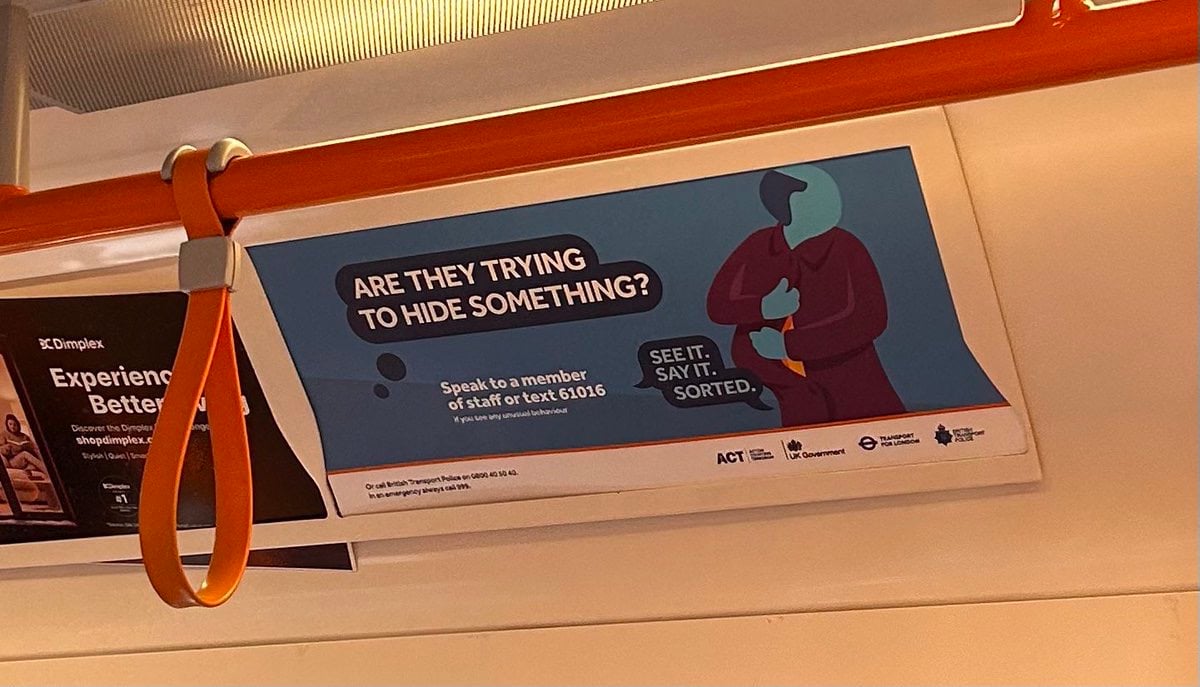
The Department for Transport says the monochrome illustration shows a balding man with a suspicious package in his jacket. Some social media users read it as a woman in a hijab, and TfL’s initial statement has reportedly been deleted.
Transport for London (TfL) has admitted that a genuine government poster was mistaken for illegal flyposting. The Department for Transport (DfT) poster, which shows a figure looking over their shoulder, was widely shared online by people who thought it depicted a woman wearing a hijab. The DfT says the monochrome designs were not meant to suggest or refer to any ethnicity, and show a balding man with a suspicious package in his jacket. The poster is part of the “See it, Say it, Sorted” campaign, relaunched in 2025.
What TfL said
One user on X shared a photograph of the poster and described a “disgusting insinuation” in the campaign. TfL replied: “This poster was not authorised by TfL or our media partner and has been installed without TfL’s permission. Our media partner, our teams, and our contractors have been instructed to inspect trains and remove any unauthorised posters found on our network. This incident has been reported to the BTP as flyposting is an illegal activity.”
According to Creative Bloq, which reported on 26 October, that statement was later deleted. It also said social media users had found earlier publicity showing the same designs, which undercut the suggestion that the poster was unofficial. The research notes could not confirm whether British Transport Police (BTP) has closed the reported flyposting matter, or whether TfL has explained its original mistake.
A documented campaign design
AML Group confirmed in September 2025 that it had developed nine new posters for the DfT’s updated security campaign. They cover scenarios including suspicious behaviour, unattended luggage, people photographing CCTV cameras and people apparently hiding something under their clothing. Advertising-industry coverage that month described a poster featuring a figure in a bulging coat, so the design was not created during this week’s row.
BTP’s current advice asks passengers to report suspicious behaviour such as unattended bags, attempts to enter restricted areas and people who appear to conceal objects under their clothing. It focuses on behaviour and not on ethnicity, religion or faith-related clothing. That supports the DfT’s account of the intended message, though how the illustration was perceived is a separate debate.
Cost and TfL’s involvement
A parliamentary answer dated 28 October 2025, after Conservative MP Richard Holden questioned the DfT, said the first redesign since the campaign’s 2016 launch cost £333,751 plus VAT. That covers the whole refresh and not only this image. A separate £17m announced alongside it was for railway CCTV connectivity, not advertising.
When the DfT announced the posters on 16 September 2025, it included a statement from TfL’s director of security, policing and enforcement, Siwan Hayward, according to GOV.UK. She described the campaign as an important public-safety initiative and said TfL was working with BTP and the DfT on its rollout. That shows TfL’s involvement in the wider campaign but does not prove that its advertising team approved each placement.
The DfT said in November 2025 that operators should display the posters in spaces already set aside for public messaging, and replace them as part of routine maintenance to avoid unnecessary costs or lost advertising revenue. Whether this poster was installed in a designated space, or whether there was an administrative error over its placement, has not been independently resolved.
TfL and unauthorised adverts
In a London Assembly response published on 20 January 2026, the Mayor’s office said TfL does not keep a comprehensive record of every unauthorised advert found on its network, because it would divert resources from maintenance and cleaning. Officials also acknowledged that images of supposed unauthorised adverts on social media can mislead, as some posters are displayed only briefly for photographs or are digitally altered. That does not explain why TfL first called this poster illegal flyposting.
TfL’s 2024-25 Advertising Annual Report shows 19,837 campaigns carried, 760 customer complaints about advertising and 355 complaints about unauthorised adverts, two of which were referred to the Advertising Standards Authority. TfL described illegal posters as a persistent problem and said it routinely instructed contractors to remove them and referred incidents to BTP. Those figures relate to the previous financial year.
