



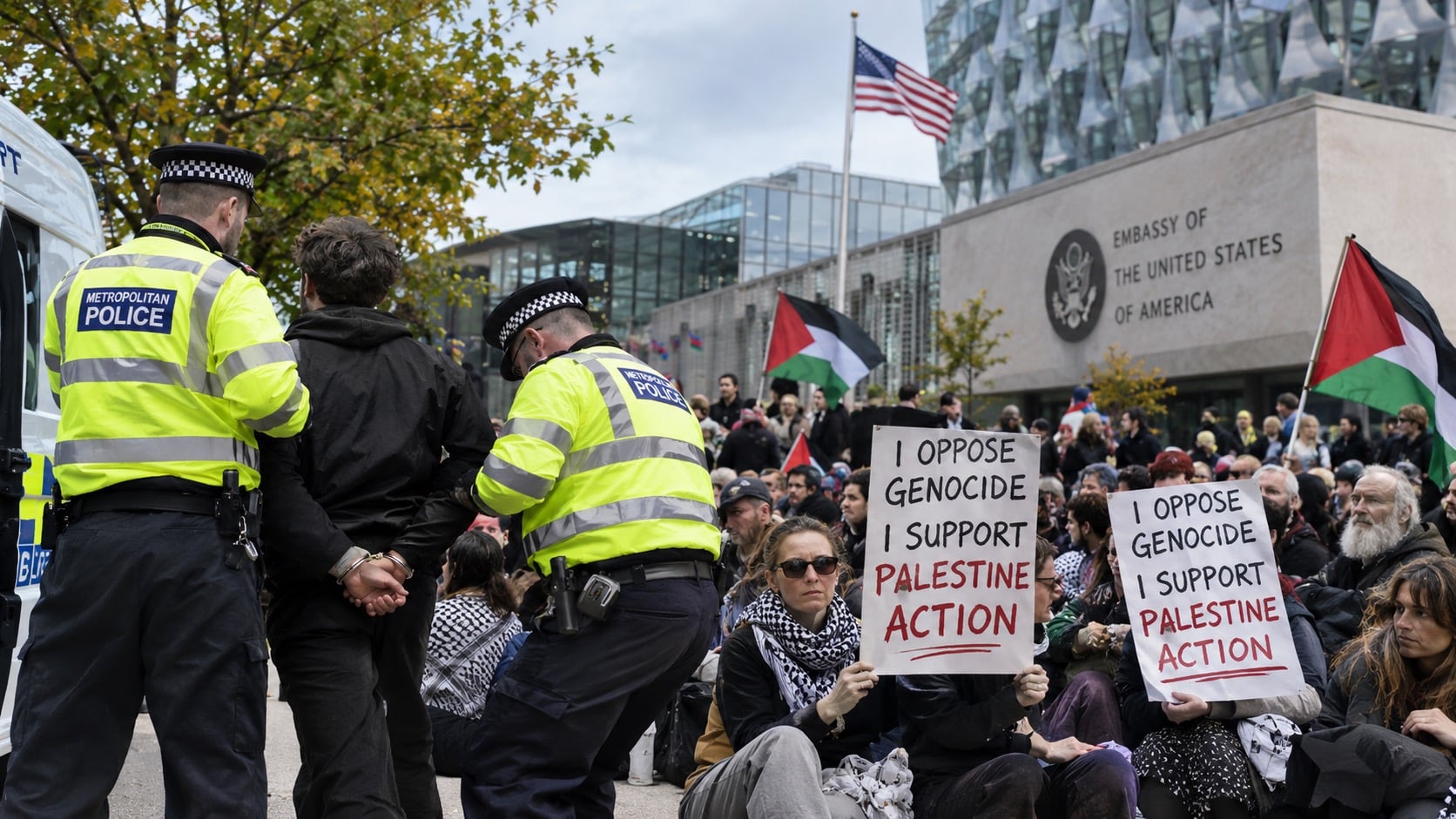
The Metropolitan Police said 139 people had been detained by early evening, as the group’s ban faces a Supreme Court challenge next week
More than 100 people were arrested in London on Saturday at a protest outside the US embassy in support of Palestine Action, which was banned under the Terrorism Act in 2025. The Metropolitan Police said at 6.15pm that 139 people had been detained, most for expressing support for a proscribed organisation, with further arrests expected. Hundreds gathered at the embassy in Nine Elms, many holding signs reading “I oppose genocide, I support Palestine Action”. The demonstration came days before the Supreme Court is due to hear a challenge to the ban.
At the embassy
Officers began arresting protesters one by one shortly after 12.30pm, carrying some who refused to walk. Crowds applauded and chanted “free, free Palestine” as those detained were taken to police vans on Ponton Road, next to the embassy grounds, and then to police stations. Just after 5pm, one protester climbed a tree outside the embassy and held up a placard, to chants from the crowd below.
Organisers Defend Our Juries estimated around 400 people took part, The Guardian reported. That is the group’s figure, not a police count.
Retired lawyer Charles Allison, 75, travelled from Cumbria. He told the Press Association: “I fear for our civil liberties, which are being devalued and watered down, even by this new Labour Government. So I’m dejected, but enthused that there are so many wonderful people protesting.”
Police powers and warnings
Expressing support for a proscribed organisation is an offence under the Terrorism Act 2000. Home Office figures show most Palestine Action cases are brought under Section 13, which covers displaying items in a way that raises reasonable suspicion of support. It carries up to six months in prison and/or a fine of up to £5,000. Some offences under Sections 11 and 12 carry up to 14 years, so not everyone arrested for holding a placard faces that penalty.
On Friday, Commander Adam Slonecki said police would look at the conduct of people organising or helping the demonstration, not only those carrying signs. ITV News reported a Section 35 dispersal order covering the area around the embassy from 8am to 11pm. Defend Our Juries alleged that volunteers and people with blank placards were arrested. That is the organisers’ claim, and I found no independent finding on whether those arrests were lawful.
The US Embassy advised American citizens to avoid the protest and to expect possible road closures and transport disruption.
The Home Office defended the ban after the arrests. A spokesperson told Sky News that the Court of Appeal found Palestine Action had carried out terrorist acts and promoted violence, and that lawful demonstrations in support of Palestinians remain permitted.
Edinburgh
Police Scotland said there were no arrests at a demonstration near the US Consulate at Holyrood in Edinburgh. STV News reported that officers are trying to identify people seen in T-shirts or with banners that appeared to express support for the group. That means action could still follow.
The wider numbers
Home Office figures published on 8 October put arrests linked to Palestine Action at 3,630 in the year to June 2026, 94% of all terrorism-related arrests. Total terrorism-related arrests rose from 234 to 3,867, and women made up 49% of them, up from 14%. By 28 August, 632 people had been charged, 621 of them under Section 13. The official figures say 50 were released without charge and 2,936 were on bail or under investigation, so many cases remain open. Defend Our Juries says more than 4,000 people have been arrested since the ban, a running estimate that covers a longer period than the official data.
The Guardian reported that a similar protest at Labour’s conference in Liverpool in September led to more than 160 arrests or summonses.
The Supreme Court challenge
Five justices will hear Palestine Action co-founder Huda Ammori’s challenge on 4 and 5 November. The High Court ruled the ban unlawful in February 2026, finding it breached the Home Secretary’s own policy and disproportionately interfered with freedom of expression and assembly. The Court of Appeal overturned that ruling in June, and the Supreme Court granted permission to appeal in part on 29 July. The afternoon session on 5 November will be held in private. The court is deciding whether the Home Secretary’s decision was lawful, not whether Saturday’s demonstrators committed any offence.
