



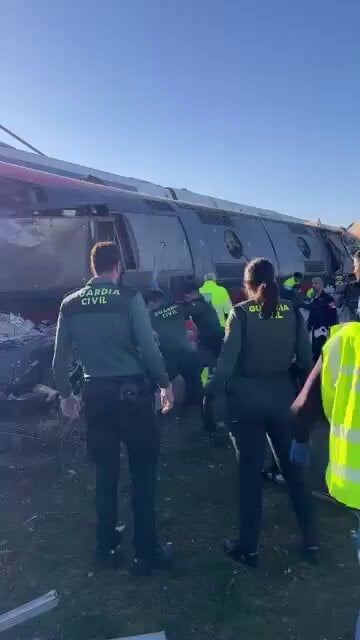
Two high-speed trains collided near Urda in Toledo on the Madrid to Andalusia line. The transport minister blames an “inexplicable” order from the central command centre after a safety system failed.
At least 68 people have died after a high-speed train ran into a stationary train near Urda, in the province of Toledo, on the line between Madrid and Andalusia. Carriages derailed and rolled down an embankment. Survivors have described scenes of chaos and devastation, and one told of seeing a man walking with a severed arm. Casualty figures are still changing. The authorities have announced three days of national mourning.
What survivors say
Jesus Jeronimo, 54, was working on his laptop when, he told El Pais, “there was a very strong surge forward” and he was thrown into the seat in front. He and others first thought the train had derailed, and found it “tilted” when they got out. He told Cadena Ser: “We realised it was an accident and tried to evacuate as quickly as possible because the carriage had overturned onto the tracks and there was a risk that it might fall further.”
He described “many injured and dead”. “It was an absolute emergency,” he said. “I saw a young man walking with an arm, and I saw bodies lying on the ground that, when touched, felt like corpses.”
Another passenger, Eduarda, told Cadena Ser she was sitting calmly with her two cats beside her “when there was a sudden, violent jolt”. She said: “People began to get out; there were people crying, and you could see bodies under the trains. So many people were trapped and couldn’t get out; there was screaming… It was a nightmare.”
Sebastian Herrero, 46, from Seville, was near the front of the Iryo train. He told El Mundo that the rear three carriages had been destroyed and that rescuers kept pulling people out and covering them with sheets. “It’s apocalyptic,” he said. “It’s hard to imagine anyone is still alive in those three carriages. It’s just a twisted mass of metal. It’s as if a bomb had gone off.” He added: “Of the nine carriages, those from one through four or five are all derailed. Five of the high-speed carriages ended up exactly where the Iryo carriages should have been.”
A Civil Guard officer who was on the train used similar language, calling the scene a “twisted mass of metal”. One passenger who did not want to be named said: “I don’t want to remember anything because it was a traumatic experience. I feel like I was born again.”
The cause under investigation
Transport minister Oscar Puente said the crash was caused by what he called an “inexplicable” order from the central command centre after a safety system failed. He said the train engineers were not to blame.
The security system on a 39-mile stretch stopped working at about 8.30am because of a computer malfunction, which brought all trains on the section to a halt. The central command then told the Renfe train travelling from Madrid to Seville to start moving again with no speed restrictions, which led to the collision. The research notes say the fault was in the LZB automatic train-protection system, covering about 63km of track, and that the authorisation came at about 8.36am despite an active stop signal. Mr Puente said the Renfe train should instead have operated under a restricted-speed procedure that would let its driver stop safely if it met an obstruction. He said the train could have reached 200km/h on that section, but the speed at impact has not been established.
Sources close to Iryo told the news agency EFE that its train stopped around 8.30am after a signalling failure, and that its driver began talking to control staff at about 8.38am. The driver was reportedly still seeking clearance when the Renfe train hit it from behind. That account has not been independently confirmed. The exact time of impact is inconsistent, with Iryo’s statement giving 8.48am at kilometre marker 118 near Urda and other accounts giving about 8.53 to 8.54am.
The trains and the casualty figures
Renfe’s AVE train 2080 left Madrid at 8am for Seville with 397 passengers reported. Iryo’s train 6076 left Madrid at 7.54am for Seville with 147 passengers.
The figure of at least 68 dead is confirmed in the reports checked. Hospital figures vary. The source says another 107 people are in hospital, but RTVE reported 53 hospitalised, 15 of them seriously injured, and later international reports cited 80 injured in total. The numbers may count different groups, and the 107 figure should not be treated as a confirmed hospital total.
RTVE’s analysis of aerial footage shows the damage was not confined to the Iryo train. The Renfe train’s leading unit separated from the rest and fell down the opposite embankment, with its first carriage badly broken up.
The response
Prime Minister Pedro Sanchez visited the emergency command post near Urda and promised a thorough investigation, saying any negligence or safety-system failures would bring accountability. Three days of official mourning were declared, and King Felipe VI cancelled his engagements. Spanish railway accident investigators are at the scene, and the judicial district of Orgaz is expected to oversee the criminal investigation. The Spanish football federation postponed 24 Copa del Rey first-round matches scheduled for Wednesday evening.
Renfe has suspended services between Madrid, Ciudad Real and Andalusia, and Iryo has cancelled its Madrid to southern Spain services with no reopening date. Iryo says passengers can change or cancel for free, and Renfe has arranged alternative transport for some journeys. Assistance lines for victims and relatives are:
| Organisation | Number |
|---|---|
| Renfe | 900 10 10 20 |
| Iryo | 900 001 403 |
| Adif | 900 00 14 02 |
