



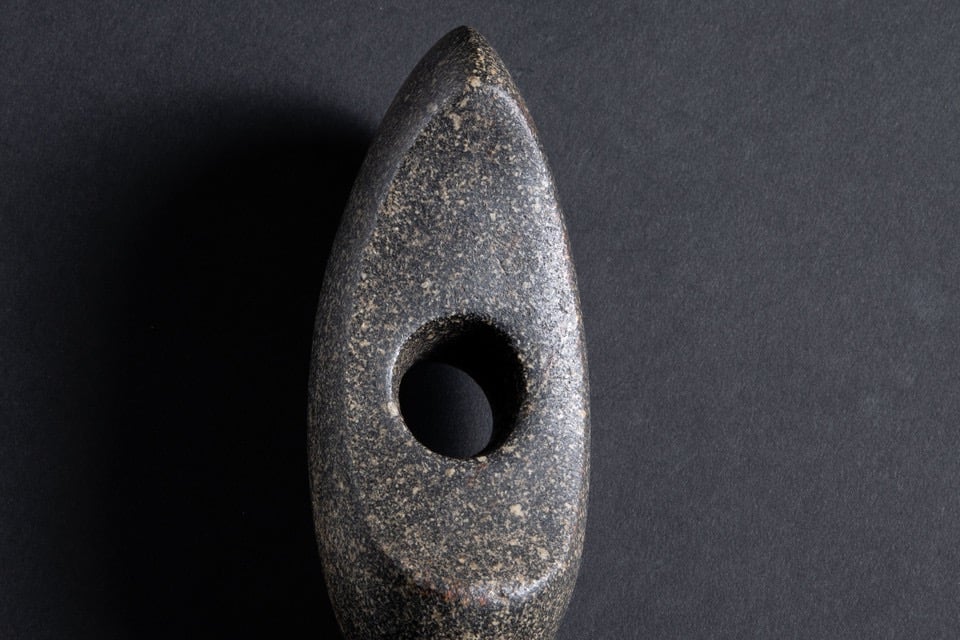
The Government has temporarily blocked the sale abroad of the rare Bronze Age stone axe, found in North Yorkshire in 1974. Buyers have until 22 December to come forward.
The UK Government has placed a temporary export bar on the Scarthingwell battle-axe head, a well-preserved survivor from prehistoric Britain, in the hope that a UK museum, gallery or institution can buy it for public display. The axe is about 4,000 years old and was found near Tadcaster, North Yorkshire. The bar follows a recommendation from the Reviewing Committee on the Export of Works of Art and Objects of Cultural Interest. The recommended price is £15,000.
Why the axe matters
Heritage Minister Baroness Twycross said: “The Scarthingwell battle-axe head is an important part of the UK’s ancient story. Its outstanding craftsmanship and exceptional condition make it an object of national significance. Securing this piece of our archaeological heritage for the UK would ensure it can be protected, studied and shared with future generations.”
The axe is made of weather-altered diorite, an igneous rock with a speckled appearance. It has a waisted profile and tear-drop shape, and its perforation for the handle is slightly offset. These features place it in Needham’s Class 2, the earliest period of battle-axe production in Britain, around 2050 to 1850 BC. Its condition is exceptionally good, with little sign of heavy plough scarring or rolling, suggesting it lay largely undisturbed until it was found. It is about 120mm long, 50mm wide and 360g in weight.
It was found on the surface in the winter of 1974 during agricultural work at Scarthingwell, and was reported to the British Museum’s Portable Antiquities Scheme in 2012 (unique ID CORN-70CDC7). The research notes add that earlier records catalogued it under a wider date range of 2100 to 1500 BC, which reflects differing dating precision, not an error.
Tim Pestell, a member of the committee, said that in a period when society moved from flint to metalwork, battle-axes “became some of the most powerful symbolic objects, labelled by one scholar as ‘blunt instruments of power’”. Though made of stone and not metal, “they conveyed important social, sacred and political messages”. He said the axe was “exceptional for its preservation and highly developed aesthetic qualities”, and that its finely polished surface and deeply waisted shape “would have taken hundreds of hours to make”. He added: “Having been in this country for the last four thousand years, I sincerely hope that the export block placed on this wonderful battle axe will enable a museum to acquire and retain it on these shores for public benefit.”
The committee judged that the axe met the first, second and third Waverley criteria, for its outstanding connection with national life and history, its outstanding aesthetic importance, and its outstanding significance to the study of such artefacts, regional context, production techniques and use.
How the deferral works
The decision on the export licence is deferred until 22 December 2026 inclusive, during which expressions of interest from an appropriate buyer are welcome. After that, the owners have 15 business days to consider any offers at the recommended price of £15,000. A second deferral period of three months starts once an option agreement is signed.
The bar does not guarantee the axe will stay. If no serious buyer emerges, an export licence can normally be granted. According to the notes, eligible private buyers can take part if they agree to keep the object in the UK with reasonable public access, so a museum is not the only possible purchaser. If an owner declines an eligible matching offer, the minister will refuse the licence, Arts Council England guidance says. The 2024-25 annual report found that six of 18 objects whose export was deferred were bought by UK buyers, nine were or could be exported and three remained unresolved.
Organisations or individuals interested in buying the axe should contact the Reviewing Committee on the Export of Works of Art on 020 7268 0534 or rcewa@artscouncil.org.uk. The committee is an independent body serviced by Arts Council England, which advises the Culture Secretary on whether objects intended for export are of national importance.
What is not known
The research notes say the owner, any auction history, the intended destination, any museum interest and any fundraising progress could not be established.
