



Serbia’s student movement says “victory” is within reach, while the governing party’s leader predicts a “tough, uncertain struggle” ahead of Sunday’s parliamentary election.
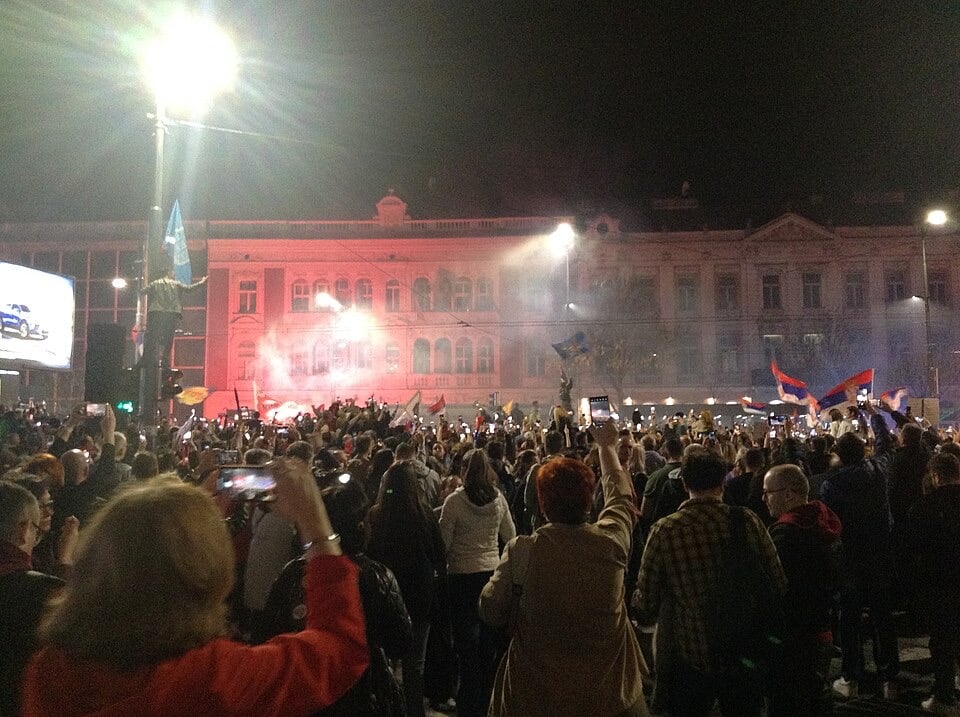
Hundreds of thousands of supporters of Serbia’s protesting student movement packed Belgrade’s Slavija square on Thursday for their final rally before Sunday’s parliamentary election. Crowds filled the square and several blocks around it, waving flags and chanting “Victory”. The vote, on 25 October, follows almost two years of student-led protests against the rule of Aleksandar Vucic. Analysts say a close result could leave the outcome uncertain and pave the way for post-election instability if both sides claim victory.
The rally
The movement’s Students’ List is polling neck and neck with Mr Vucic’s right-wing Serbian Progressive Party (SNS). Support for the movement has grown since the protests began in November 2024, despite the ruling party’s tight control over mainstream media and all institutions.
Drama student Natalija Stepanovic told the crowd: “Three more days are left and they will pass.” She added: “So will fear, blackmail, injustice. Tyrants will pass, like they always do, but the people of this country never will and they will stand tall as a monument to our joint struggle.”
Marina Popov Taparicki, from Belgrade, said: “There is hope for the first time in like 30 years. People want change.” Igor Zecevic, also from Belgrade, said: “The students woke us up, woke everybody up in this country, and we just have to do our thing now, we have to get out, we have to vote.”
Vucic’s closing rally
Mr Vucic held his own closing rally on Thursday at a sports hall in a separate part of Belgrade, before several thousand people. He said he expected to win by a margin of several hundred thousand votes. He later conceded on Radio Belgrade: “We’ll see what the result will be,” predicting a “tough, uncertain struggle”. He said “nothing special will happen” on election night and that “those who win will celebrate”. An appearance on the state broadcaster RTS was scheduled for the evening.
Mr Vucic, who controls the police, has said any unrest after the vote would be swiftly quashed. He has accused the students of being financed from abroad to destroy the country. Scores of students have been detained during the protests, and critics accuse Mr Vucic of corruption, ties to organised crime and a crackdown on democratic freedoms, particularly the media. He denies this.
Several minor parties are also standing, but observers say the referendum-like atmosphere could push most below the 3% threshold needed to enter the 250-member parliament.
Where the protests began
Suspicions of high-level graft in state railway projects set off the student protests after a collapsed canopy at a train station in northern Serbia killed 16 people in November 2024. Slavija square was also the scene of a huge protest last March, which ended in a sudden disruption. Experts later said it involved a sonic weapon used against peaceful demonstrators, which the government denies.
Concerns over the vote
International election monitors and the European Union have raised concerns about the safety and fairness of the ballot. They cite near-total government control of the media, reports of surveillance and cyber attacks on activists, and a deeply polarised society.
According to the research notes, the monitoring group CRTA reported that:
- 116 incidents of physical violence or threats were recorded during the campaign
- nearly three-quarters of political airtime on national broadcasters went to government officials, and more than 80% of coverage of the Student List was negative
- there were more than 250 instances in which jobs, social assistance or public services were allegedly used to pressure citizens
These are findings from CRTA’s monitoring and not court rulings. Serbian authorities and the governing party have challenged claims of bias. A separate CRTA report, published on 17 September, alleged unlawful practices during the collection and certification of nomination signatures. They included signatures allegedly certified without the voter present and suspected falsification. These are allegations and not proven criminal conduct.
Serbian authorities arrested six people on Wednesday, accusing them of preparing violent disturbances on election day, according to Reuters. Prosecutors say five were arrested in Novi Sad and one in Belgrade, and allege that the group planned attacks on police officers and political opponents. They have asked for five to stay in detention, and a sixth was released pending trial. The allegations have not been proved, and authorities have not established that the Student List was involved.
The polls and the vote
An NSPM institute telephone poll of 1,050 people, conducted between 25 September and 5 October and published on 20 October, put the Student List at 44.5% and Mr Vucic’s coalition at 42.7% among decided voters. The gap of 1.8 points is small, and the survey is not a forecast.
Mr Vucic resigned as president in September to lead the governing coalition as its candidate for prime minister, according to Reuters as cited in the notes. Voters are therefore choosing a parliament, and a government must then be formed. The students’ list is headed by Dr Ilija Srdjanovic, a cardiologist and university professor.
Serbia’s Republic Electoral Commission says 8,392 polling stations will open, 93 of them in 37 countries abroad, with 6,450,523 ballots being printed. The Associated Press reports that nearly 100,000 Serbians abroad have registered, up from 39,000 in 2023. It found one voter in Vancouver was told to travel about 3,500km to Toronto to vote. Opposition figures accuse the authorities of discouraging overseas voting. Foreign Minister Marko Djuric rejects that, citing logistical, security and staffing requirements.
The OSCE’s Office for Democratic Institutions and Human Rights has deployed an observation mission, and plans to publish preliminary findings at 3pm Belgrade time (2pm UK) on Monday 26 October. CRTA plans about 2,500 observers and a parallel vote count from 500 polling stations.
