



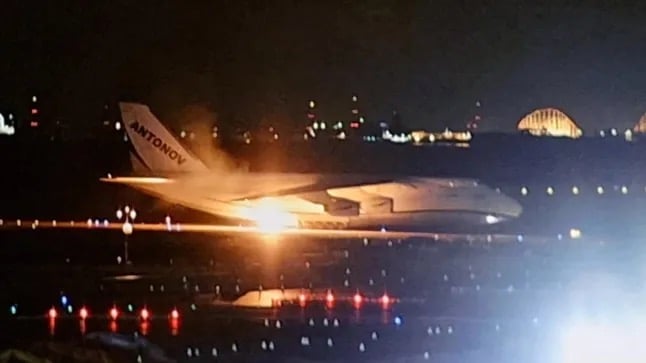
Flames were seen around the Antonov An-124 at Chubu Centrair airport near Nagoya, closing a runway for about 15 minutes. No one was hurt, and the cause has not been established.
A giant Ukrainian cargo plane appeared to catch fire as it landed in Japan, forcing the temporary closure of a runway. The Antonov An-124 Ruslan, the world’s largest operational military transport aircraft, was involved at Chubu Centrair International Airport, near Nagoya. Flames were seen around the four-engined plane shortly after it landed on Thursday evening. Flight records show it had been operating from Leipzig in Germany days earlier, where a Russian sabotage operation against this type of plane was reported. Nothing so far links the two.
What happened
NHK reported that the fire happened at 7.20pm local time. Emergency precautions were taken and the runway was shut for about 15 minutes, briefly disrupting operations. The aircraft taxied to its parking position under its own power, and no injuries were reported. Local reports suggest the flames were brief and did not develop into a sustained blaze. Japanese authorities are investigating, and the type of cargo has not been disclosed.
According to the Greek aviation publication PTISI, citing NHK and the Chunichi Shimbun, firefighters who inspected the aircraft found no active fire, which suggests the flames had gone out beforehand. News agency JX Press reports that the Chubu Airport Office had not identified a cause by 8.10pm local time, and that scheduled passenger flights saw no significant disruption.
Possible causes
The Ukrainian outlet Komersant, citing the aviation account FL360aero, reported a preliminary theory that the auxiliary power unit (APU) may have been involved. The APU supplies power independently of the main engines. ZAXID.NET reports that eyewitness footage shows flames towards the rear, where the An-124’s APU equipment is housed, but that does not show the APU was responsible. No official investigation has verified this. Komersant also reported accounts of minor damage, while noting that no official damage assessment has been released.
The research notes say these remain open:
- whether the cause was the APU, an engine or another system
- whether a sustained fire actually developed
- whether the aircraft was damaged
- whether Japan has ordered it to stay on the ground
- whether Antonov Airlines has given a technical explanation
The aircraft
The aircraft is an An-124-100, registration UR-82029, flying as cargo flight ADB5561, according to ZN.ua and PTISI. It arrived from Fairbanks, Alaska. The notes, based on Plane Finder, show it flew from Leipzig to Chania, Greece on 16 October and from Leipzig to Goose Bay, Canada on 17 October. The tracker gives a 5.28pm arrival for the Fairbanks flight, while Japanese reports say about 7.20pm, and the discrepancy has not been resolved.
Planespotters.net records that it was delivered to Antonov Airlines in March 1992, so it is nearly 36 years old. The notes say it overran a runway at Windsor in Canada in December 2000, was parked at Leipzig/Halle from September 2024 to April 2025, and is now listed as parked at Nagoya. None of this has been linked to the incident.
The 226ft An-124 has a 240ft wingspan and can carry up to 150 tonnes. It is designed to move enormous industrial equipment, military vehicles and other oversized loads. It is operated by Antonov Airlines, which has kept flying its giant transport planes around the world from outside Ukraine despite Russia’s invasion.
The Leipzig background
In August, a Russian sabotage operation involving Ukrainian Antonov planes at Leipzig and Halle Airport was reported. An explosive drone was found near a Ukrainian cargo aircraft, which was seen as alarming evidence of Russian hybrid warfare in NATO states.
According to the research notes, German investigators later found a third drone on 14 August in Kabelsketal, with about 50 grams of suspected military explosive that German reporting said could be hexogen. They also reported possible damage to a DHL cargo aircraft’s tail after it diverted to Hanover, possible DNA evidence, and a communications antenna on a tree near the airport. ABC News reported an American intelligence source linking the drone design to Russia’s GRU military intelligence. Russia denied involvement. That does not establish responsibility for anything in Japan, and no connection between that case and this event has been found.
