



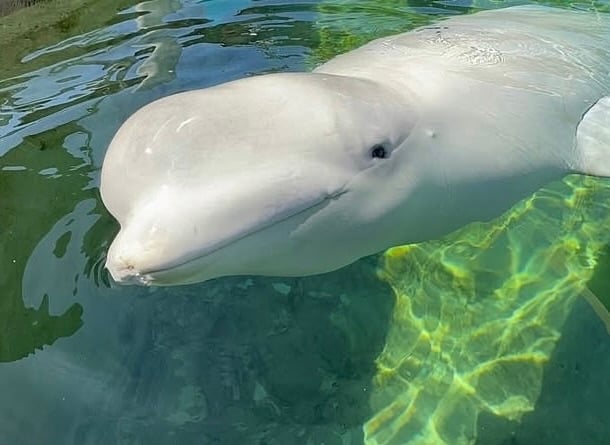
Nine-year-old Cyprus stopped eating on Saturday and died after a night of veterinary care, less than two months after his transfer from Marineland of Canada.
Cyprus, a nine-year-old male beluga, has died at SeaWorld San Diego less than two months after being moved from the now-closed Marineland of Canada park in Ontario. He is the sixth beluga to die after relocation from Marineland, according to animal rescuers. He arrived in California on 22 August. SeaWorld said he had been interacting with trainers and adjusting well until he stopped eating on Saturday. A full necropsy will be carried out and the results shared with the US National Oceanic and Atmospheric Administration (NOAA).
What SeaWorld said
Veterinarians and the animal care team examined the highly vocal whale through the night. SeaWorld wrote in a Facebook post: “We are saddened to share that Cyprus has passed away unexpectedly.”
It added: “An ultrasound showed that his intestinal tract did not appear to be functioning normally and could indicate a serious life-threatening condition.”
That ultrasound finding is not a final diagnosis. No cause of death has been announced, and nothing has confirmed an intestinal blockage, an infection, a pre-existing condition or transport stress as a factor. Nor has there been any finding of negligence by SeaWorld or Marineland. Cyprus had been rescued, with two other male belugas, from what was described as a “dire situation”. Those two, Xavier and Jasper, remain at SeaWorld in stable condition under close monitoring, according to the Daily Beast. They travelled more than 2,500 miles from Ontario in temperature-controlled transport, and no illness has been reported in either.
The other deaths
Four of Marineland’s last surviving belugas died at Chicago’s Shedd Aquarium. The fifth whale, and a 30-year-old female dolphin, died at Oceanografic de Valencia in Spain, Animal Justice Canada said. The research notes give the tally of the 30 relocated belugas as six dead and 24 surviving, which is 20% of the group.
Shedd Aquarium published post-mortem findings on 9 October for two of the whales. Rain, 20, had severe chronic inflammation of the small intestine, liver damage with areas of dead tissue and evidence of an earlier fungal respiratory infection. Peekachu, 23, had longstanding intestinal disease, high blood pressure and lung scarring. External pathologists said such illnesses may have made both more vulnerable to cardiovascular stress, but their findings do not show that relocation caused the deaths. Preliminary findings for Osiris, 26, who died in September, showed chronic liver disease, and the full report is awaited. Caspian, 27, died on 7 October after about four hours of life support, with blood tests showing severe electrolyte disturbances and dangerously acidic blood. No final cause was established.
The rescue and the scrutiny
Georgia Aquarium confirmed that all 30 belugas and four dolphins had left Marineland by 1 September 2026. It described the operation as the largest marine-mammal relocation in history, with six major transports over six weeks across three countries. Groups were moved together to preserve social bonds, and the animals could take months to adapt.
NOAA approved the emergency import of 28 belugas into the US, saying it was necessary to provide medical care not available to the animals at Marineland. In a regulatory memorandum on an earlier transfer to Mystic Aquarium, which did not concern this group, it said it could not rule out transport stress, adjustment to new surroundings, water conditions or repeated handling as factors in the deaths of medically vulnerable whales.
Animal Justice, a Canadian welfare group, has asked federal Fisheries Minister Joanne Thompson to investigate the deaths and review the transfers, including pre-move veterinary records, health in transit and how export approvals were decided. It has criticised the pace of the programme. No Canadian government investigation has been reported as finding negligence or wrongdoing. Six deaths do not show why the animals died.
