



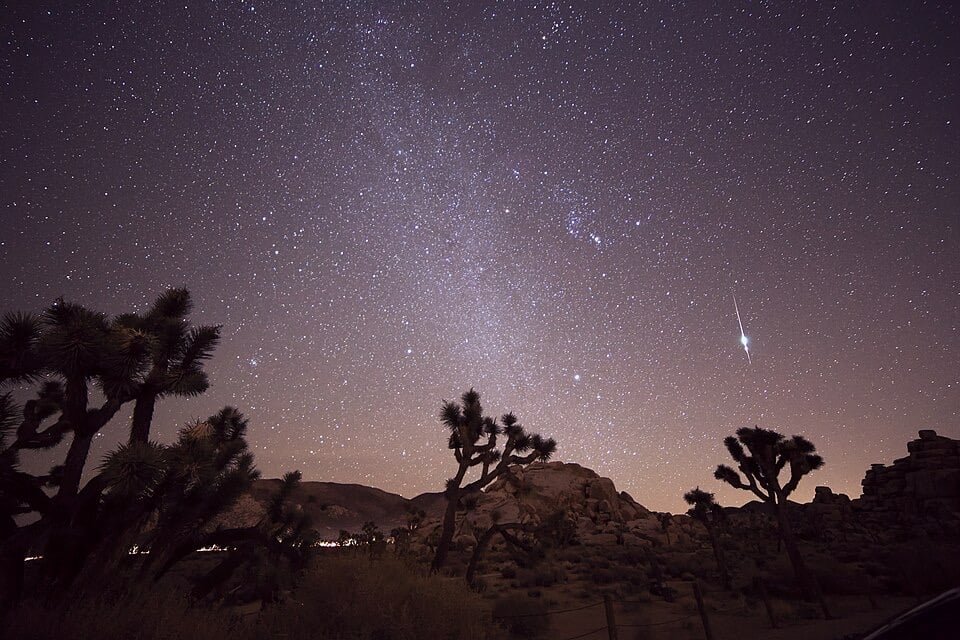
The long-running shower is known for slow, bright fireballs, though forecasters stress it is a minor display with only a handful of meteors an hour.
The annual Southern Taurid meteor shower peaks this evening, Wednesday 14 October, according to the American Meteor Society. It is known for slow-moving and exceptionally bright fireballs. The meteors appear to radiate from the constellation Taurus, although the brightest can flash across any part of the sky. The display is considered minor, but it has staying power, lasting for weeks and months through the northern hemisphere’s autumn, according to EarthSky.com.
Why it happens
The shower occurs when Earth passes through a trail of dust and rocky debris shed by Comet 2P/Encke. As the particles hit the atmosphere, friction heats them until they glow and streak across the sky.
The Taurids are in fact two overlapping streams, the Southern and Northern Taurids. The Southern Taurids are generally active from late September into November, and the Northern Taurids from October into December. Because their activity overlaps for several weeks, it is hard for casual observers to tell which stream a meteor belongs to, and meteors can be seen on many nights, not only on the peak dates.
Comet Encke orbits the Sun about every 3.3 years, one of the shortest periods known among comets. The British Astronomical Association says it will next reach perihelion, its closest point to the Sun, on 10 February 2027. The comet is expected to remain too faint to see with the naked eye this autumn, but the shower can be seen without it.
Peak dates
| Shower | Peak | Moon |
|---|---|---|
| Southern Taurids (annual component) | 14 October | Waxing crescent |
| Southern Taurids (fireball swarm) | Late evening of 4 to 5 November | Waning crescent, roughly 25% lit |
| Northern Taurids | 11 to 12 November | Waxing crescent, roughly 4% lit |
The Northern Taurids’ peak in November should have especially dark skies, since the Moon will be only a thin crescent.
Different calendars use different definitions of the peak. The Royal Observatory Greenwich lists 10 October 2026 as the Southern Taurids’ maximum. The shower has a broad period of activity rather than a sharply defined maximum, so this does not necessarily mean either date is wrong.
What to expect
The American Meteor Society gives both branches a typical zenithal hourly rate of about five meteors. That is a theoretical rate under excellent conditions, and not a promise that every observer will see five an hour. Taurid meteors are comparatively slow, travelling at about 27km a second for the Southern branch and 29km a second for the Northern, which helps distinguish them from faster showers such as the Orionids.
The November fireball swarm occurs when Earth passes through a concentration of larger particles, producing unusually bright meteors. These displays do not happen with the same intensity every year. The American Meteor Society says 2026 is not a Taurid swarm year, and suggests mid-October may give slightly more Southern Taurid activity than early November. The November date should therefore not be presented as a guarantee of a spectacular display.
How to watch
Go somewhere dark with a clear view of the sky, settle in and allow about 30 minutes for your eyes to adjust. You do not need binoculars or a telescope, and watching with the naked eye lets you take in more of the sky. Be patient. There may be only a handful of meteors an hour, but a bright fireball can make the wait worthwhile.
Taurus can be found near the bright star Aldebaran. Look around the constellation rather than directly at it, because meteors close to the radiant leave shorter trails. For British observers, a useful window during the November peaks is roughly 9pm to 1am GMT, as Taurus climbs higher through the evening. Meteors can appear at other times too. Even where light pollution hides faint meteors, a bright Taurid can sometimes still be seen.
What comes next
The Orionids are next, peaking around 21 and 22 October, just after the Northern Taurids begin to build. The Leonids follow around 16 and 17 November.
