



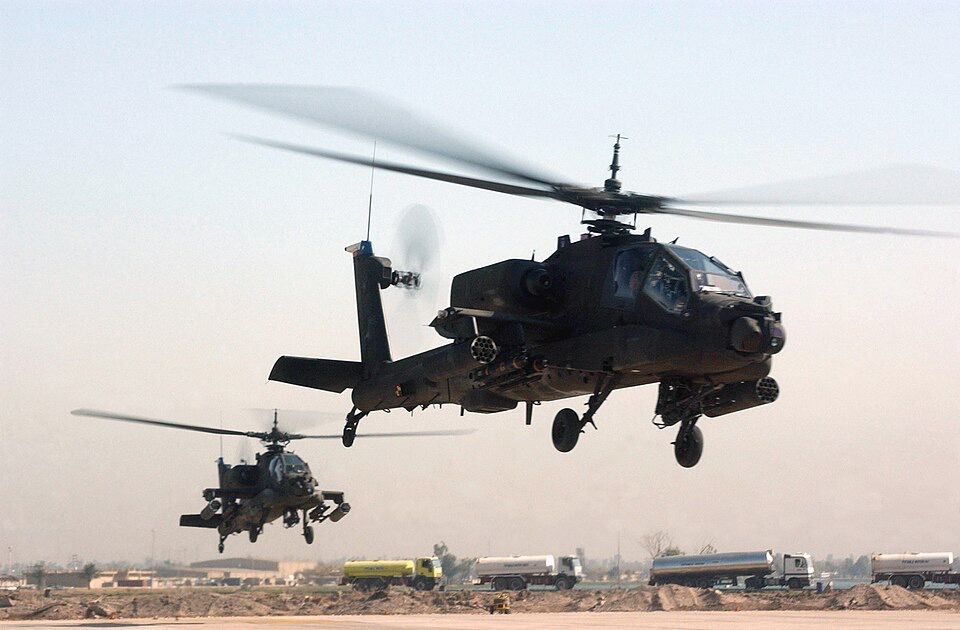
The United States military has carried out what it is describing as “self-defence strikes” against Iranian air defence and radar sites near the Strait of Hormuz, after American forces determined that Iran was responsible for downing a US Army Apache helicopter in the area — with Iran’s Revolutionary Guards responding by launching a drone attack on the US Fifth Fleet in Bahrain and vowing heavier retaliation if American “aggression” continues.
US Central Command confirmed its forces had “completed self-defence strikes against Iran,” saying the attacks were “a proportional response to recent attacks on US forces and international commercial ships transiting regional waters.” CENTCOM said precision munitions were fired from US Air Force and Navy fighter jets against Iranian air defence installations, ground control stations and surveillance radar sites in the Jask, Sirik and Qeshm Island areas of southern Iran. “US forces remain vigilant and postured to defend against unjustified Iranian aggression,” the command added.
Iran’s Islamic Revolutionary Guard Corps confirmed the US strikes had hit multiple locations in the south of the country, saying a telecommunications tower had been damaged and two water tanks in Sirik’s Bemani district destroyed. The IRGC then announced its own response — a drone strike on the US Fifth Fleet base in Bahrain — and warned that “heavier retaliatory measures” would follow if US military action continued.
Iran’s Foreign Minister Abbas Araghchi issued a stark warning to Washington. “The US has chosen to test our determination,” he said, adding that Iranian armed forces would “leave no attack or threat unanswered.” In a direct message to US forces in the region, he said: “Leave our region if you want to be safe.” Tehran’s deputy foreign minister had earlier told Al Jazeera that Iran had not deliberately targeted the Apache helicopter — a claim that sits awkwardly alongside the scale of what followed.
The exchange represents the most direct military confrontation between the United States and Iran since the current conflict escalated, and comes as the wider region deteriorates rapidly. Israeli strikes killed almost 20 people in southern Lebanon on Tuesday as Israel issued forced displacement orders ahead of further planned military action. Meanwhile, Gaza’s Health Ministry accused Israel of effectively killing patients by preventing more than 16,500 Palestinians from leaving the besieged territory to receive medical treatment abroad, according to Al Jazeera.
Oil prices, already approaching $100 a barrel before the latest escalation, are expected to rise further following news of direct US-Iran military exchanges near the Strait of Hormuz — the waterway through which approximately 20 per cent of the world’s oil trade passes and which Iran has previously threatened to close entirely.
