



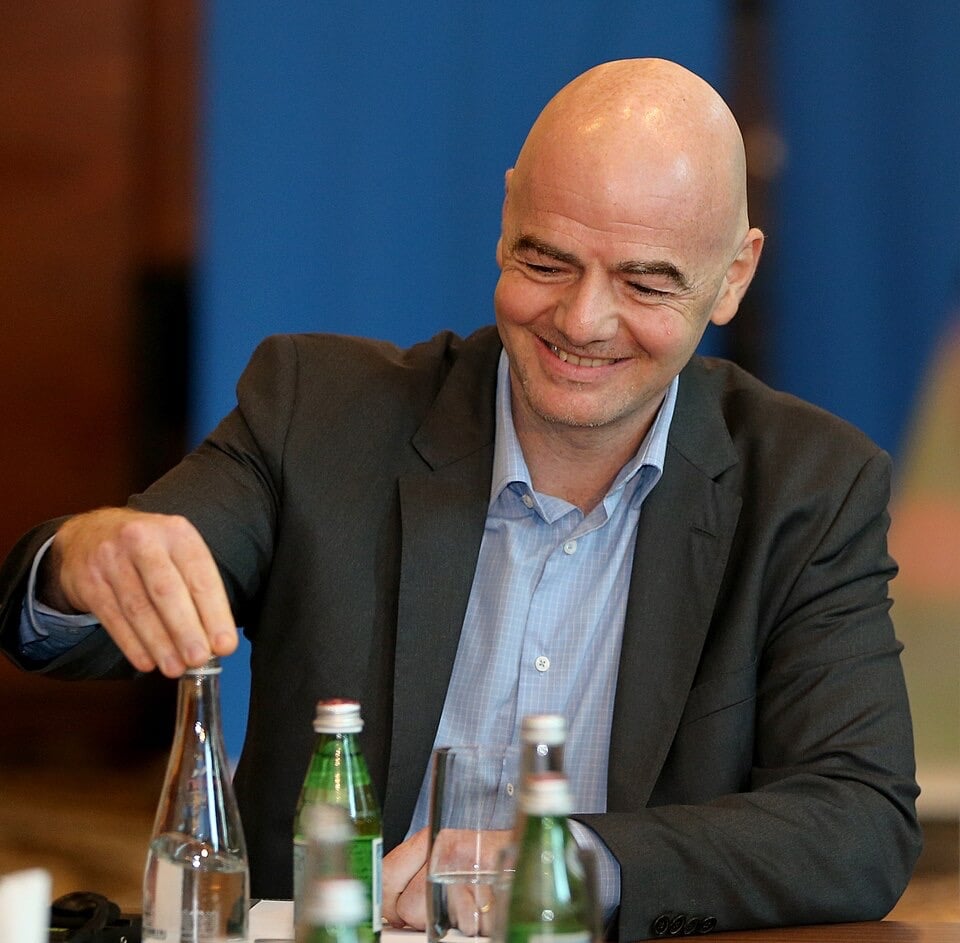
FIFA president Gianni Infantino ignored a request from his own vice president to stay away from an Under-14 tournament in the Caribbean, making a rare public appearance in the Dominican Republic just weeks after abandoning a controversial plan to sell a stake in FIFA’s commercial operations to private investors, amid mounting internal opposition to his leadership.
FIFA president Gianni Infantino has defied a request from one of his own vice presidents to stay away from a youth football tournament in the Caribbean, making a rare public appearance amid the ongoing fallout from his abandoned plan to sell future World Cup profits to private investors. On Saturday, Infantino posted photos on Instagram showing him meeting political and football officials from the Dominican Republic on the sidelines of a Caribbean Football Union (CFU) Under-14 tournament in Punta Cana, just a day after being asked not to attend.
The vice president’s warning
The request came from Victor Montagliani, the Canadian president of Miami-based continental body CONCACAF, who wrote to Infantino on Friday asking him to reconsider attending. In an emailed letter seen by the Associated Press, Montagliani warned that Infantino’s presence would overshadow the tournament itself. “I believe that considering the governance crisis surrounding FIFA as a result of your controversial FIFA Forward Enterprise proposal, the media will focus on this situation,” he wrote, “which will unfortunately significantly take away from the technical nature of the CFU youth competition.”
Montagliani went further, framing his request as being made in the interests of the sport: “As such, I respectfully ask you in the name of football to reconsider your attendance as it will unfortunately undermine the technical nature of this important youth development activity.” FIFA declined to comment directly on Montagliani’s letter, though it noted that it provides regional bodies such as the CFU with up to $5 million from each four-year World Cup cycle.
A trip with political undertones
Infantino’s visit is reported to have carried significance beyond the tournament itself. According to reports, he was seeking direct contact with the CFU’s 21 member associations, whose backing could prove valuable ahead of next year’s FIFA presidential election. The Dominican Republic had previously supported Infantino but later aligned itself with calls for an independent review of the FIFA Forward Enterprise proposal and an emergency FIFA Council meeting.
The abandoned investment plan
At the centre of the current crisis is Infantino’s now-withdrawn proposal to spin off FIFA’s multi-billion-dollar commercial activities into a subsidiary partly owned by outside investors led by Joshua Kushner. According to an explanatory document citing JPMorgan, the plan would have created a commercial subsidiary valued at approximately $20 billion, with up to a 20% stake sold to outside investors.
Infantino withdrew the proposal on 1 August, following a global backlash from football leaders and fans, and just hours after his own chief operating officer, Kevin Lamour, published sharp criticism of both the proposal and Infantino’s leadership style in a statement to the Associated Press. Lamour, who was based in Zurich, was dismissed this week. FIFA has officially confirmed only that Lamour’s working relationship with the organisation ended on 17 August, declining to provide further detail despite widespread reports that he had been fired over his criticism of Infantino.
Growing opposition within FIFA
Montagliani has aligned with fellow FIFA vice presidents Aleksander Ceferin of European body UEFA and Asian Football Confederation president Sheikh Salman bin Ebrahim Al Khalifa in seeking to end what they characterise as Infantino’s increasingly executive presidency, now in its 11th year. Two weeks ago, the trio accused Infantino of “deception” over what they said was a year-long secret plan to develop the investment proposal.
Collectively, UEFA, CONCACAF and the Asian Football Confederation represent 136 of FIFA’s 211 member associations, with UEFA alone accounting for 55 of them, though not all member associations within those confederations are necessarily opposed to Infantino. Several British and Irish football associations, including those representing England, Scotland, Wales, Northern Ireland and the Republic of Ireland, are reported to have withdrawn their support for him.
Opposition has also emerged within African football. FIFA General Secretary Mattias Grafström has reportedly been approached by senior figures in African football about potentially mounting a challenge to Infantino’s presidency. Although the Confederation of African Football (CAF) has formally backed Infantino, reports suggest as many as 15 African member associations could be prepared to oppose him.
Potential challengers and the path to an election
The deadline for candidates to enter the FIFA presidential race is 18 November, with the election itself scheduled for 2027. Infantino is seeking a further term that would keep him in office until 2031.
Should opposition to his leadership continue to build, it could potentially trigger an extraordinary FIFA Congress ahead of the scheduled election. Under FIFA rules, such a meeting can be called if 43 of the organisation’s 211 member associations request one, opening the possibility of a vote of no confidence.
Grafström had previously distanced himself from the investment proposal before later expressing support for Infantino, a shift that has fuelled speculation he could yet emerge as an alternative candidate. Sheikh Salman bin Ebrahim Al Khalifa, president of the Asian Football Confederation, is also viewed by some football officials as a figure capable of attracting support across multiple continents should he choose to run.
Internal resignations deepen the crisis
The scale of internal opposition to Infantino has been underlined by a series of high-profile departures. Carlos Cordeiro, a senior adviser to Infantino, resigned in protest over the investment proposal, separately describing the project as a bad deal for football. His departure, alongside that of Kevin Lamour, has highlighted the extent of resistance within FIFA’s senior ranks.
Norway’s football president, Lise Klaveness, publicly condemned Lamour’s removal, describing the episode as evidence of what she called a culture of “management by fear” and urging other football leaders to resist potentially damaging directives from within the organisation.
