



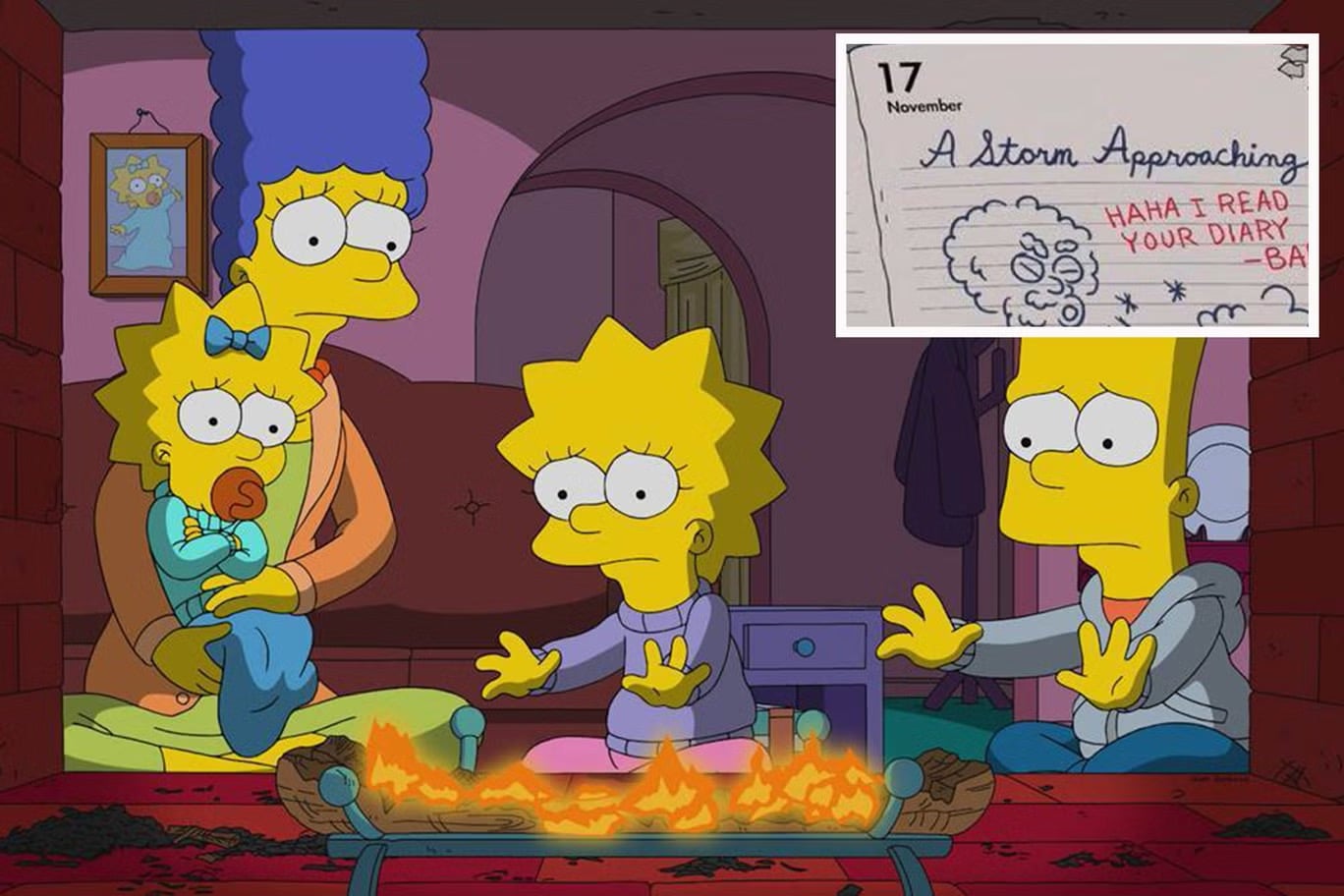
A clip from a 2023 episode has spread online as a supposed warning of a global blackout. Fact-checkers have found no evidence for it, and the scheduled US emergency alert test on the same day is routine.
A 2023 episode of The Simpsons is being shared online as a prophecy of a worldwide power cut on 17 November. In “It’s a Blunderful Life”, an older Lisa Simpson writes in her diary about a blackout caused by an epic storm that began on 17 November. The clip has found a new audience after last week’s Microsoft outage and the grounding of US aircraft in recent days. A BBC News Brasil investigation published on 14 November found no evidence for a worldwide blackout.
What the episode shows
The episode sends the Simpson family 60 years into the future. Lisa’s diary says that every Thanksgiving they light a candle “in remembrance of the great blackout that almost destroyed our town, when we actually had to write things by hand”.
The episode first aired on 19 November 2023, two days after the fictional date. It is the seventh episode of season 35. The blackout lasts six days in the storyline, with power returning around Thanksgiving, according to Agência Lupa. That is very different from the 90-day global shutdown of electricity, internet and digital payments now being claimed on social media. Exame reported on 16 November that no technical evidence supports those versions. The episode also blames Mr Burns, who accidentally starts a fire at the nuclear plant, though Homer is blamed in the story, Philenews reported.
Why the claim does not add up
The calendar does not match. Thanksgiving fell on 23 November in 2023, six days after 17 November, which fits the cartoon’s timeline. In 2026 it falls on 26 November, nine days after, according to a USA Today Network fact-check published on 16 November.
Experts quoted by BBC News Brasil also said there is no single worldwide electricity network that could be switched off at once, which is a major technical obstacle to the claim.
The US alert test
A scheduled nationwide test of the US Emergency Alert System is also due on 17 November. Governments worldwide are increasingly urging citizens to prepare for national outages, or “Black Sky” events, caused by severe weather or cyber attacks. This test is not an emergency. Britain ran a similar one in 2025.
According to FEMA and the Federal Communications Commission (FCC):
- the test is set for 2.20pm Eastern, which is 7.20pm GMT;
- the interruption to radio and television programmes should last about a minute;
- mobile phones will not receive alerts, as Wireless Emergency Alerts, last tested in 2023, are excluded;
- the exercise uses the Integrated Public Alert and Warning System, with the Nationwide Test event code and messages in English and Spanish;
- 3 December 2026 is the backup date if a genuine emergency or major weather event forces a postponement; and
- the 2015 IPAWS Modernization Act requires nationwide testing at least once every three years to find technical or operational weaknesses.
How the rumour spread
Agência Lupa reported on 9 November that one TikTok video promoting the claim had passed eight million views. It said the video was among the ten trending posts highlighted in TikTok Studio that day, even though the theory had already been debunked, and that TikTok had not responded to its request for comment. The USA Today Network reported that a viral post on X pointing viewers to the final 15 seconds of the episode had about 768,400 views. VEJA reported that another version circulated via a post falsely attributed to Google’s official account.
The Microsoft outage added a numerical coincidence. A Microsoft Exchange Online incident record listed an estimated start of 11.17am Eastern, so some users suggested “11/17” in the cartoon could refer to a time. No evidence connects the two. Exame reported that posts also tied the supposed blackout to cyberattacks on European supermarket refrigeration systems and systems at Brazil’s Port of Santos, with no demonstrated link to a global electricity failure.
Brazilian civil defence authorities have rejected any link between emergency-kit advice and an alleged blackout, saying their recommendations were preventive measures, UOL reported. Agência Lupa found that the planning behind European and British preparedness guidance began years ago, so the advice is not a new warning about 17 November.
What a Black Sky event would involve
In a major emergency, such an event could knock out electricity, water, shops and communications. People are advised to have non-digital alternatives such as wind-up radios, along with power banks to keep devices going and enough food and water for three to four days.
What the UK has in place
The National Energy System Operator runs a Restoration Services programme, previously called Black Start. It lets selected generators restart supplies without relying on the external grid, and is designed for a total or partial shutdown of the national transmission system, which the operator says is unlikely.
Government “Be Ready” guidance recommends:
- at least three litres of drinking water per person per day, so nine litres per person for three days, plus extra for cooking and washing;
- torches and spare batteries rather than candles, along with warm clothing, blankets and sleeping bags; and
- a mix of notes and coins, because ATMs and card payments may not work in a disruption.
The British Red Cross refreshed its emergency-kit advice on 29 October 2026. It stresses affordable household supplies over expensive specialist equipment, and describes preparing for 72 hours of disrupted services.
