


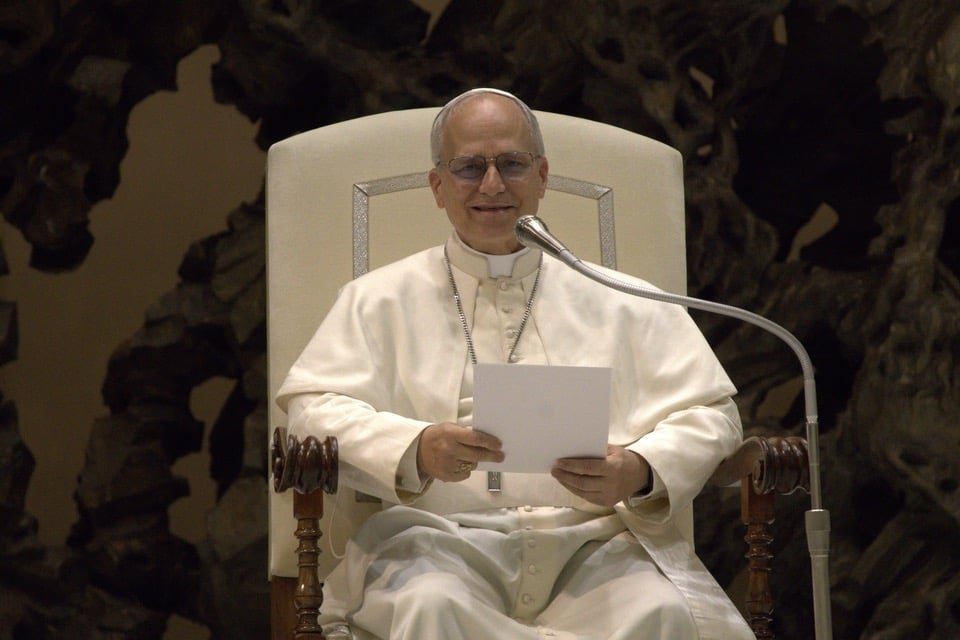
Speaking on the Ucayali River in Pucallpa, the Pope backed Indigenous communities fighting illegal logging and mining, and condemned the “impunity” and “corruption” around sexual violence against Indigenous schoolgirls.
Pope Leo XIV demanded justice on Sunday for environmental defenders killed while protecting the Amazon. “The blood of these brothers cries out to God and demands justice,” he said, to applause from a crowd in which many wore the feathered headdresses and face markings of the region. On the penultimate day of his South American tour, he travelled into the Peruvian rainforest and backed Indigenous communities fighting to stop logging, illegal mining and what he called an “insatiable thirst for domination”.
“The cry of the earth and the cry of the poor”
Addressing Indigenous representatives and missionaries gathered on the Ucayali River in Pucallpa, in north-eastern Peru, Leo echoed a central teaching of Pope Francis. “The cry of the earth and the cry of the poor are inseparable,” he said. He said he had come to support them in their search for justice and peace, and referred to the 57 murders of environmental defenders that campaign groups estimate took place between 2010 and 2024.
Drawing on his years as a bishop in Peru, he used the meeting and a Mass that followed to call for an economic model that respects the Earth and those who protect it, in place of the “irresponsible exploitation” practised by outsiders. “Very little has been done, and very slowly at that, while the means to exploit and pollute creation have accelerated,” he said at Mass. “In the face of these evils, let us not bury the Lord’s gifts, for he gives us the strength to repair and heal the suffering caused by an insatiable thirst for domination.”
He also called for education that preserves Indigenous languages and ancestral knowledge. He noted that the Apostolic Vicariate of Pucallpa has only 25 priests across a vast area, and praised the religious women, laypeople and community leaders who keep services going in remote settlements.
The Vatican said he arrived in Pucallpa at 2.22pm local time, spoke to Indigenous representatives at 3pm, celebrated Mass from 5.06pm and left for Lima at 7.05pm. Local authorities estimated about 100,000 people at the Mass, counting those in the surrounding area as well as inside the Villa Deportiva Regional Ucayali. About 20,000 more reportedly lined the streets for the Indigenous meeting, with around 5,000 at the entrance to Malecón Puerto Callao. Peru’s state news agency Andina reported that children and their mothers gave the Pope saplings of shihuahuaco, a native Amazonian tree that can grow more than 50 metres tall, which he blessed and planted. It said representatives of 21 Indigenous communities took part.
Killings that go unpunished
Illegal mining and coca production are driving deforestation and pushing into Indigenous territories, putting ancestral lands at risk and exposing communities to violence and organised crime. On Saturday, Peruvian police reported three operations against illegal mining in Madre de Dios, one of the country’s most biodiverse regions, destroying equipment, rafts and engines worth €3.8m ($4.1m).
In Peru, most killings of environmental defenders go unpunished and convictions are rare. In 2025, the courts upheld 28-year prison sentences for four timber merchants over the murder of four Indigenous people who opposed logging, after a trial lasting a decade.
The most recent conviction came in the case of Quinto Inuma Alvarado, a Kichwa leader ambushed and killed by hitmen on a river in the San Martín region in 2023. He led the community of Santa Rosillo de Yanayacu and was killed on 29 November 2023 after reporting illegal logging. On 25 August 2026, Peru’s national specialised criminal court convicted four people. The court found Inuma had complained about deforestation and other crimes, including drug trafficking, and that the defendants plotted his death because he had spoken out. The sentences, according to the judiciary, were:
| Defendant | Sentence |
|---|---|
| Genix Saboya Saboya | 35 years |
| Limber Ríos Ruiz | 35 years |
| Segundo Juan Villalobos Guevara | 28 years and 4 months |
| Jerrly Saboya Saboya | 15 years |
The two 35-year sentences covered contract killing and attempted aggravated murder. Mr Villalobos was convicted as a co-perpetrator of contract killing, and Mr Saboya as a principal accomplice.
Global Witness reported on 16 September that at least 124 land and environmental defenders were killed worldwide in 2025, and 2,375 killed or disappeared since 2012. Colombia and Brazil accounted for 52% of the 2025 killings, and more than three-quarters of victims were Indigenous people, small-scale farmers or Afro-descendant people. The organisation says its figures are minimums.
Sexual violence against schoolgirls
Leo also addressed a sharp rise in sexual violence against Awajún and Wampis schoolgirls in Condorcanqui province, in the northern Amazon, and condemned the “complicity”, “impunity” and “corruption” surrounding it. The Awajún and Wampis Women’s Council, Comuawuy, recorded 370 cases of sexual violence in the province between January and July alone.
Four days before the Pope spoke, Peru’s Ombudsman’s Office published findings documenting 536 cases of sexual violence against students allegedly involving teaching staff in Condorcanqui between 2010 and June 2024. Of these, 198 had become time-barred in administrative proceedings, which ends disciplinary action through that route but does not settle whether criminal proceedings were possible. Another 184 were not referred to prosecutors in good time, which the office called a significant institutional failure. An inspection found eight students who had experienced sexual violence across five schools, along with weak preventive measures for staff who had been reported. The report makes 17 recommendations to the Education, Women’s and Justice ministries, prosecutors, and regional and education authorities.
After persistent pressure from women’s groups, specialised prosecutors’ offices were created and the government launched a prevention plan. In January, the Ministry of Women and Vulnerable Populations announced a 32-year prison sentence for a man accused of sexually abusing a 14-year-old girl.
Stamina on a punishing tour
Earlier on Sunday, the Pope was in Cusco, 3,400 metres (more than 11,000 feet) above sea level, which tested his stamina as he recovers from lung cancer surgery last month. He mostly sat in the popemobile chair during part of the ride around the city, though it was not clear whether that was to save energy or to steady himself on uneven streets. At Saqsaywaman, in front of about 100,000 people according to local estimates published by the Vatican, he began by paying tribute to Richard Daniel Alarcón Urrutia, the former Archbishop of Cusco, who helped organise the visit but died before the Pope arrived. An estimated 500,000 more people lined the city’s streets. Leo presented a Golden Rose in honour of Our Lady of Belén and paid his respects at the archbishop’s tomb in the cathedral.
Leo, 71, underwent surgery on 13 October to remove a lung lobe containing a malignant nodule, and later tests identified adenocarcinoma, according to the Associated Press. On 26 October the Vatican confirmed he could make the 6 to 17 November tour. His physician, Luigi Carbone, said recovery was going well and there was no medical reason to cancel. The itinerary includes about a dozen flights and two helicopter journeys.
Overall, he has appeared unfazed by the trip, the longest of his pontificate. Others aboard the papal plane have fallen ill, but Leo has shown no sign of fatigue and has seemed energised, particularly by the days spent seeing old friends in his former diocese of Chiclayo.
