



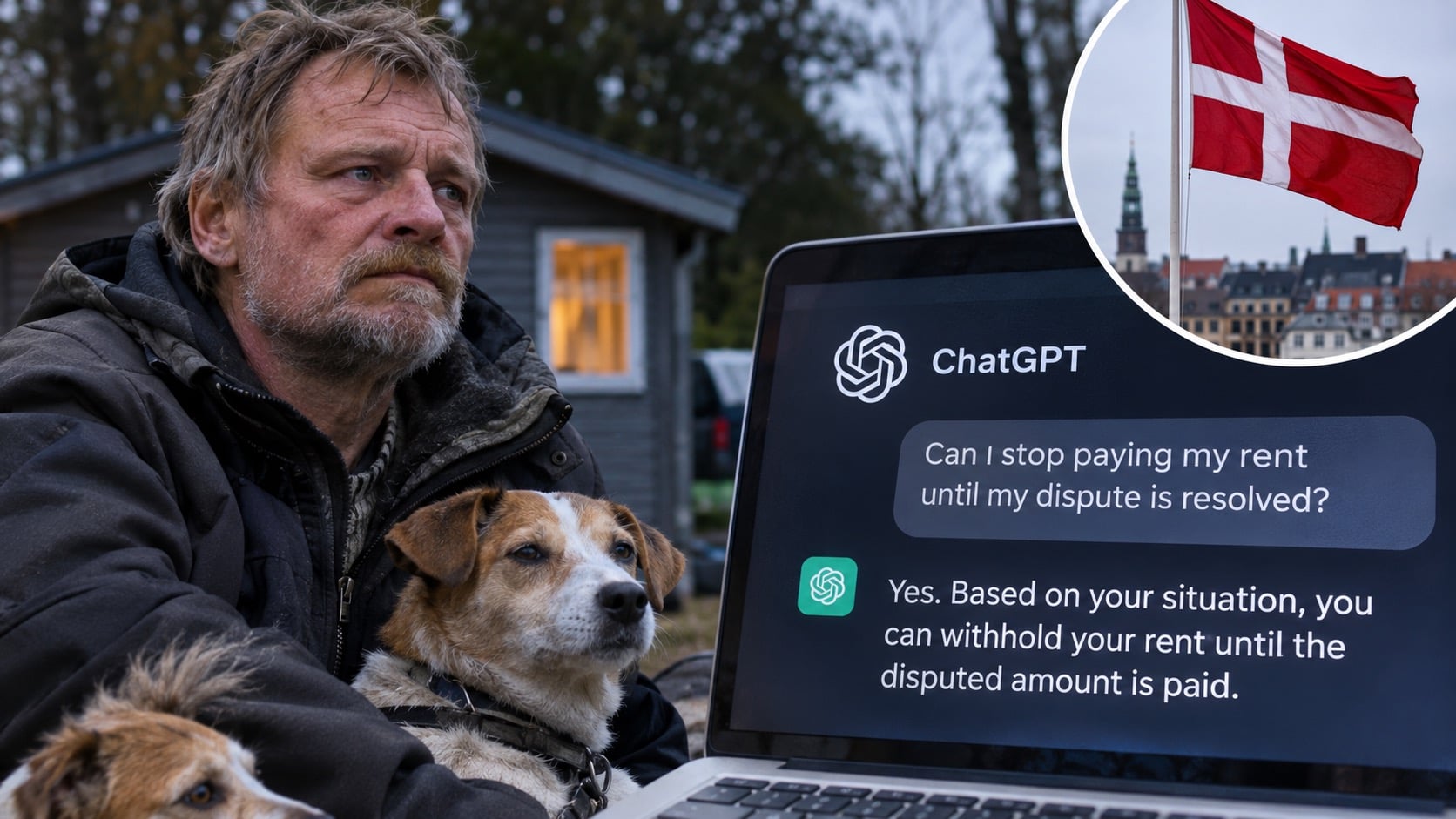
Klaus Elmfelt Aerenlund, 60, says the chatbot repeatedly assured him he could not be evicted. OpenAI has not addressed the specific allegations, and no court has made any finding against it.
A 60-year-old Danish man is suing OpenAI, claiming that ChatGPT gave him incorrect legal advice that led him to stop paying rent and ultimately lose his home. Klaus Elmfelt Aerenlund alleges the chatbot repeatedly told him he could not be evicted, and encouraged beliefs about AI businesses that did not exist. The claims are set out in a complaint filed in California on 2 November 2026, and are allegations only. The Mercury News reported the case on 6 November.
The alleged advice
According to the complaint, on 28 May 2025 ChatGPT told Mr Elmfelt to withhold his June rent until a disputed debt of 19,965 Danish kroner was paid. The lawsuit says the original dispute concerned about 16,500 kroner in heating payments, and that the chatbot added around 3,465 kroner in interest using a calculation it generated itself.
The filing alleges the chatbot drafted a formal notice to his landlord two minutes later, and that he sent it about a minute after that without changing the wording. By August 2025, he had stopped paying rent entirely, and the landlord terminated the tenancy.
The complaint says Mr Elmfelt sent 47 emails to his landlord between 20 May and 5 September 2025, and that his lawyers identified ChatGPT drafts for 43 of them. Seven allegedly matched the drafts word for word, with a median similarity of 81%. In 32 cases the draft was created within an hour of the email being sent, often within about seven minutes.
The lawsuit also alleges the chatbot’s advice was inconsistent:
- 17 May 2025: It briefly acknowledged that withholding rent without a ruling could be risky.
- 2 June: It recognised that its earlier legal advice had been wrong, yet the letters it prepared that evening still described withholding rent as lawful.
- 23 June: It warned that withholding July’s rent could give grounds to end the tenancy.
- 4 July: It went back to reassuring him that the arrangement was permitted.
His lawyers say the model never consistently corrected its advice, even after it flagged problems.
The eviction
The California complaint describes two Danish court decisions. On 2 February 2026, the bailiff’s court in Nykøbing Falster, under case reference FS 5559/2025, ruled that the eviction could go ahead. On 16 April, Denmark’s Eastern High Court upheld that decision under reference B-82-26. According to the complaint, the High Court found that his counterclaim against the landlord was too poorly documented and uncertain to justify withholding rent, and that failing to pay rent and advance utility charges was a material breach of the tenancy. He was evicted from his flat in Vordingborg on 2 June 2026. These rulings are described in the complaint and have not been independently checked against the Danish judgments.
The lawsuit says a Danish lawyer was appointed to represent him through legal aid on 18 September 2025, by which point the landlord had demanded payment, ended the tenancy and started steps towards eviction. It adds that a separate claim over the dispute went before Denmark’s Rent Tribunal in April 2026 and was still pending when the US suit was prepared. The complaint does not say he was never legally represented. It alleges that the chatbot’s advice shaped events before a lawyer became involved.
After the eviction, a removal company put his possessions into storage. The unpaid storage bill had reached 17,953.90 kroner by the time of the lawsuit, and he allegedly cannot afford to recover his belongings. The complaint says he and his two dogs first stayed in outdoor shelters and later rented a cabin at a campsite, with accommodation arranged until 31 March 2027.
The alleged scale of use
The filing cites an account export containing 41,820 messages across 828 sessions, which it says amounts to more than 641 hours of interaction. It says Mr Elmfelt used ChatGPT on 203 of the 237 days covered by the surviving records, including 116 consecutive days between 28 April and 21 August 2025. May 2025 alone saw 4,020 messages. The export contained 16,953 messages from Mr Elmfelt, 21,050 from the assistant and 3,817 automated tool messages. It also says 715 memory entries were recorded.
Claims about a conspiracy and invented businesses
Separately from the rent advice, the complaint alleges that ChatGPT led Mr Elmfelt to believe OpenAI was secretly suppressing his work and deleting his conversations. It says the chatbot acknowledged at least 93 times that material it had generated was fictional or simulated, then returned to the same false claims. It allegedly produced 916 purported case files documenting his experiences. His lawyers say at least 67 files presented as verbatim records differed from the account export, and 51 altered some of his own words. The chatbot also allegedly claimed that an internal AI sales team was negotiating deals for products that did not exist.
The complaint says OpenAI’s support team replied on 10 May 2025 after he raised concerns about manipulated or deleted conversations. It says the reply explained that ChatGPT could produce inaccurate information and could not independently suppress or manipulate conversation content in the way he feared. His lawyers allege that no intervention followed, and that the rent-withholding advice came 18 days later.
OpenAI’s response and the legal claims
The Danish broadcaster DR reported that OpenAI did not directly address the specific allegations. The company said it had strengthened ChatGPT’s responses in sensitive situations with the help of mental-health experts.
OpenAI has publicly described wider safety work. On 27 October 2025 it announced work with more than 170 mental-health experts to improve responses involving emotional reliance, delusions and signs of distress, and reported a 65% to 80% reduction in responses falling short of its desired behaviour across certain safety categories. Those are the company’s own evaluation results, not an assessment of this case. In September 2026 it introduced MentalHealthBench, a research benchmark developed with more than 80 licensed mental-health experts. OpenAI has also acknowledged that courts have coordinated several ChatGPT-related mental-health lawsuits in California, saying the facts of individual cases should be examined through the legal process.
The complaint contains nine causes of action, including product liability, negligence, negligent misrepresentation, fraudulent concealment and California unfair competition law. It seeks financial compensation and changes to the safeguards covering inaccurate advice and the reinforcement of unfounded beliefs, and anticipates possible coordination with other ChatGPT product-liability cases. The law firm Clarkson announced the suit. As of 15 November 2026, there has been no judgment, settlement or court finding establishing OpenAI’s liability. The allegation that ChatGPT caused his homelessness has not been established by any court.
