



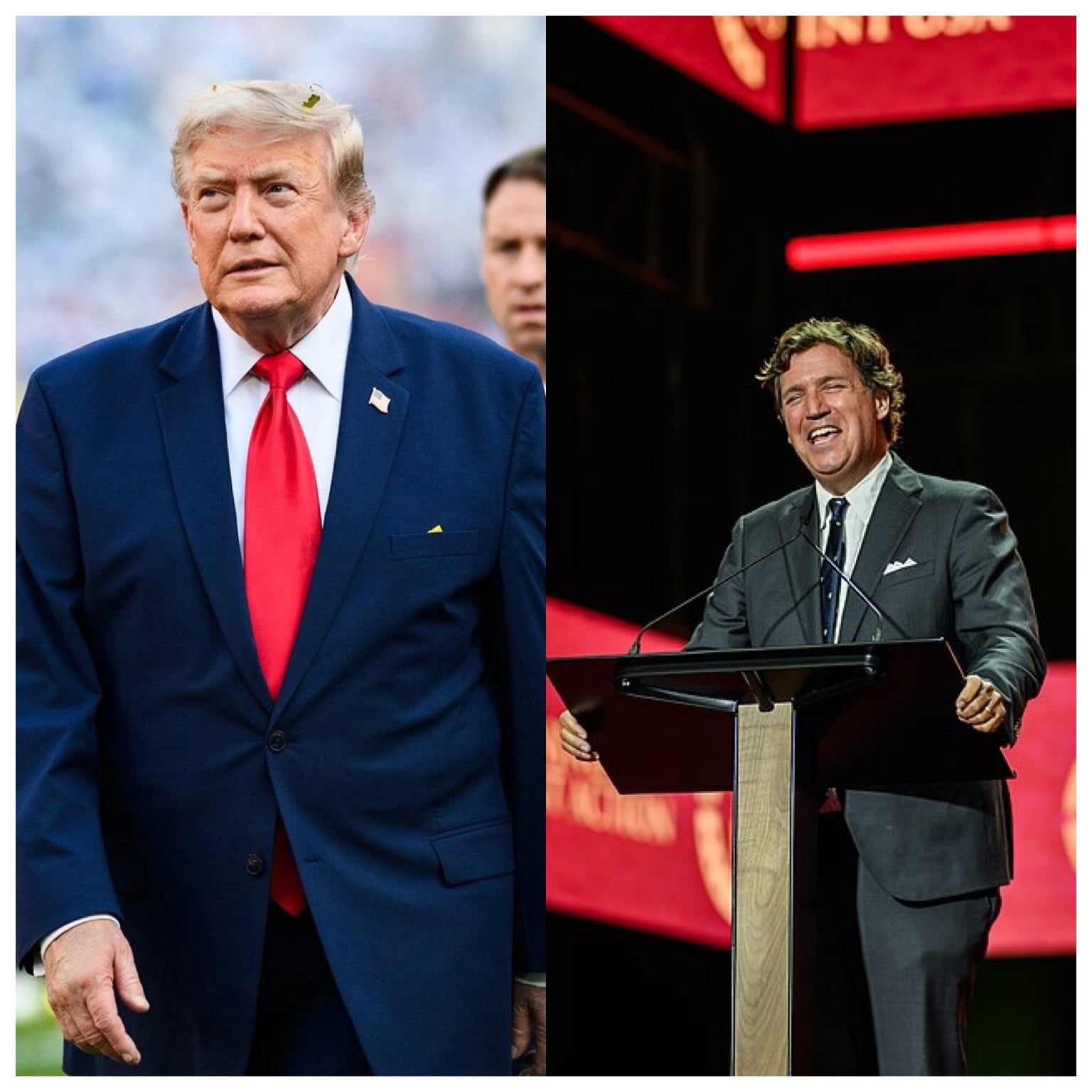
President Donald Trump has publicly turned on former Fox News host Tucker Carlson, branding him a “loser” with a “very low IQ” on Truth Social, after Carlson met with prominent former MAGA allies Marjorie Taylor Greene and Thomas Massie in what has been described as a gathering of an emerging anti-Trump, anti-war faction within the movement.
President Donald Trump has turned publicly against former ally Tucker Carlson, accusing the journalist of conspiring with politicians to undermine him. Trump, 80, launched the attack late on Friday night, describing the former Fox News personality as a “loser” with a “very low IQ” in a post on Truth Social. “Tucker’s ‘Views’ have fallen through the floor, and will only get worse. Nobody cares about him any longer in that he has become totally irrelevant, and happens to be, surprisingly, a very Low-IQ individual,” Trump wrote, adding: “Tucker wants to run for political office, but he should be required to take a cognitive test.”
Trump widens his attack
Trump’s criticism extended well beyond Carlson himself. The president directed his ire at Representative Thomas Massie and former Representative Marjorie Taylor Greene as well, referring to the trio collectively as “LOSERS ALL” after learning of a meeting between them. He went further in his attack on Carlson specifically, claiming the former host “could barely get out of College, and maybe he didn’t,” while repeating his call for Carlson to undergo a cognitive test should he ever pursue political office.
Despite dismissing Carlson as politically irrelevant, Trump also suggested a Carlson political campaign could siphon votes away from the eventual Republican presidential ticket, an argument that appeared somewhat at odds with his broader claim that Carlson no longer mattered politically.
Greene fires back
Marjorie Taylor Greene responded furiously to Trump’s remarks on Saturday, rejecting his characterisation of the situation and arguing instead that Trump himself had shifted position. “We never changed, Trump did,” she wrote. Greene went further still, expressing regret over her past support for the president, writing that she wished she had recognised the changes in him sooner and adding: “I wish I had never supported him.”
The Maine meeting behind the row
The dispute followed a gathering at Carlson’s property in Maine, which brought together Carlson, Greene, Massie and former Trump administration official Joe Kent. Kent had previously resigned from his counterterrorism position within the administration amid disagreements over the Iran war. The meeting has fuelled speculation about an emerging anti-Trump, anti-war faction within the wider MAGA movement, with those involved arguing that Trump has drifted away from his original “America First” promises.
Carlson’s political ambitions
Carlson, 57, has not announced any bid for political office and has previously said he has no intention of running for one. He has, however, told the Columbia Journalism Review that he hopes to help build a “third party,” and earlier this month unveiled a 10-point political platform setting out his vision for a potential new political movement. The proposals reportedly place particular emphasis on ending foreign wars and reducing what Carlson regards as excessive foreign influence over US policy.
Speculation about Carlson’s political future intensified following his meeting with Greene, Massie and Kent, with some allies reportedly encouraging him to consider a run for the presidency in 2028, positioning himself on a MAGA but explicitly anti-Trump platform. Carlson has continued to publicly state that he has no desire to become a candidate himself, despite this speculation.
A rift months in the making
The split between Carlson and Trump has developed gradually over several months, rooted particularly in disagreements over US military involvement in Iran. In an interview published in July, Carlson said he had not spoken to Trump since what he described as the start of the administration’s “regime-change war,” adding that he was no longer interested in speaking with the president.
The latest public confrontation marks a significant escalation in the dispute, moving the disagreement beyond policy criticism into a direct and public feud between Trump and several figures who had previously ranked among his most prominent political allies.
