



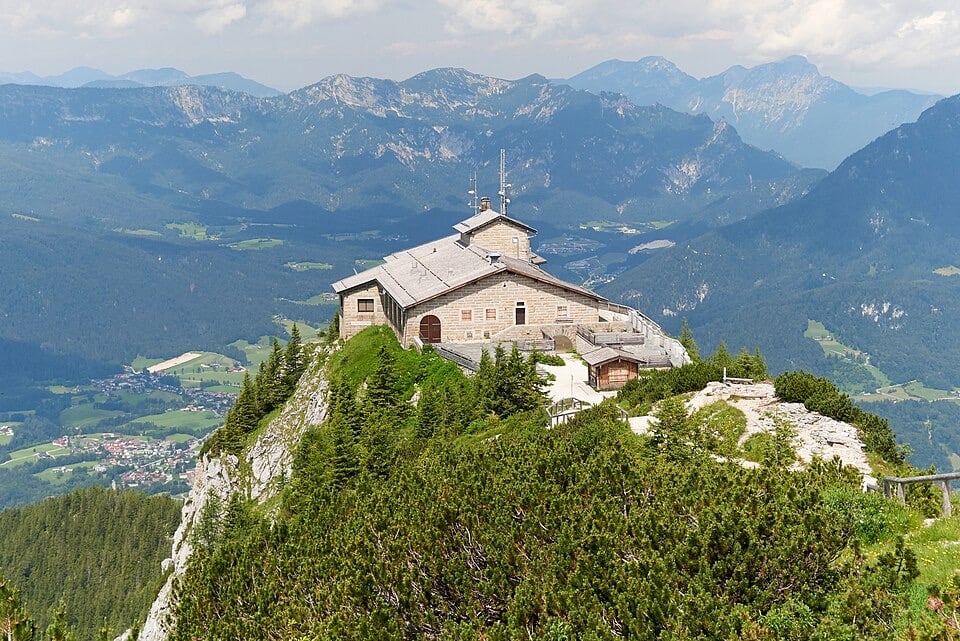
Police detained a suspect near the Kehlsteinhaus as about 200 emergency personnel tackled the blaze. Bavaria’s interior minister says the site will “under no circumstances remain a ruin”.
Police in Bavaria have arrested a 33-year-old German man during a fire at the Kehlsteinhaus, the Alpine mountain retreat also known as Hitler’s Eagle’s Nest. Dispatchers in Traunstein received a fire alarm from the building at 21:15 local time (19:15 GMT) on Friday, and firefighters found it engulfed in flames. No injuries were reported. Police said they apprehended the suspect riding a motorcycle near the scene, and that a criminal investigation has been launched.
The fire and the arrest
Difficult terrain hindered efforts to put out the blaze. About 200 emergency personnel were deployed. Police said any possible motive was still being examined. Local police official Gerhart Holzinger told a press conference there was currently no evidence of any further suspects. Local media reported that the site had been “largely destroyed”, and the public was urged to avoid the area.
Bavaria’s Interior Minister Joachim Herrmann told reporters, according to broadcaster BR24, that the site would “under no circumstances remain a ruin”. “It is important that we continue our work of remembrance,” he said.
No cause has been given for the fire, and the arrested man has not been charged in the information available. Police have not said whether he is believed to have started it.
The building
The Kehlsteinhaus stands at about 1,800m (5,900ft) above the town of Berchtesgaden. The Nazis completed it in 1938, and it escaped destruction after their defeat in 1945. It has since become a popular tourist destination and houses a mountain inn. Its official website describes it as “a cautionary reminder of the abysses of the inhumane Nazi dictatorship”.
It was one of several buildings in the area used by Hitler and his entourage during the Second World War. Hitler and senior Nazis used his nearby Berghof residence to plan the 1941 invasion of the USSR, and the whole complex was regarded as one of his headquarters. He also used the area as a backdrop for propaganda films portraying him as a lover of animals and nature. During the war, Hitler and his followers were responsible for the deaths of tens of millions of people, including the mass murder of European Jews. Homosexuals, Roma, disabled people and ethnic minorities were sent to concentration camps and killed.
A wider debate
There has been a wider debate in Germany and Vienna over whether to preserve, repurpose or demolish buildings linked to Hitler. Some argue they should be kept for historical reasons, while others fear they could become monuments or places of pilgrimage for neo-Nazis and far-right extremists.
In June, Berlin authorities announced they would tear down one of Hitler’s bunkers, described at the time as “the power centre of Nazi Germany”, to build flats and offices. Critics said it had “significant historical value” and should have become a museum and memorial site with an exhibit on the end of the war. In July, after years of controversy, Austrian authorities refurbished the house in Braunau am Inn where Hitler was born and turned it into a police station.
