



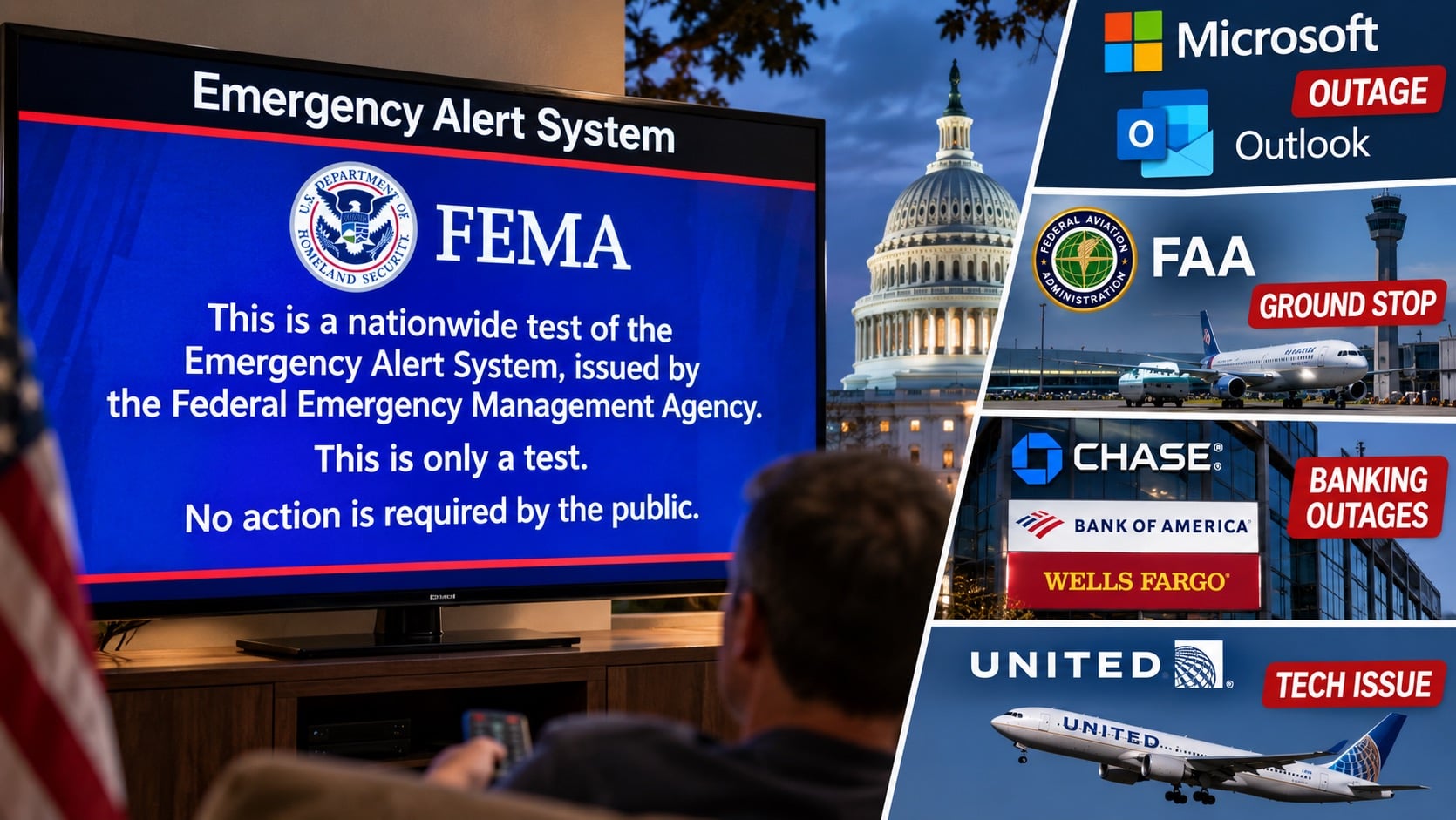
The nationwide exercise, which interrupted TV and radio broadcasts but did not reach mobile phones, was announced in September and is required by law.
The US government tested its Emergency Alert System across the country at 2.20pm Eastern Time on Tuesday (7.20pm GMT), interrupting television and radio programming nationwide. Officials said the exercise is required by law and has no connection to the recent outages or any “secret emergency”. The Federal Communications Commission (FCC) had announced the test in September and confirmed the date as 17 November. Mobile phones did not receive an alert, but the timing has fed online conspiracy theories after a week of high-profile technology failures.
What the test involved
The system is designed to override normal programming so the president can “share life-saving information with the public during a national emergency”, according to officials. The Federal Emergency Management Agency (FEMA) had warned that the test was coming. Its message read: “This is a nationwide test of the Emergency Alert System, issued by the Federal Emergency Management Agency. This is only a test. No action is required by the public.” The warning did not reach everyone in advance.
An FCC public notice dated 16 September says the message used the Nationwide Test event code, known as NPT. It was sent through the Integrated Public Alert and Warning System in the Common Alerting Protocol, in English and Spanish. Broadcasters must report their initial results on Form Two by 2.20pm Eastern Time on Thursday 19 November, within 48 hours of the test. The FCC says stations whose equipment fails to receive or transmit the alert could face enforcement action. It has also invited members of the public to report missing alerts or other problems through its Public Safety Support Center.
The Society of Broadcast Engineers says FEMA distributes the alert by two routes. The main one uses internet-connected equipment, and stations can also pick up the warning over the air from other stations. Differences in how often equipment checks for messages mean some stations may receive the alert from a neighbour before FEMA’s internet message arrives. The society says this would not necessarily indicate a fault. FEMA held technical preparation sessions for broadcasters on 16 and 20 October. Engineers were advised to check audio quality manually, as an alert can look successful in automated logs while sounding distorted or too quiet. The National Weather Service confirmed that NOAA Weather Radio was excluded from this exercise.
A week of disruption
Microsoft: Outlook went down in about 70 countries for nearly two days last week, according to the source report. Microsoft said an internal technical glitch after a network upgrade was behind it. A preliminary Microsoft investigation, reported by BleepingComputer, traced the problem to a software defect dating from July 2026. It lay dormant in the company’s networking infrastructure until it was triggered by a combination of conditions: extra traffic diverted during a Teams failover, and reduced server capacity in its network gateways. About 14 per cent of the affected gateway capacity was already unavailable, according to StatusStack. IncidentHub puts the disruption at about 23 hours and 50 minutes, from 4.20pm UTC on 12 November to 4.10pm UTC on 13 November. Office Watch reports that Microsoft’s standard rollback methods could not quickly reverse the problem because the defect was months old. The company restored capacity in stages using alternative network routes, and extended the email-delivery window so delayed messages would not be returned as undeliverable.
FAA ground stop: The Federal Aviation Administration (FAA) ordered a nationwide ground stop on Friday 13 November, which the source says had not happened on this scale since 9/11. The FAA’s update of 15 November says about 17 of its 22 regional air traffic control centres experienced instability, which spread to several terminal radar approach control facilities. About 1,000 connection attempts every four to five seconds overwhelmed its telecommunications network, disrupting some aircraft communication and radar feeds. It identified two possible origins, a radar facility in Amarillo, Texas, and a radio communications site in El Dorado, Arkansas, and had not established a definitive root cause. Contractor L3Harris had been installing a replacement router at the Arkansas site. The FAA said the network stabilised after L3Harris blocked traffic from both locations, and broadcasting functions were also disabled on newly installed routers as a precaution.
The FAA said about 3,500 aircraft were in the air when restrictions began, and all landed safely. Emergency, military and law-enforcement flights continued. It disclosed about 12,462 cancellations on 13 November, including 9,082 by major airlines, but cautioned that not all were directly caused by the ground stop. The ground stop ended at about 8.15pm Eastern Time. The agency says it has identified no evidence of a cyberattack, and attributes the instability to legacy telecommunications equipment and network traffic. It said it would reassess its procedures for replacing equipment during operational hours.
Banks: Chase, Bank of America, Capital One and Wells Fargo all reported outages on Monday, according to the source. Downdetector.com recorded almost 5,000 reports for Chase and about 1,400 between Bank of America and Wells Fargo. JPMorgan Chase told the Associated Press on Tuesday that the problem was fixed on Monday evening and transactions were processing normally. Spokesman Joe Evangelisti blamed a software bug affecting an on-premises hardware system. He ruled out a cyberattack and said the problem was not systemic across the banking sector. Bank of America told CBS News its systems ran normally throughout Monday, and Capital One said it was unaffected, though customers making transactions involving Chase may have faced delays. Early Warning Services, which runs Zelle, said its central infrastructure stayed operational and that problems at participating institutions can delay individual payments without Zelle itself failing. CBS News reported that complaints had subsided by Tuesday morning.
United Airlines: A separate technology problem hit United on Monday 16 November. It affected software pilots use to calculate takeoff performance, including requirements linked to runway and weather conditions. United spokeswoman Leslie Scott told CNN that fewer than 150 flights were affected and the software disruption lasted about 30 minutes, though recovery took longer. Flights already airborne and United Express flights were not affected. The airline said there was no current indication of malicious cyber activity.
Experts on fragile systems
University of Notre Dame technology specialist Mike Chapple told CBS News that each failure had a plausible separate explanation, but together they exposed how complex and fragile the systems Americans rely on have become. Tufts University engineering professor Karen Panetta said failures at major providers can spread to dependent businesses, and that interconnected financial and technology networks can magnify the consequences of a problem at one institution. Craig Timm of the Association of Certified Anti-Money Laundering Specialists warned that fraudsters could exploit anxiety over the outages with fake bank alerts and phishing messages.
