



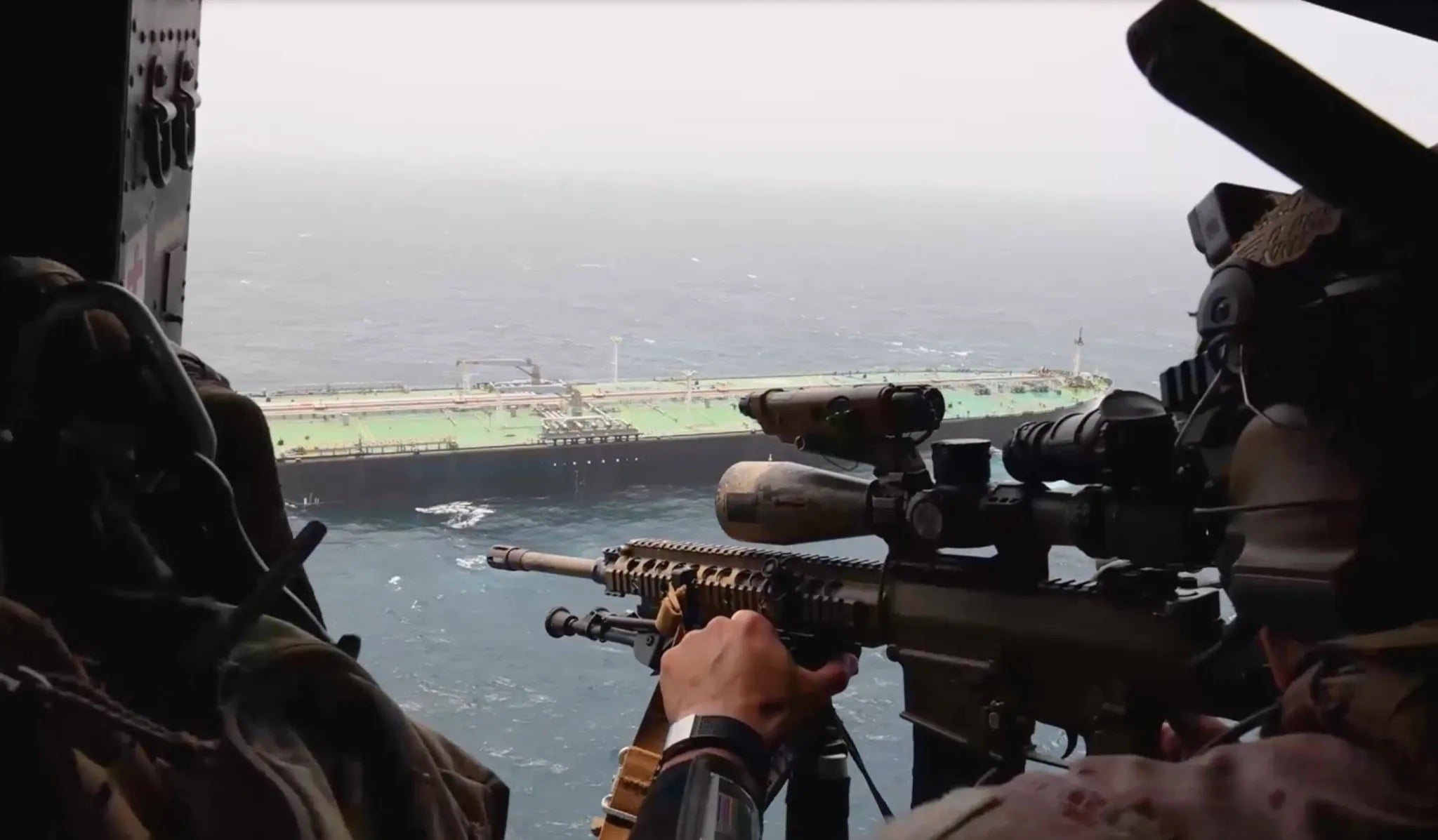
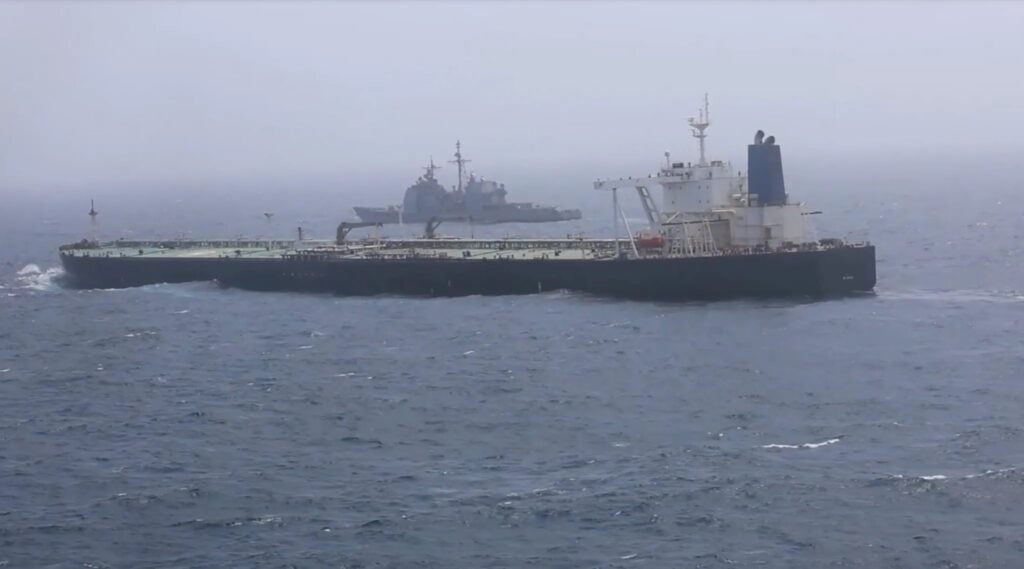
US Marines have boarded a commercial tanker near the Strait of Hormuz in a dramatic operation aimed at enforcing Washington’s naval blockade of Iranian ports, as President Donald Trump ordered a sixth consecutive night of strikes on the country. Footage released by US Central Command (CENTCOM) shows troops from the 11th Marine Expeditionary Unit fast-roping from a helicopter onto the deck of the M/T Wen Yao in the Gulf of Oman on 16 July, with one Marine later seen posing in front of an Iranian flag.
CENTCOM described the operation as a “verification boarding,” intended to confirm the vessel’s compliance with the US naval blockade rather than a seizure of the ship. According to CENTCOM, one commercial vessel has been disabled, three redirected, and one boarded since the blockade was reimposed earlier in the week. The US military stressed that the Strait of Hormuz remains open to international shipping, with only vessels attempting to breach the blockade being intercepted. The crew of the Wen Yao remained assembled on deck throughout the inspection.
Oil prices climb as tensions rise
The latest escalation has pushed the price of Brent crude above $87 a barrel, its highest level in more than a month, as traders weigh the risk of disruption to oil exports moving through the Gulf. The UK Maritime Trade Operations (UKMTO) body has reported several maritime security incidents in the region in recent days and continues to advise commercial vessels operating near the Strait of Hormuz to exercise heightened caution. During a previous phase of the US blockade, CENTCOM said its forces had redirected more than 140 compliant vessels, disabled nine non-compliant ships, and allowed more than 50 humanitarian vessels to pass, before those restrictions were temporarily lifted.
Strikes continue on Iranian infrastructure
The tanker boarding came as Trump ordered a sixth consecutive night of strikes against Iran, targeting bridges and an airport. Seven people were reported killed in attacks on bridges in the southern port of Bandar Khamir, where a train station was also struck. Trump had warned last week that he would “knock out all their bridges unless they get to the table and negotiate.”
Iran retaliates across the Gulf
In response to the fresh strikes, Tehran launched retaliatory fire across Bahrain, Qatar and Kuwait. Authorities in Kuwait said the bombardment struck power generation and water desalination facilities. The Gulf states, several of which host US military bases, have been repeatedly drawn into the conflict since it began in February. Iran also said it fired on Syria for the first time during the war, claiming to target a US special forces base at Tanf, despite Syria stating that US forces had already withdrawn from the base earlier this year.
Threats of further escalation
Iran’s Islamic Revolutionary Guard Corps (IRGC) has warned of an even “more crushing” retaliation should US strikes continue, and has threatened to encourage its Houthi allies in Yemen to close the Bab al-Mandeb strait at the mouth of the Red Sea, a move that could cut off the main alternative route for Middle East oil exports bypassing the Gulf entirely.
The threats have coincided with disturbing propaganda directed at the US president personally. A mural depicting Trump and his children in coffins, branded with the slogan “Blood for Blood,” recently appeared in Tehran. Iran has repeatedly threatened to assassinate the US president in revenge for the killing of its former supreme leader, Ali Khamenei, at the start of the war.
Collapse of the ceasefire
An interim agreement intended to end the war has been left in tatters since 7 July, when Iran struck ships in the Strait of Hormuz and the US responded with air strikes. Iran subsequently announced the closure of the strait, prompting Washington to reimpose its own blockade of Iranian ports, setting off the current cycle of escalation between the two sides.
