



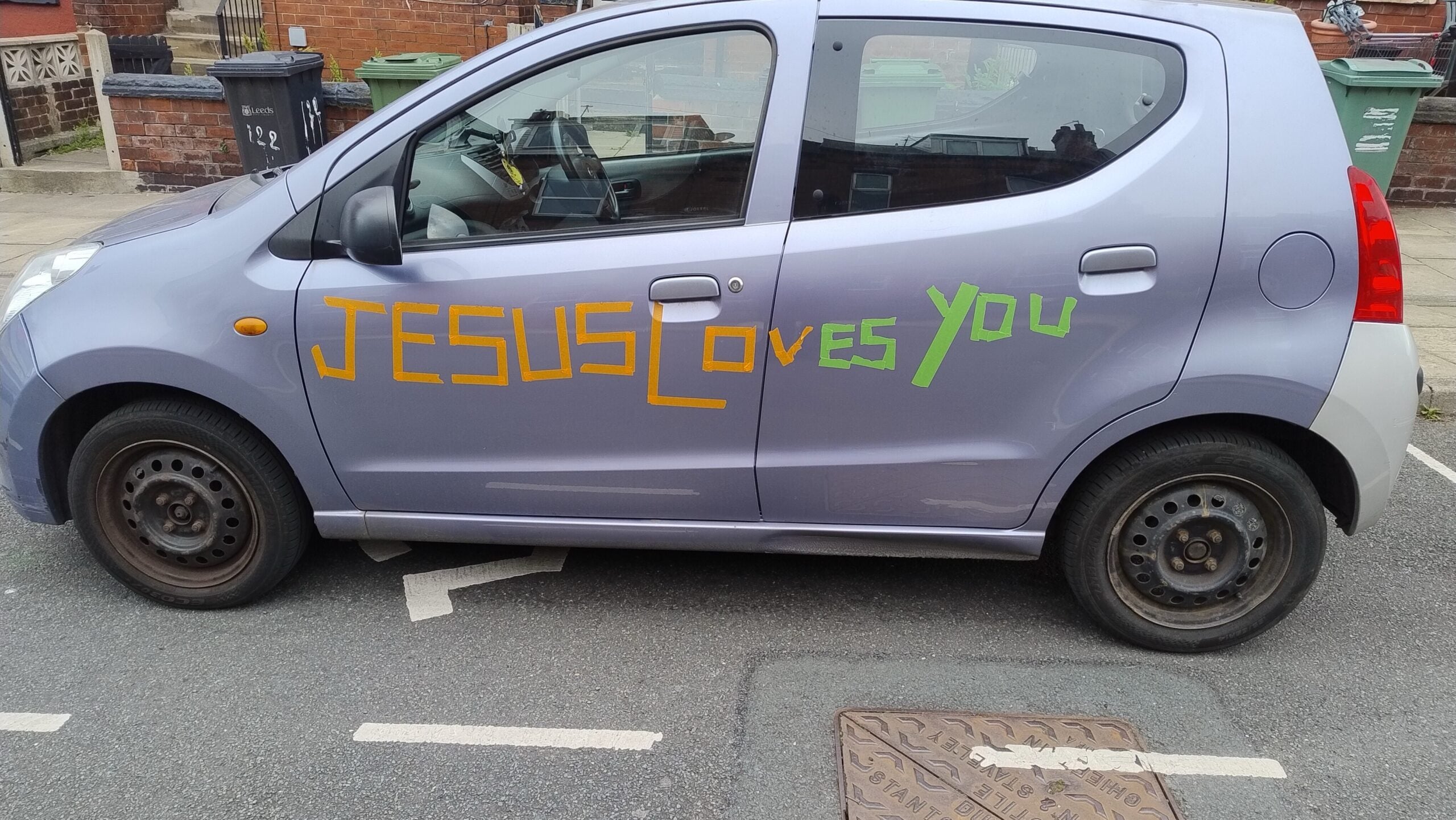
A Christian driver says he is considering legal action after his insurer told him his policy could not continue unless he removed handmade “Jesus Loves You” stickers from his car, in a case now being supported by the Christian Legal Centre.
A Christian motorist is considering legal action after being told by his car insurance provider that his policy could not continue unless he removed “Jesus Loves You” stickers from his vehicle. Simeon Chandra, 35, said GoSkippy Insurance informed him in writing that its underwriting department had rejected the stickers as an unauthorised vehicle modification, and that the policy would only continue if the stickers were removed and a dated photograph confirming this was sent to the insurer. Chandra says he had proactively disclosed the stickers to the insurer beforehand in an effort to be transparent, only for the situation to leave him uncertain whether he remained legally insured to drive.
What the insurer said
According to correspondence seen in connection with the case, Chandra contacted GoSkippy both before and after adding the stickers to his car, wanting to be upfront about the change. He says he was initially told he could proceed provided he sent photographs of the stickers to be added to his file.
However, GoSkippy later emailed him with a different message, stating: “Feedback from the Underwriting Department declined the modification done on the vehicle as per stickers added on the vehicle. For the policy to continue and be insured we require the stickers to be removed from the vehicle and send a dated photograph once the stickers have been removed.”
Chandra said subsequent emails he sent seeking clarification went unanswered, leaving him unsure of his position. The stickers themselves, displayed on the side of his car, read simply: “Jesus Loves You.” Chandra has said the message was not intended for business use, but rather “to spread a positive message that Jesus loves you.”
A pattern of similar cases
Chandra’s case echoes previous disputes involving religious expression and insurance or employment. In 2015, Reverend Wena Parry was warned that religious graphics on her car, including the words “Christ For Me,” could invalidate her insurance policy. Electrician Colin Atkinson separately faced the possibility of disciplinary action after displaying a palm cross in his company van.
Legal support and equality concerns
The Christian Legal Centre is now supporting Chandra as he considers his legal options. The organisation says the case raises questions under equality law, specifically whether a Christian customer has been treated unfavourably because of religious expression.
Andrea Williams, chief executive of the Christian Legal Centre, argued the dispute goes beyond a simple insurance technicality. “This case is not about a technical vehicle modification. It is about whether ordinary Christians are free to express their faith in public without being excluded from essential services,” she said. “A sticker saying ‘Jesus Loves You’ is not comparable to a commercial advert, a political campaign or an offensive slogan. It is a peaceful statement of Christian belief.”
She added: “If insurers can refuse cover because a customer displays a Christian message, that should alarm everyone who cares about freedom of religion and freedom of expression.”
The Christian Legal Centre has also pointed to what it describes as a double standard in public life, contrasting Chandra’s experience with the routine display of Progress Pride flags on public buildings, businesses, streets and transport networks during Pride month, including branded trains such as Avanti West Coast’s “Progress” train and TransPennine Express’s “Unity Train.” The organisation argues that public endorsement of certain beliefs and causes has become normalised, while ordinary Christian expression is increasingly treated as controversial or unacceptable.
Chandra’s response
Speaking about the experience, Chandra said: “I was shocked, surprised and upset when they told me I had to take the stickers off. I had tried to do the right thing by telling the insurer about the stickers and sending photographs. The message on my car is very simple: ‘Jesus Loves You.’ It is not abusive, political, hateful or commercial. It is a message of hope.”
He went on to question why the message had caused a problem when other forms of public messaging had not: “I could not understand why this would mean I could not have car insurance. We see all kinds of messages, flags and slogans in public life. But when a Christian puts a peaceful message on his own car, suddenly it appears to become a problem.”
Describing the emotional impact of the situation, Chandra said: “I felt sad, and it felt that things are really against the Lord Jesus. I could have cried. I think people with other messages would not have faced the same situation.” He added that he wants the insurer to respond directly to his concerns: “I want answers from GoSkippy as they have not responded to my emails. I want to be able to put the stickers back on and for other Christians to know they can do this without being ashamed. If they insist on banning these stickers then all other stickers on cars should also be banned.”
Chandra’s background and faith
Chandra was raised in a family of Indian heritage with a strong Christian background. His mother became a Christian after a serious accident led her to a church, where she experienced healing in an injured leg. His father, raised as a Hindu, said he experienced a personal revelation of Jesus while searching for answers about faith, after which both of Chandra’s parents dedicated their lives to Christian missionary work.
Chandra’s own childhood, however, was marked by hardship. His father died while he was still young, and he and his brothers required intervention from council children’s services, leading to periods of instability without his biological family. He later gained a place at university but continued to struggle with clinical depression, for which he received support from child psychologists and adolescent counselling services over many years, having been told by professionals that he should expect to live with depression indefinitely.
Chandra says his life changed during a moment of prayer alone in his university room, which he describes as a supernatural transformation that lifted his depression entirely. He has not experienced clinical depression since, and the experience became a turning point that deepened his commitment to his Christian faith and shaped his desire to help others find similar hope and purpose.
Reflecting on why Chandra feels strongly about sharing his faith publicly, Williams said: “Stories like Simeon’s show why Christians are compelled to live out their faith publicly. Having experienced profound transformation through Jesus, from despair to hope, and from brokenness to purpose, he is not ashamed to share what he believes. For Simeon, speaking about his faith is not about imposing beliefs on others, but about helping others discover the same faith, hope and love that have changed his life.”
