



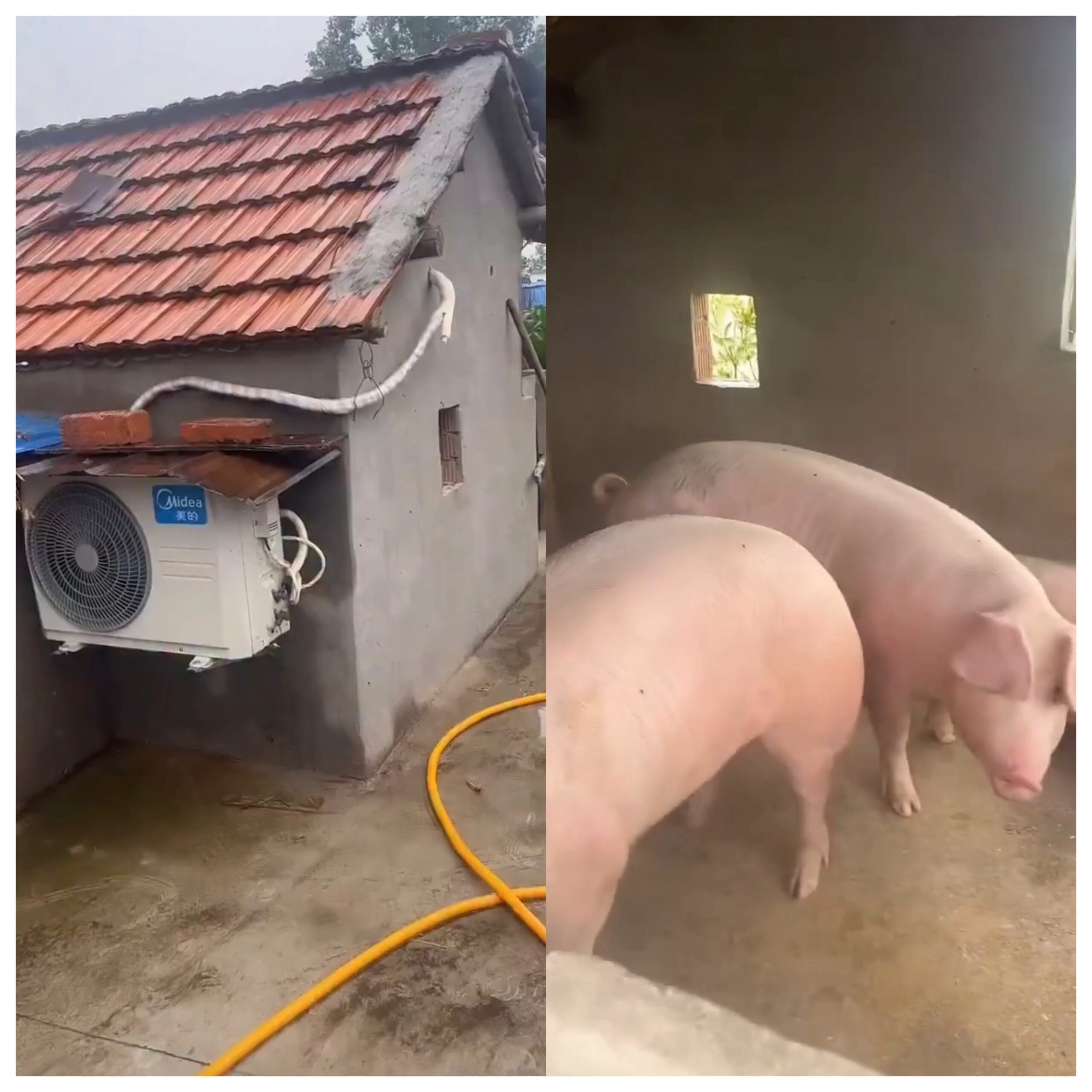
A viral social media trend has taken off in which Chinese users are posting videos of their pigs living in fully air conditioned barns — pointedly mocking Europeans who are sweltering through a record-breaking heatwave while facing planning rules, permit requirements and green building regulations that make fitting air conditioning at home far more difficult than it sounds.
The videos, circulating widely on Chinese and Western platforms alike, show climate-controlled pig enclosures in China’s warmer southern farming regions, often with commentary that drives the joke home: while Europe lectures the world about saving the planet and restricts air conditioning, Chinese livestock are living in cooler conditions than many European families. The timing could hardly be more pointed — temperatures across large parts of Europe have been exceeding 40C this week, with schools shutting, hospitals under pressure and rail networks grinding to a halt.
The farming logic behind the videos is sound. Pigs cannot sweat, meaning heat stress cuts directly into their growth rates, feed efficiency and reproduction. Climate control in large-scale pig barns is not a luxury in China’s south — it is a commercial necessity, and farmers have invested in it accordingly. The contrast with European households unable to get planning permission for an external air conditioning unit has made the joke almost too easy to make.
What makes the viral trend sting is that the underlying complaint is not entirely wrong. No blanket EU ban on air conditioning exists, but a web of obstacles — building regulations, aesthetic permit rules, energy efficiency mandates and in some cases outright council orders to remove units already installed — has kept household air conditioning adoption at roughly 10 to 20 per cent across the EU on average. In the UK, new buildings must prove that passive measures such as shading, ventilation and insulation have been tried first before mechanical cooling can be considered. Some local councils have forced homeowners to rip out units they paid to install, citing carbon output concerns. Parts of Italy and Switzerland require permits for external units on heritage or noise grounds. In some cases a medical need must be formally demonstrated before permission is granted.
A large part of Europe’s low adoption rate is also simply historical. Much of the continent’s housing stock was built for cold winters rather than baking summers, and retrofitting older buildings with air conditioning is expensive, disruptive and often blocked by the same planning systems designed to preserve architectural character. High electricity prices have further discouraged investment, and EU climate policy has consistently pushed passive cooling to the front of the queue over energy-hungry mechanical systems.
The irony is not lost on observers that a continent which has positioned itself as the global standard-bearer for climate action is now watching its citizens collapse in the heat while Chinese farmers keep their pigs comfortable. Europe is buying more air conditioning — Chinese-made units have sold in huge numbers during this week’s heatwave — but the gap between how fast temperatures are rising and how fast attitudes and regulations are changing is becoming harder to ignore. The Chinese pig farmers may be trolling, but the question embedded in the joke is a serious one.
