



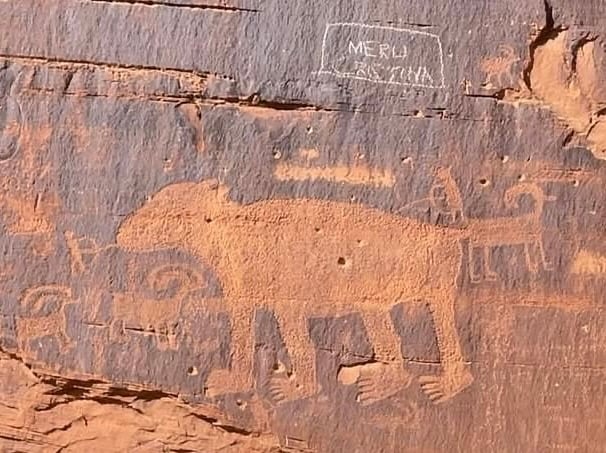
The Bureau of Land Management says two panels in Utah’s Moab area have been damaged, and it is appealing for information. No suspects have been named.
Two panels of prehistoric rock art near Moab, Utah, have been vandalised, according to the Bureau of Land Management (BLM). The agency said on Friday that it is investigating the damage, which was found along Highway 279 and near Hell’s Revenge. In both cases, people carved their names into or beside the ancient Native American petroglyphs. The BLM has described the panels as “irreplaceable cultural resources”, and no suspects have been named.
What was damaged
The BLM said that in each incident, names were carved on or close to the prehistoric images. One of the affected sites is known as the Bear Panel. There, graffiti was scratched near the bear petroglyph and directly beside a depiction of a bighorn sheep. One of the markings appeared to read “Meru”, though it is unclear what it means.
At the second site, the name “Craig” appeared to have been scrawled across the panel, covering several figures.
Both incidents took place in Grand County. The BLM has not said when the damage was done, so the date it was discovered should not be taken as the date it occurred.
“Our cultural resources are part of our shared heritage,” the BLM said. “Once damaged, they cannot be restored to their original condition.” It urged members of the public not to try to remove the graffiti themselves.
Appeal for information
The BLM has published a telephone number, +1 435-259-2131, for anyone with information that could help identify those responsible. No arrests, charges or reward have been announced. By contrast, a $10,000 reward was offered after a separate vandalism case in 2021.
Federal protection and penalties
The panels are protected under the Archaeological Resources Protection Act. The BLM said that vandalism of archaeological resources is a federal offence that can lead to imprisonment, fines and exclusion from public lands.
Under federal regulations (36 CFR §296.4), penalties depend on the offence and the damage involved. For a first offence involving lower-value damage, the maximum is one year in prison and a $10,000 fine. Where the combined archaeological or commercial value and the cost of repair exceed $500, the maximum rises to two years and $20,000. A second or later offence carries up to five years and $100,000. The law also covers attempts to damage archaeological resources, as well as completed damage.
No penalty can yet be assigned in the latest cases, as investigators would first need to establish who was responsible, which legal provisions apply and what evidence supports any charges.
Not the first attack on Moab rock art
The Moab area’s rock art has been targeted before. According to FOX13, vulgar and racist graffiti was scrawled across petroglyph panels in 2021, including the panel depicting a birthing scene, known as Birthing Rock.
The Grand County Commission and records reproduced by the US National Park Service say three of Birthing Rock’s four carved faces were heavily damaged in April 2021. Utah state archaeologist Elizabeth Hora identified some of the damaged carvings as belonging to the Fremont tradition, which existed in the area between about AD 500 and 1300. Reporting by The Salt Lake Tribune indicates that Indigenous people made images at the site over more than 3,000 years, including Archaic, Ancestral Puebloan and Ute work. A wooden barrier had been put up around the rock before the vandalism to protect it from rising visitor numbers, but it did not prevent the attack.
The BLM offered a $10,000 reward on 27 April 2021 for information leading to an arrest and conviction. It said professional conservators, rather than volunteers, would assess and treat the damaged surfaces.
Other incidents have followed a similar pattern. In August 2021, four names were carved into rock art in Mill Creek Canyon, alongside the date 3 August 2021, according to a report carried by the Idaho State Journal. Conservation specialists removed or faded most of the markings, but some letters remained visible. There is no evidence linking that case or the 2021 Birthing Rock vandalism to the latest incidents.
Separately, the Denver Gazette reported in April 2021 that a Colorado Springs climber, Richard Gilbert, had admitted installing climbing bolts across a petroglyph panel at Sunshine Wall near Moab. The site is estimated to be about 1,000 years old, and the panel measures about 20 feet by 30 feet. Mr Gilbert said he had mistaken the markings for graffiti, and he contacted a BLM ranger after learning their significance.
Advice for visitors
The BLM says natural oils and residue from human hands can damage ancient rock imagery, and asks visitors not to touch, lean on or climb on archaeological features. Its Moab Field Office advises anyone who finds graffiti to photograph it and record its location instead of trying to clean it, warning that scratches, chalk and charcoal can permanently damage culturally significant sites. Utah also runs a Cultural Site Stewardship Program, which lets volunteers help monitor archaeological sites.
The Bear Panel
Moab Rock Art says the Bear Panel shows a large bear surrounded by smaller human figures, some apparently carrying bows and arrows, and an interpretive sign at the site describes the scene. It says the carvings may represent more than one cultural tradition. Fremont influences have been identified, while the bear’s distinctive style has prompted discussion of links to later Ute or Paiute traditions. The exact age and authorship of every figure cannot be assumed.
