



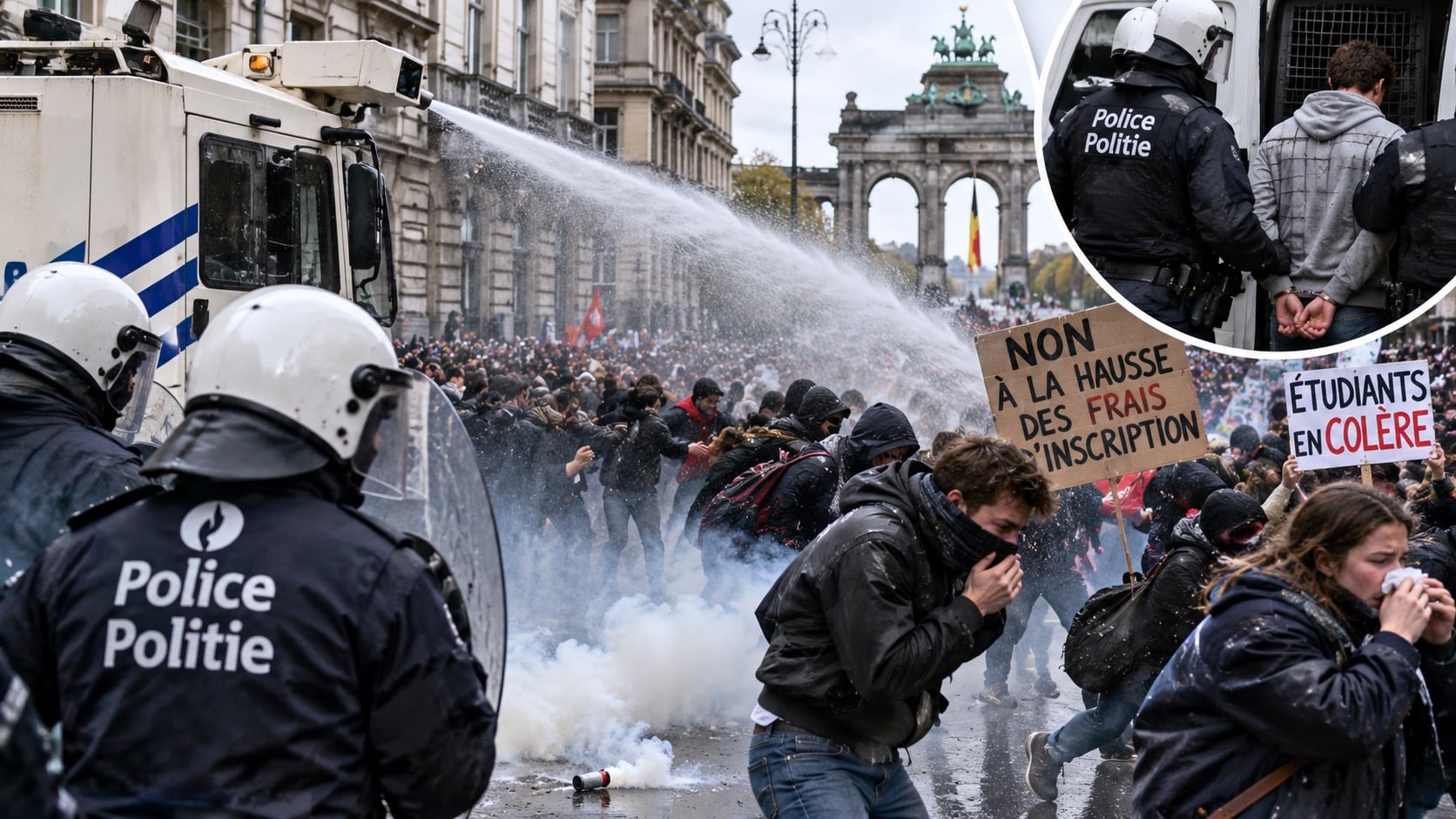
Three people, including a minor, were arrested after a breakaway group left the authorised route. Police and organisers gave very different turnout figures.
Riot police in Brussels used tear gas and water cannon on Tuesday to disperse crowds after a student march against higher tuition fees, education reforms and public spending cuts. Thousands of students and teachers took part in the demonstration, which was largely peaceful. Brussels-Capital/Ixelles police later confirmed three judicial arrests, one of them a minor, over alleged vandalism and the throwing of projectiles. Organisers said 15,000 people marched, while police counted about 3,200.
Police account of the clashes
According to a police statement issued after the protest, the authorised march passed without major incident. The force said trouble began when a group of several hundred people left the official route after it ended. It said they built makeshift barricades from street furniture, rubbish bins, shared bicycles and electric scooters. Police also said property along the route was defaced with graffiti. They said the breakaway group blocked the inner ring road near the Arts-Loi junction and then headed towards Boulevard du Jardin Botanique. Police did not identify those arrested or announce charges. These are the force’s allegations.
Belgian media reported stones and fireworks being thrown as officers prepared to disperse the crowd near Rue Royale and the Botanique area, before tear gas and water cannon were used. Police intervened at about 2.30pm, according to The Brussels Times, and the inner ring road had fully reopened by 3pm. Some demonstrators continued towards Saint-Josse-ten-Noode and Schaerbeek, with police vehicles following. Belga journalists reported seeing several detained young people with visible marks on their bodies. The cause of the marks has not been established, and no confirmed number of injuries has been given.
Disputed turnout
Police recorded about 3,200 demonstrators. Lenaïk Dumont, president of the Federation of French-speaking Students (FEF), put the figure at 15,000. Neither figure is agreed. Speaking at the end of the march, Ms Dumont said: “On ne lâchera pas” (“We won’t give up”). She said earlier protests had won concessions and that students would keep mobilising in the coming weeks, BX1 reported. An earlier student protest on 16 September drew between 1,000 and 2,000 people.
What the protest is about
The French-speaking Community Parliament approved an austerity package on 5 June after a session lasting about 14 hours. The governing MR and Les Engagés parties backed it, and opposition parties voted against. The Brussels Times reports the programme is intended to save about €500m by 2029, against a community budget of about €15bn. It also raises secondary-school teachers’ teaching hours by 10 per cent without extra pay and tightens sick-leave rules for permanent staff.
The maximum standard university registration fee rose by €359 to €1,194 in 2026-27, a 43 per cent increase from €835. Scholarship recipients remain exempt, and other students pay different rates according to their circumstances. The Brussels Times reported in June that about 58 per cent of higher-education students could be affected by the maximum fee. The FEF says the previous maximum for certain students at Hautes Écoles and arts institutions was €175, so their increase is €1,019.
The FEF estimates that a year of study now costs between €8,100 and €13,600, including accommodation, food and transport. These are the federation’s estimates and not government figures. Organisers also protested the loss of low-cost TEC public transport passes. The Flemish student association VVS raised concerns about cuts to study grants and the Groeipakket family-benefit system.
Legal challenge and union support
On 30 October, nine student, family and human-rights organisations filed a constitutional challenge seeking to annul parts of the 5 June decree on higher fees and free schooling. The group includes the Belgian Human Rights League, the League of Families, parent associations and the Walloon anti-poverty network. They say the Council of State had twice warned about protections for free education before the legislation was adopted. No ruling has been made.
Marie-Hélène Ska, general secretary of the Christian trade union CSC, joined the march. She said students had asked for union support because they feared disturbances. Isis Pohl of the FGTB youth wing described an unusually broad joint mobilisation and said unions had filed federal strike notices in support of students. Railway workers, metalworkers, Flemish student representatives and anti-poverty campaigners also took part, BX1 reported.
Disruption on the day
Students blockaded the Solbosch campus of the Université libre de Bruxelles on Tuesday morning, according to BX1. A student procession left the campus at 10am to join the main march near Brussels Central Station. Public transport operator STIB warned that tram routes 92 and 93 and bus routes 29, 38, 61, 63, 65, 66, 71 and 89 could be disrupted.
